
[論文レビュー] Constraining the onset density for the QCD phase transition with the neutrino signal from core-collapse supernovae
本論文は、将来の銀河系の超新星爆発におけるニュートリノ信号が、ハドロン-クォーク物質相転移に関連する第二の、電子反ニュートリノが支配するバーストによって、QCD相転移の開始密度を制約できることを提案している。3つのフレーバーのボルツマンニュートリノ輸送と微視的ハドロン-クォークハイブリッド状態方程式を用いた球対称かつ一般相対性理論的シミュレーションを通じて、著者たちは第二のバーストの放射度と平均エネルギーと開始密度の間の経験的線形関係を同定し、将来的なニュートリノ観測から高密度物質の性質を調べる道筋を示している。
The occurrence of a first-order hadron-quark matter phase transition at high baryon densities is investigated in astrophysical simulations of core-collapse supernovae, to decipher yet incompletely understood properties of the dense matter equation of state (EOS) using neutrinos from such cosmic events. It is found that the emission of a nonstandard second neutrino burst, dominated by electron antineutrinos, is not only a measurable signal for the appearance of deconfined quark matter but also reveals information about the state of matter at extreme conditions encountered at the supernova (SN) interior. To this end, a large set of spherically symmetric SN models is investigated, studying the dependence on the EOS and the stellar progenitor. General relativistic neutrino-radiation hydrodynamics is employed featuring three-flavor Boltzmann neutrino transport and a microscopic hadron-quark hybrid matter EOS class. Therefore, the DD2 relativistic mean-field hadronic model is employed, and several variations of it, and the string-flip model for the description of deconfined quark matter. The resulting hybrid model covers a representative range of onset densities for the phase transition and latent heats. This facilitates the direct connection between intrinsic signatures of the neutrino signal and properties of the EOS. In particular, a set of linear relations has been found empirically. These potentially provide a constraint for the onset density of a possible QCD phase transition from the future neutrino observation of the next galactic core-collapse SN, if a millisecond electron anti-neutrino burst is present around or less than 1s.
研究の動機と目的
- 一次的ハドロン-クォーク相転移が核崩壊超新星におけるニュートリノ放射に与える影響を調査すること。
- 第二のニュートリノバースト(ニュートリノ球を二度目に通過するショック波に関連)が、QCD相転移の開始密度に関する情報を明らかにできるかどうかを特定すること。
- 観測可能なニュートリノバーストの性質とハドロン-クォークハイブリッド状態方程式の熱力学的パラメータとの間の経験的関係を確立すること。
- 将来的な銀河系超新星からのニュートリノ検出を用いて、QCD相転移の開始密度を制約する手法を提供すること。
提案手法
- 3つのフレーバーのボルツマンニュートリノ輸送を用いた球対称かつ一般相対性理論的ニュートリノ放射流体力学的シミュレーションの適用。
- 反発的クォーク相互作用と閉じ込め効果を組み込んだ微視的ハドロン-クォークハイブリッド状態方程式(RDFモデル)の使用。
- 相転移パラメータに応じたニュートリノ信号の依存性を調査するため、状態方程式と前身星モデル(初期質量関数質量 30–75 M⊙)を体系的に変化させた。
- 500 km の半径で共動フレームにおけるニュートリノ放射度と平均エネルギーをサンプリングし、バースト特性を分析。
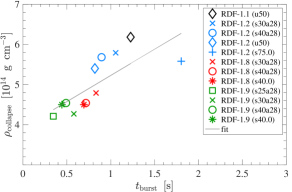
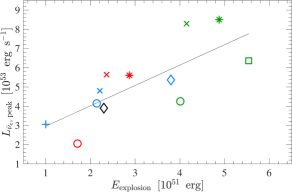
- 第二のバーストのピーク放射度と平均エネルギーと相転移の開始密度との間の経験的線形相関関係を同定。
- 質量の大きなパulsar やブラックホール形成に関する既知の制約と比較し、先行シミュレーションと照合することで結果の妥当性を検証。
実験結果
リサーチクエスチョン
- RQ1核崩壊超新星における第二のニュートリノバーストは、QCD相転移の開始密度を調べるためのプローブとして機能できるか?
- RQ2ハドロン-クォークハイブリッド状態方程式の変化が第二のニュートリノバーストの性質に与える影響は何か?
- RQ3観測可能なニュートリノバーストの特徴と相転移の熱力学的パラメータとの間にどのような経験的関係があるか?
- RQ4将来的な銀河系超新星からのニュートリノ観測によって、QCD相転移の開始密度をどの程度まで制約できるか?
主な発見
- 第二のニュートリノバーストは、電子反ニュートリノが支配的であり、ハドロン-クォーク相転移の兆候として測定可能であり、開始密度に関する情報を保持している。
- 相転移の開始が早い(密度が低い)モデルでは、ピーク放射度が高く、第二のバーストが広がるが、遅い開始では放射度が低く、バーストが狭くなる。
- 第二のバーストのピーク放射度と平均エネルギーと相転移の開始密度との間で、経験的線形関係が見つかり、将来的な観測から間接的に制約可能である。
- 第二のバーストの性質は、電子割合と中性子のデジェネレート状態に強く依存し、高い中性子含有量のおかげで $\bar{\nu}_e$ の放射が最も高くなる。
- 第一および第二のニュートリノバーストの時間遅れは、開始密度と相関しており、早期の相転移では遅れが短くなる。
- 結果は、30–75 M⊙ の異なる前身星質量およびハイブリッド状態方程式のバリエーションに対して一貫しており、ニュートリノ信号と相転移開始密度との間の一般化可能な関係が示されている。
この論文を読む
Nubintのビューアで原文を開き、読みながら気になる箇所をすぐに質問できます。
Nubintでこの論文を読むこのレビューはAIが論文の原文をもとに作成しました。引用する前に原文をご確認ください。