
[論文レビュー] Construction of perfect tensors using biunimodular vectors
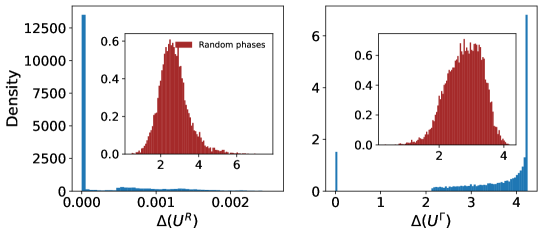
本稿は、二重ユニモジュラー配列(離散フーリエ変換がユニモジュラーである2次元ユニモジュラー配列)を用いて、局所次元6における完全テンソルおよび双対ユニタリゲートの、新たな解析的・数値的構成法を提示する。特に、AME(4,6)状態を対象とする。この手法により、制御ユニタリ回路として実現可能な完全テンソルが得られ、従来の符号ベースやグラフ状態に基づく構成では達成できなかった、AME(4,6)の存在問題が解決される。
Dual unitary gates are highly non-local two-qudit unitary gates that have been studied extensively in quantum many-body physics and quantum information in the recent past. A special class of dual unitary gates consists of rank-four perfect tensors that are equivalent to highly entangled multipartite pure states called absolutely maximally entangled (AME) states. In this work, numerical and analytical constructions of dual unitary gates and perfect tensors that are diagonal in a special maximally entangled basis are presented. The main ingredient in our construction is a phase-valued (unimodular) two-dimensional array whose discrete Fourier transform is also unimodular. We obtain perfect tensors for several local Hilbert space dimensions, particularly, in dimension six. A perfect tensor in local dimension six is equivalent to an AME state of four qudits, denoted as AME(4,6). Such a state cannot be constructed from existing constructions of AME states based on error-correcting codes and graph states. An explicit construction of AME(4,6) states is provided in this work using two-qudit controlled and single-qudit gates making it feasible to generate such states experimentally.
研究の動機と目的
- エラー訂正符号、組合せデザイン、グラフ状態に基づく従来の構成法では達成できなかった、AME(4,6)状態の存在問題を解決すること。
- 特に局所次元d=6に対して、最大もつれ基底で対角化可能な完全テンソルおよび双対ユニタリゲートを構成するための新しい手法を開発すること。
- 二重ユニモジュラー配列と制御ユニタリ操作を用いて、次元6における明示的かつ回路に適した完全テンソルの構成を提供すること。
- 偶数次元、特にd=6における二重ユニモジュラー配列の構造を調査すること。ここでは、分解可能解が失敗する。
- 二重ユニモジュラー配列とサイズ36の2ユニタリ複素ヘイジンマトリクスの間の関係を確立すること。これは、従来達成されていなかった。
提案手法
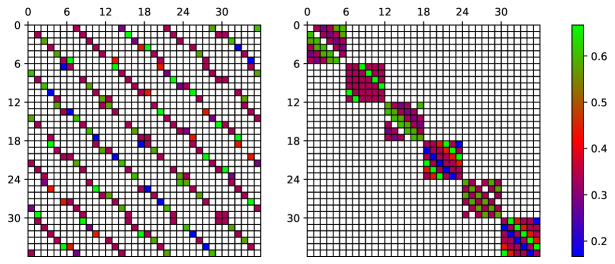
- 二重ユニモジュラー配列(離散フーリエ変換がユニモジュラーである2次元ユニモジュラー配列)を、完全テンソルの構成の核となる要素として用いる。
- Weyl-Heisenberg最大もつれ基底で対角化可能なユニタリ演算子として双対ユニタリゲートを構成し、二重ユニモジュラー配列Λでパrameter化する。
- フーリエゲートF₆、一般化されたCNOT(制御置換)ゲートP、および対角ユニタリD(Λ)を用いた回路分解を採用し、𝒰(Λ) = P(F₆⊗I)D(Λ)(F₆†⊗I)Pの形を得る。
- よりシンプルな量子回路実装を目的に、対称的変種𝒰′(Λ) = P(F₆⊗I)D(Λ)(F₆⊗I)Pを導入するが、最大もつれ基底での対角化性を失う。
- 共役を用いて2ユニタリ複素ヘイジンマトリクスを構成する:𝒰_CHM(Λ) = (F₆⊗I)𝒰(Λ)(F₆†⊗I)。これにより、従来の手法では達成できなかった2ユニタリ性が実現される。
- 数値的および解析的技術を用いて、長さ6の分解可能二重ユニモジュラー配列がd=6における完全テンソルを生成しないことを確認し、解の非自明性を裏付ける。
実験結果
リサーチクエスチョン
- RQ1既存の符号ベースおよび組合せ的手法が失敗する状況において、二重ユニモジュラー配列を用いて局所次元6における完全テンソル(すなわちAME(4,6)状態)を構成可能か?
- RQ2二重ユニモジュラー配列は、最大もつれ基底で対角化可能な双対ユニタリゲートの生成に果たす役割は何か?
- RQ3なぜ、奇数次元では機能するが、偶数次元(d=6)では分解可能二重ユニモジュラー配列が完全テンソルを生成しないのか?
- RQ4サイズ36の2ユニタリ複素ヘイジンマトリクスを明示的に構成可能か?また、それらは二重ユニモジュラー配列から生じるか?
- RQ5二重ユニモジュラー配列とアーベル群における差集合の間には、二値列の既知の結果を一般化する構造的対応関係が存在するか?
主な発見
- 本稿は、局所次元6における完全テンソルの、初めての明示的構成を提供し、以前未解決であったAME(4,6)状態の存在を解決する。
- 長さ6のすべての48個の二重ユニモジュラー配列を数値的に検証した結果、48² = 2,304個の分解可能な組み合わせすべてが完全テンソルを生成せず、d=6における解の非自明性が裏付けられた。
- 構築された完全テンソルは、制御ユニタリゲートを用いた量子回路表現を有し、𝒰′(Λ) = P(F₆⊗I)D(Λ)(F₆⊗I)Pの形を取ることで、実験的実装が可能である。
- フーリエゲートを用いた共役により、36次サイズの2ユニタリ複素ヘイジンマトリクスが構成可能であり、これは従来の手法では達成できなかった。
- 奇数次元(d=3およびd=5)では、分解可能二重ユニモジュラー配列が完全テンソルを生成するが、偶数次元では失敗する。これは構造的差を示している。
- 本手法により、制御ユニタリゲートやフーリエゲートを含む二ユニタリ操作の系列から構成される、統一的フレームワークが確立され、完全テンソルが二ユニタリ合成により構築可能であることが示された。
より良い研究を、今すぐ始めましょう
論文の読解から最終レビューまで、研究時間を劇的に削減しましょう。
クレジットカード登録不要
このレビューはAIが作成し、人間の編集者が確認しました。