
[論文レビュー] Controlling the Photon Number Coherence of Solid-state Quantum Light Sources for Quantum Cryptography
本論文は、刺激パルスを用いた特注の二光子励起スキームを用いて、半導体量子ドットからオンデマンドで高忠実度の単一光子を生成し、光子数コherenec(PNC)を完全に制御することに成功した。これにより、高い純度と同一性を維持したまま、PNCを制御可能にした。この手法により、PNCレベルを自在に調整可能であり、ゼロまたは特定の非ゼロPNCを必要とする量子暗号プロトコル、特にセキュリティと性能を向上させるために最適である。
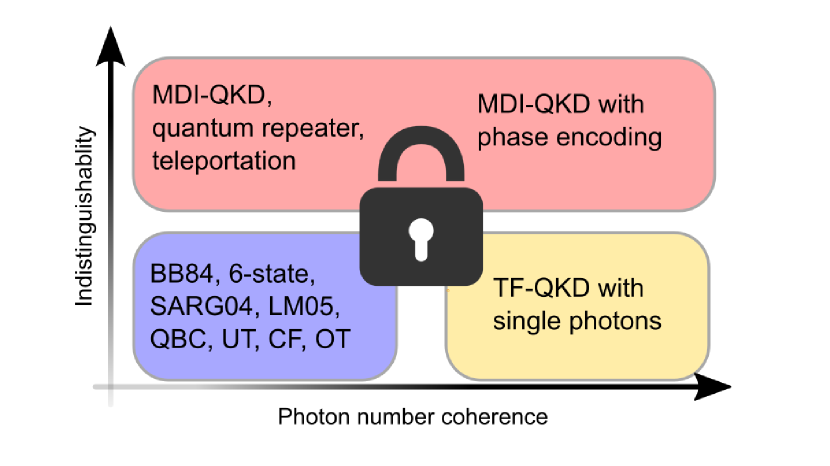
Quantum communication networks rely on quantum cryptographic protocols including quantum key distribution (QKD) using single photons. A critical element regarding the security of QKD protocols is the photon number coherence (PNC), i.e. the phase relation between the zero and one-photon Fock state, which critically depends on the excitation scheme. Thus, to obtain flying qubits with the desired properties, optimal pumping schemes for quantum emitters need to be selected. Semiconductor quantum dots generate on-demand single photons with high purity and indistinguishability. Exploiting two-photon excitation of a quantum dot combined with a stimulation pulse, we demonstrate the generation of high-quality single photons with a controllable degree of PNC. Our approach provides a viable route toward secure communication in quantum networks.
研究の動機と目的
- 固体状態の単一光子源における光子数コherenec(PNC)の制御という、量子暗号分野における重要な課題に取り組むこと。
- PNCのオンデマンド制御を可能にする励起スキームを開発し、単一光子の純度や同一性を損なわないようにすること。
- PNCレベルを特定のプロトコル要件に合わせて調整可能にすることで、幅広い量子暗号プロトコルとの互換性を実現すること。
- InAs/GaAs量子ドットを用いた二光子励起プロトコルと刺激パルスを用いて、PNCが正確に制御可能であることを実験的に示すこと。
提案手法
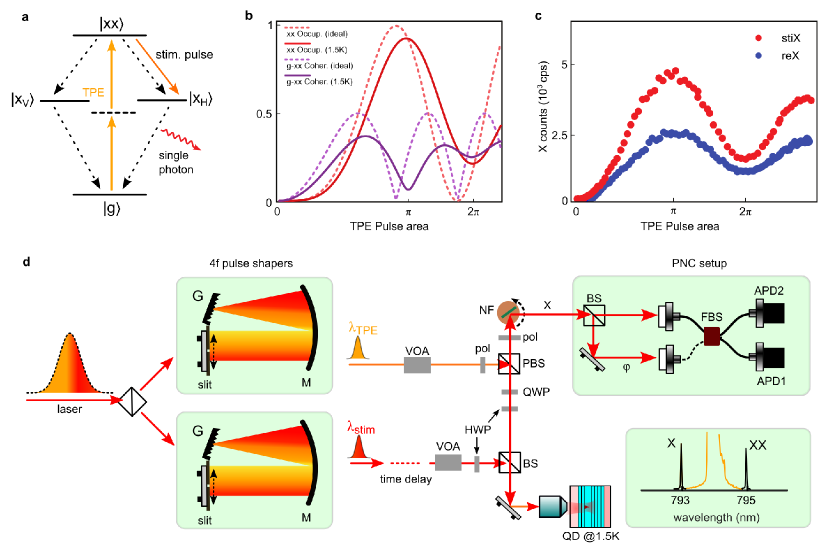
- 刺激パルスを用いた二光子励起スキームを用い、量子ドットを基底状態と単一励起状態の重ね合わせ状態にコherentに準備すること。
- 可変位相シフターとして、半波長板と四分の波長板の組み合わせを用い、干渉計の一方の光路における位相を連続的に変調すること。
- 50:50のファイバー分光ビームスプリッターを用いたファイバー型ハンブリッジ・ブラウン・アンド・トゥイス(HBT)装置を実装し、光子の同一性と可視度を測定すること。
- 理論的モデルを用いて密度行列を純粋成分と混合成分に分解し、可視度と光子占有確率を用いてPNCを抽出すること。
- 干渉計のキャリブレーションとして、励起レーザーを自己干渉させ、縞のコントラストを最大にする。これにより98%の可視度を達成した。
- 基底状態占有確率の関数としての可視度を用い、PNCの度合いを定量化するパrameter λ を抽出すること。
実験結果
リサーチクエスチョン
- RQ1固体状態の単一光子源において、単一光子の品質を損なわずに、光子数コherenec(PNC)を実験的に制御可能か?
- RQ2刺激パルスを用いた二光子励起スキームが、半導体量子ドットにおけるPNCの度合いにどのように影響を与えるか?
- RQ3PNCは、BB84、MDI-QKD、または二重フィールドQKDなどの異なる量子暗号プロトコルの要件に合わせて、どの程度調整可能か?
- RQ4制御された励起スキームにおいて、光子の同一性、可視度、および抽出されたPNCの関係は何か?
- RQ5修正されたHBT装置と密度行列の分解を用いて、PNCを正確に測定・定量化できるか?
主な発見
- HBT干渉計において98%の可視度を達成し、光子の高い同一性と安定した干渉計アライメントを示した。
- 実験的に光子数コherenec(PNC)の度合いを制御・測定し、ゼロから最大コherenecまで全範囲で調整可能であった。
- 従来の共鳴励起に比べ、光子出力レートを最大2倍に向上させ、光源の明るさを著しく向上させた。
- 可視度と占有確率のモデルベース解析により、PNC^exp = λ√(ρ₁,₁(1−ρ₁,₁)) を抽出した。ここでλはコherenec強度を定量化するパラメータである。
- 高い単一光子純度と同一性を維持したまま、正確なPNC制御が可能であるため、高度な量子暗号プロトコルに適している。
- 本結果は、半導体量子ドットをオンデマンド単一光子源として用いることで、安全で高性能な量子ネットワークを実現するための実用的道筋を示している。
より良い研究を、今すぐ始めましょう
論文の読解から最終レビューまで、研究時間を劇的に削減しましょう。
クレジットカード登録不要
このレビューはAIが作成し、人間の編集者が確認しました。