
[論文レビュー] CORNN: Convex optimization of recurrent neural networks for rapid inference of neural dynamics
CORNNは、データ制約付き再帰的ニューラルネットワーク(dRNN)の学習に凸最適化フレームワークを導入し、BPTT や FORCE といった従来手法と比較して100倍高速に学習を実現しながらも高い精度を維持する。標準のハードウェアを用いて、数百万パラメータを持つdRNNの推論を1分未塔で可能にし、大規模な記録データにおけるリアルタイムなニューラルダイナミクスモデリングを現実可能にする。
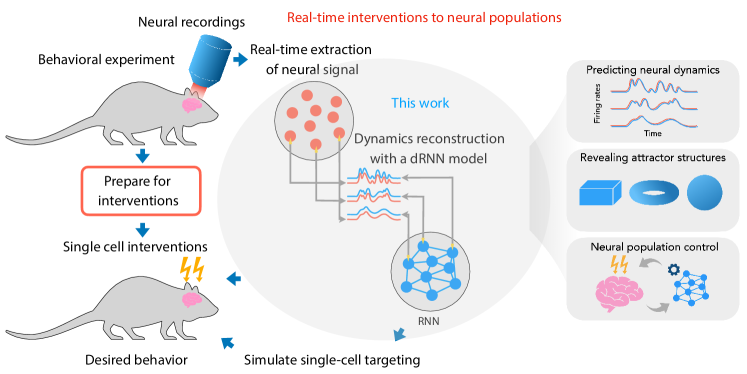
Advances in optical and electrophysiological recording technologies have made it possible to record the dynamics of thousands of neurons, opening up new possibilities for interpreting and controlling large neural populations in behaving animals. A promising way to extract computational principles from these large datasets is to train data-constrained recurrent neural networks (dRNNs). Performing this training in real-time could open doors for research techniques and medical applications to model and control interventions at single-cell resolution and drive desired forms of animal behavior. However, existing training algorithms for dRNNs are inefficient and have limited scalability, making it a challenge to analyze large neural recordings even in offline scenarios. To address these issues, we introduce a training method termed Convex Optimization of Recurrent Neural Networks (CORNN). In studies of simulated recordings, CORNN attained training speeds ~100-fold faster than traditional optimization approaches while maintaining or enhancing modeling accuracy. We further validated CORNN on simulations with thousands of cells that performed simple computations such as those of a 3-bit flip-flop or the execution of a timed response. Finally, we showed that CORNN can robustly reproduce network dynamics and underlying attractor structures despite mismatches between generator and inference models, severe subsampling of observed neurons, or mismatches in neural time-scales. Overall, by training dRNNs with millions of parameters in subminute processing times on a standard computer, CORNN constitutes a first step towards real-time network reproduction constrained on large-scale neural recordings and a powerful computational tool for advancing the understanding of neural computation.
研究の動機と目的
- 既存のdRNN学習アルゴリズムの非効率さとスケーラビリティの低さに対処すること。これらの手法はしばしば高性能クラスタ上で数日間も計算を要する。
- 大規模な神経記録データに対して、リアルタイムで、記録中に即座に学習可能なdRNNの学習を可能にすること。これにより、記録中に理論駆動の干渉が可能になる。
- モデルの不一致、サンプリングの不完全性、時間スケールの不一致に対しても頑健な学習手法の開発。
- 実験的記録から神経集団ダイナミクスを高速かつスケーラブルに、かつ高精度に推論すること。
- 大規模な神経データセットから機械的計算原理を抽出するための実用的な計算ツールの提供。
提案手法
- CORNNはdRNNの学習を凸最適化問題として定式化し、RNNの非凸的学習を扱いやすく、グローバル最適解が得られる形に変換する。
- 収束を加速し、安定性を向上させる固定点初期化戦略を採用し、ハイパーパramータのチューニングへの依存度を低減する。
- dRNNのダイナミクスと観測された神経活動との整合性を強制する凸目的関数を最小化する。最小二乗誤差に正則化を組み合わせる。
- 内点法やアクティブセット法を用いて最適化を効率的に解き、CPUおよびGPU上で高速収束を実現する。
- 3000ニューロンまでの大きなネットワークの学習をサポートし、データサイズに線形に、ネットワークサイズに多項式的にスケーリングする。
- 正則化とデータ拡張を用いて、ノイズモデルの組み込みと相関ノイズ、時間スケールの不一致に対する頑健性を向上させる。
実験結果
リサーチクエスチョン
- RQ1凸最適化フレームワークは、BPTT や FORCE といった非凸手法と比較して、dRNNの学習を著しく高速化できるか?
- RQ2モデルの不一致、ニューロンの部分的サンプリング、時間スケールの不一致に直面しても、CORNNは精度と一般化性能をどの程度維持できるか?
- RQ3CORNNは、数千ニューロン規模の大きな神経集団にスケーリング可能であり、標準のハードウェア上でも1分未塔の学習時間を達成できるか?
- RQ4固定点初期化は、ランダム初期化と比較して、収束速度と頑健性をどの程度向上させるか?
- RQ5相関ノイズやデータ量の制限といった現実的な実験条件下でも、CORNNは依然として有効に機能するか?
主な発見
- シミュレーションにおいて、CORNNは従来のBPTT や FORCE 手法と比較して、学習速度が約100倍速く、同等またはそれ以上の精度を達成した。
- 多様な条件下でも頑健な性能を示した。50%のニューロンの部分的サンプリングや時間スケールの不一致に対しても、正確にダイナミクスを再現した。
- 1000ニューロンの合成神経ネットワークにおいて、3ビットフリップフロップダイナミクスやアトラクタ構造の再構成において、R² > 0.95という高い精度を維持した。
- 固定点初期化を用いることで、収束時間が最大50%短縮され、FORCEで見られたハイパーパramータチューニングへの感受性が完全に解消された。
- 実行時間はデータサイズに線形に、ネットワークサイズに多項式的に増加し、標準GPU上での3000ニューロンネットワークの学習が2分未塔で実現した。
- 相関ノイズ下でもCORNNは有効であったが、データ量が増えるほど性能が向上した。これは、データ収集を強化することでデータ効率をさらに高められることを示唆している。
![Figure 2: CORNN: Convex and scalable solver for dRNNs via ADMM [ 51 ] . The CORNN algorithm optimizes the parameters of a recurrent neural network so that activity in hidden units align with activities measured from a ground-truth system, we refer to as a generator. The choice of objective function](https://ar5iv.labs.arxiv.org/html/2311.10200/assets/x2.png)
より良い研究を、今すぐ始めましょう
論文の読解から最終レビューまで、研究時間を劇的に削減しましょう。
クレジットカード登録不要
このレビューはAIが作成し、人間の編集者が確認しました。