
[論文レビュー] Cosmology with 6 parameters in the Stage-IV era: efficient marginalisation over nuisance parameters
本論文は、特にステージ-IVの写真測光調査を対象として、宇宙論的パラメータ推定における多数のノイズパラメータを解析的に周辺化するための効率的なラプラース近似手法を導入する。3–10倍の高速化を達成しつつ、ほぼブルートフォースの精度を維持でき、高次元のノイズパラメータ空間であっても複数の調査をスケーラブルに統合分析することが可能になる。
The analysis of photometric large-scale structure data is often complicated by the need to account for many observational and astrophysical systematics. The elaborate models needed to describe them often introduce many ``nuisance parameters'', which can be a major inhibitor of an efficient parameter inference. In this paper we introduce an approximate method to analytically marginalise over a large number of nuisance parameters based on the Laplace approximation. We discuss the mathematics of the method, its relation to concepts such as volume effects and profile likelihood, and show that it can be further simplified for calibratable systematics by linearising the dependence of the theory on the associated parameters. We quantify the accuracy of this approach by comparing it with traditional sampling methods in the context of existing data from the Dark Energy Survey, as well as futuristic Stage-IV photometric data. The linearised version of the method is able to obtain parameter constraints that are virtually equivalent to those found by exploring the full parameter space for a large number of calibratable nuisance parameters, while reducing the computation time by a factor 3-10. Furthermore, the non-linearised approach is able to analytically marginalise over a large number of parameters, returning constraints that are virtually indistinguishable from the brute-force method in most cases, accurately reproducing both the marginalised uncertainty on cosmological parameters, and the impact of volume effects associated with this marginalisation. We provide simple recipes to diagnose when the approximations made by the method fail and one should thus resort to traditional methods. The gains in sampling efficiency associated with this method enable the joint analysis of multiple surveys, typically hindered by the large number of nuisance parameters needed to describe them.
研究の動機と目的
- 写真測光大規模構造データの宇宙論的解析における、高次元のノイズパラメータ空間の増大という課題に対処すること。
- 赤方偏移分布の誤差や固有配列の系統的誤差といった系誤差に起因する多数のノイズパラメータが引き起こすMCMCサンプリングの計算的ボトルネックを克服すること。
- 精度を損なわずに、ノイズパラメータを解析的に周辺化できる高速で解析的扱い可能な手法を開発すること。
- LSST、Euclid、Romanなどの将来の複数の調査を統合分析可能にするために、サンプリング時間を著しく短縮すること。
- 現実のデータシナリオにおける、従来のサンプリング手法と比較しての近似の精度と失敗条件を定量化すること。
提案手法
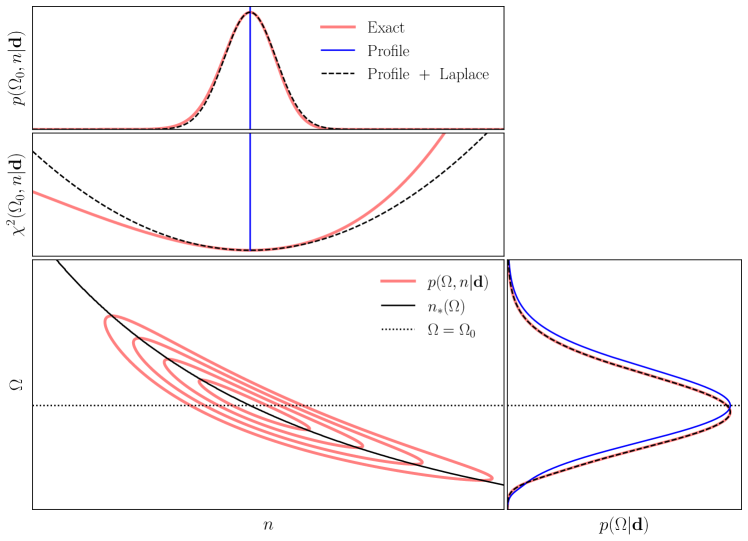
- 尤度関数におけるノイズパラメータの解析的周辺化にラプラース近似を適用し、パrameter空間の次元を低減する。
- 理論予測がノイズパラメータ(例:バイアス、固有配列)に関して解析的に微分可能であることを活用し、ラプラース近似を効率的に計算する。
- 理論がノイズパラメータに対して線形に依存するキャリブレーション可能な系誤差に対しては、線形化されたバージョンの手法を導入し、近似を簡略化する。
- 周辺化におけるボリューム効果をラプラース近似で捉えることで、正確な不確実性推定とバイアスの回避に寄与する。
- 尤度関数の非ガウス性や非二次的挙動に基づく簡単な基準を用いて、失敗ケースを診断し、必要に応じて完全なサンプリングに切り替えるべきタイミングを示す。
- MCMCパイプラインに手法を統合し、パrameter空間次元の低減と効率的な勾配計算のおかげで、収束速度が2–15倍向上する。
実験結果
リサーチクエスチョン
- RQ1ラプラース近似に基づく解析的周辺化手法は、計算コストを著しく削減しながらも、宇宙論的パラメータ推定においてほぼブルートフォースの精度を達成できるか?
- RQ2実際のDESデータおよびシミュレーテッドステージ-IVデータにおいて、ラプラース近似の性能は従来のMCMCサンプリングと比較して、精度と速度の両面でどのように異なるか?
- RQ3ラプラース近似が破綻する領域はどこか、そしてそのような状況を信頼性高く特定する診断ツールは何か?
- RQ4理論がノイズパラメータに対して線形に依存する場合、線形化された手法がどれほど精度を保持できるか、またノイズパラメータ数の増加に伴ってどのようにスケーリングするか?
- RQ5この手法により、高次元のノイズパラメータ空間に起因する計算的ボトル neck を克服し、複数の写真測光調査の統合分析を可能にするか?
主な発見
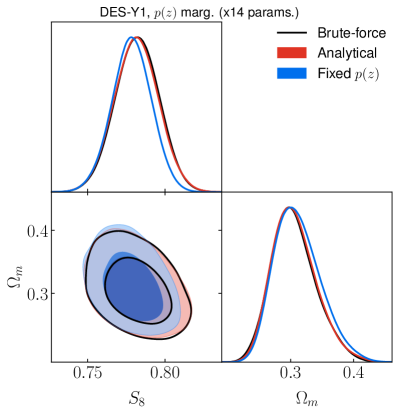
- 線形化されたラプラース近似は、キャリブレーション可能な系誤差において、完全なMCMCサンプリングとほとんど区別できないパラメータ制約を達成し、計算時間は3–10倍短縮された。
- 非線形化されたラプラース手法は、宇宙論的パラメータの周辺不確実性と周辺化に起因するボリューム効果を、ほとんどの場合ブルートフォース結果と一致させる正確な再現を実現した。
- パrameter空間次元の低減と効率的な勾配計算のおかげで、MCMC収束時間が2–15倍短縮された。
- プロファイル尤度法はバイアスのない制約を与えたのに対し、テストされた設定では周辺分布はバイアスを示した。これはボリューム効果の重要性を強調している。
- 非ガウス的データや非二次的尤度が見られるような状況では、近似が失敗する可能性があるため、そのようなケースを検出するための診断ルールを提供した。このような場合には従来のサンプリングが依然として必要となる。
- 高次元のノイズパラメータ空間に起因する計算的ボトル neck を克服することで、本手法は複数の写真測光調査のスケーラブルな統合分析を可能にした。
より良い研究を、今すぐ始めましょう
論文の読解から最終レビューまで、研究時間を劇的に削減しましょう。
クレジットカード登録不要
このレビューはAIが作成し、人間の編集者が確認しました。