
[論文レビュー] Criticality and entanglement in non-unitary quantum circuits and tensor networks of non-interacting fermions
本稿は、d次元における非ユニタリ量子回路と、d+1次元における静的 disorder を持つユニタリで非相互作用フェルミオン系との完全な対応関係を確立する。臨界的エンタングルメント位相が、Altland-Zirnbauer 型 DIII の安定した金属的臨界性に起因することを示し、不純物フェルミオン系を介してエンタングルメント遷移を分類・理解する統一的枠組みを提供する。
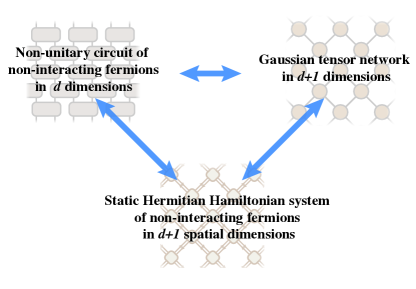
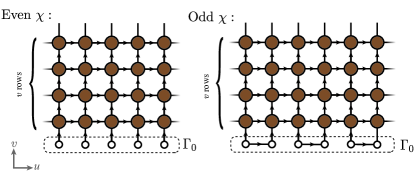
Models for non-unitary quantum dynamics, such as quantum circuits that include projective measurements, have been shown to exhibit rich quantum critical behavior. There are many complementary perspectives on this behavior. For example, there is a known correspondence between d-dimensional local non-unitary quantum circuits and tensor networks on a D=(d+1)-dimensional lattice. Here, we show that in the case of systems of non-interacting fermions, there is furthermore a full correspondence between non-unitary circuits in d spatial dimensions and unitary non-interacting fermion problems with static Hermitian Hamiltonians in D=(d+1) spatial dimensions. This provides a powerful new perspective for understanding entanglement phases and critical behavior exhibited by non-interacting circuits. Classifying the symmetries of the corresponding non-interacting Hamiltonian, we show that a large class of random circuits, including the most generic circuits with randomness in space and time, are in correspondence with Hamiltonians with static spatial disorder in the ten Altland-Zirnbauer symmetry classes. We find the criticality that is known to occur in all of these classes to be the origin of the critical entanglement properties of the corresponding random non-unitary circuit. To exemplify this, we numerically study the quantum states at the boundary of Haar-random Gaussian fermionic tensor networks of dimension D=2 and D=3. We show that the most general such tensor network ensemble corresponds to a unitary problem of non-interacting fermions with static disorder in Altland-Zirnbauer symmetry class DIII, which for both D=2 and D=3 is known to exhibit a stable critical metallic phase. Tensor networks and corresponding random non-unitary circuits in the other nine Altland-Zirnbauer symmetry classes can be obtained from the DIII case by implementing Clifford algebra extensions for classifying spaces.
研究の動機と目的
- d次元における非相互作用フェルミオンの非ユニタリ量子回路と、d+1次元におけるユニタリで不純物を有するフェルミオンハミルトニアンとの完全な対応関係を確立すること。
- 10種の Altland-Zirnbauer 対称性クラスを用いて、ランダム非ユニタリ回路におけるエンタングルメント位相と臨界的挙動を分類すること。
- ランダムガウステンソルネットワークで観測される臨界的エンタングルメントが、対称性クラス DIII の安定した金属的位相に起因することを示すこと。
- 既知の臨界的挙動を示す不純物フェルミオン系への写像を通じて、エンタングルメント遷移を統一的に理解する枠組みを提供すること。
提案手法
- 各ガウステンソルを、共分散行列から導かれる移動行列を用いて、単一の散乱中心を持つユニタリ散乱問題に写像する。
- テンソルネットワークのダイナミクスを記述する移動行列形式を構築し、静的不純物を有する非相互作用フェルミオンハミルトニアンに写像する。
- 移動行列の対称性を同定し、それに対応する系を10種の Altland-Zirnbauer 対称性クラスのいずれかに分類する。特にクラス DIII に注目する。
- 正の生成子を含むクリフォード代数の拡張を用いて、10種のすべての対称性クラスに対応するテンソルネットワーク集合を体系的に生成する。
- D=2およびD=3におけるハーレンダムガウステンソルネットワークを用いた数値シミュレーションを行い、エンタングルメントエントロピー、相関関数、相互情報量を計算する。
- 縮約化群および場の理論的手法を用いて、DIII金属的位相における相関関数の対数補正を解析的に理解する。
実験結果
リサーチクエスチョン
- RQ1d次元における非ユニタリ量子回路の非相互作用フェルミオン系を、d+1次元におけるユニタリで不純物を有するフェルミオン系にどのように写像できるか?
- RQ2ランダム非ユニタリ回路における臨界的エンタングルメントの起源は何か?また、不純物フェルミオン系の対称性クラスとどのように関係しているか?
- RQ3最も一般なガウステンソルネットワーク集合がなぜ対称性クラス DIII に対応するのか?また、エンタングルメントスケーリングにどのような意味を持つのか?
- RQ4移動行列の対称性が、エンタングルメント臨界性の普遍性クラスをどのように決定するのか?
- RQ5クリフォード代数の拡張を用いたテンソルネットワーク構成により、Altland-Zirnbauer 対称性クラスの10重分類を完全に実現できるか?
主な発見
- D=2およびD=3におけるハーレンダムガウステンソルネットワークの臨界的エンタングルメント位相は、Altland-Zirnbauer 対称性クラス DIII の安定した金属的位相に対応する。
- 臨界位相におけるエンタングルメントエントロピーは、DIII金属的位相と整合する対数補正を示し、非自明な臨界点であることを示唆する。
- 数値結果から、臨界位相における相互情報量および相関関数が対数補正とともにスケーリングされ、DIIIクラスにおける場の理論の予測と一致することが示された。
- 移動行列形式により、各ガウステンソルが粒子・ホール対称性を保ったユニタリ散乱問題に写像され、DIII分類が裏付けられた。
- 正の生成子を含むクリフォード代数の拡張を用いて、10種のすべての Altland-Zirnbauer 対称性クラスに対応するテンソルネットワーク集合が構築され、DIIIの場合を一般化した。
- 本研究により、非ユニタリ回路における臨界性がランダムネスに起因するアーティファクトではなく、クラス DIII のトポロジカルで対称性保護された金属的位相に深く関連する、頑健な性質であることが明らかになった。
より良い研究を、今すぐ始めましょう
論文の読解から最終レビューまで、研究時間を劇的に削減しましょう。
クレジットカード登録不要
このレビューはAIが作成し、人間の編集者が確認しました。