
[論文レビュー] Cross Domain Iterative Detection for Orthogonal Time Frequency Space Modulation
本稿では、直交時間周波数空間(OTFS)変調におけるクロスドメイン反復検出アルゴリズムを提案する。この手法は、時間領域における線形最小分散誤差(L-MMSE)均衡と遅延-Doppler(DD)領域におけるシンボルごとの検出を交互に適用し、ドメイン間のユニタリ変換を活用する。この方法は、分数Dopplerシフト下でも低計算量でほぼ最大尤度性能を達成でき、DD領域における非ガウス分布の信号点制約のおかげで著しい誤り性能向上が得られ、収束性が保証されている。
Recently proposed orthogonal time frequency space (OTFS) modulation has been considered as a promising candidate for accommodating various emerging communication and sensing applications in high-mobility environments. In this paper, we propose a novel cross domain iterative detection algorithm to enhance the error performance of OTFS modulation. Different from conventional OTFS detection methods, the proposed algorithm applies basic estimation/detection approaches to both the time domain and delay-Doppler (DD) domain and iteratively updates the extrinsic information from two domains with the unitary transformation. In doing so, the proposed algorithm exploits the time domain channel sparsity and the DD domain symbol constellation constraints. We evaluate the estimation/detection error variance in each domain for each iteration and derive the state evolution to investigate the detection error performance. We show that the performance gain due to iterations comes from the non-Gaussian constellation constraint in the DD domain. More importantly, we prove the proposed algorithm can indeed converge and, in the convergence, the proposed algorithm can achieve almost the same error performance as the maximum-likelihood sequence detection even in the presence of fractional Doppler shifts. Furthermore, the computational complexity associated with the domain transformation is low, thanks to the structure of the discrete Fourier transform (DFT) kernel. Simulation results are consistent with our analysis and demonstrate a significant performance improvement compared to conventional OTFS detection methods.
研究の動機と目的
- 分数Dopplerシフトを伴う高速度移動環境下におけるOTFSの高検出複雑性を解消すること。この状況下では、従来のDD領域スパarsityに基づく手法が機能しない。
- 時間領域チャネルスパarsityとDD領域シンボル信号点制約の両方を活用することで、OTFSの誤り性能を向上させること。
- メッセージパッシングに基づく手法にありがちな収束問題を回避する安定な反復検出アルゴリズムを設計すること。
- ドメイン間のユニタリ変換を活用することで、計算量を低減しつつほぼ最適性能を達成すること。
提案手法
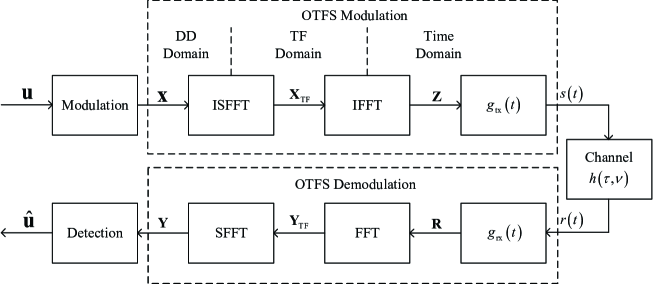
- アルゴリズムは、時間領域におけるL-MMSE均衡とDD領域におけるシンボルごとの検出を交互に繰り返す反復検出を実行する。
- 外挿情報は、特に逆シミプレクティック有限フーリエ変換(ISFFT)およびその逆変換を介してドメイン間で交換される。
- チャネル応答の時間領域スパarsityと、DD領域における非ガウス分布の信号点制約を活用することで、誤り相関を抑制する。
- 誤差分散の反復間での伝播をモデル化するための状態推移解析を導出する。これにより、性能予測が可能になる。
- 収束性が理論的に証明されており、ジェンセンの不等式と行列トレース恒等式を用いて理論的境界が導出されている。
- DFTに基づくユニタリ変換の効率的な構造のおかげで、計算複雑度が低く抑えられている。
実験結果
リサーチクエスチョン
- RQ1時間領域と遅延-Doppler領域を横断する反復検出は、従来手法を上回るOTFS誤り性能を実現できるか?
- RQ2DD領域スパarsityが崩壊する分数Dopplerシフト下でも、提案手法のクロスドメインアプローチは有効であるか?
- RQ3反復アルゴリズムは収束性を示すことができるか?その安定性の理論的根拠は何か?
- RQ4DD領域における信号点制約の寄与は何か?時間領域スパarsityと比べて性能向上にどの程度寄与しているか?
- RQ5提案手法の複雑度は、最大尤度検出および既存の低複雑性代替手法と比べてどうか?
主な発見
- 提案手法は、従来のDD領域スパarsityに基づく手法が失敗する分数Dopplerシフト下でも、ほぼ最大尤度性能を達成している。
- 性能向上の主な要因は、DD領域における非ガウス分布の信号点制約であり、チャネルスパarsityそのものではない。
- 収束性が理論的に証明されており、状態推移解析により反復間での誤差伝播が安定していることが確認されている。
- ジェンセンの不等式を用いて時間領域推定分散の下界が導出されており、ノイズ分散が小さくなるほどよりタイトな性能境界が得られることを示している。
- DFTに基づくユニタリ変換の効率的構造のおかげで、計算複雑度が低く抑えられており、実装に適している。
- シミュレーション結果は理論的解析を裏付け、従来のOTFS検出手法に比べて顕著な性能向上を示している。
より良い研究を、今すぐ始めましょう
論文の読解から最終レビューまで、研究時間を劇的に削減しましょう。
クレジットカード登録不要
このレビューはAIが作成し、人間の編集者が確認しました。