
[論文レビュー] Dark matter, fine-tuning and $(g-2)_μ$ in the pMSSM
この論文は、観測された暗黒物質の残り質量密度、ミュオンの異常磁気モーメントのずれ $(g-2)_\mu$、およびLHCと直接検出制約を同時に満たす、最小限の微調整を要する素性のMSSM(pMSSM)スケーリングを同定する。その結果、スピン依存性の暗黒物質-陽子散乱実験(例:PICO-500)が、特に低電磁的微調整とバンディオ型LSP(ヒッグスキン成分が小さい)を有する解をすべて探査可能であることが示された。
In this paper we analyze spectra in the phenomenological supersymmetric Standard Model that simultaneously result in the right dark-matter relic density $Ω_{ m DM} h^2$, offer an explanation for the $(g-2)_μ$ discrepancy $Δa_μ$ and are minimally fine-tuned. We discuss the LHC phenomenology resulting from these spectra and the sensitivity of dark-matter direct detection experiments to these spectra. We find that the latter type of experiments with sensitivity to the spin-dependent dark-matter-nucleon scattering cross section $σ_{ m SD,p}$ will probe all of our found solutions.
研究の動機と目的
- 観測された暗黒物質の残り質量密度 $\Omega_{\rm DM}h^{2}$、$(g-2)_\mu$ のずれ、およびLHC制約を同時に満たすpMSSMにおける超対称スペクトルを同定すること。
- モデルのパラメータ空間を、最小限の電磁的微調整($\Delta_{\rm EW}$)を要するスペクトルに制限すること。
- 有効なスペクトルのLHCの素性および直接検出感度を評価すること、特にスピン依存性散乱に注目すること。
提案手法
- 19個の自由パラメータを持つ素性MSSM(pMSSM)を用い、第1および第2世代のスフェルミオン質量が縮退していると仮定し、軽い世代の三重項結合がゼロであると仮定する。
- チャリオンとニュートラリノの1ループ寄与に加え、ヒッグスおよびヒッグスキンの交換を含めた、ミュオンの異常磁気モーメント $a_\mu$ を計算する。
- 残り質量密度 $\Omega_{\rm DM}h^{2}$ は、共凝縮およびsチャネル共鳴を含めて、micrOMEGAsを用いて計算する。
- 電磁的微調整は、ヒッグス質量がソフト対称性破れパラメータに対して示す相対的感度の最大値として定義される $\Delta_{\rm EW}$ 措置で定量化する。
- LHC制約は、チャリオンおよびニュートラリノの既存の探索結果を用い、特に $\widetilde{\chi}^{0}_{2}\widetilde{\chi}^{\pm}_{1}$ 終状態を対象とする。
- 直接検出断面積 $\sigma_{\rm SD,p}$ および $\sigma_{\rm SI,p}$ を計算し、PICO-40LおよびPICO-500の予想感度と比較する。
実験結果
リサーチクエスチョン
- RQ1どのpMSSMスペクトルが、正しい暗黒物質の残り質量密度、$(g-2)_\mu$ 異常、LHC制約を同時に満たし、最小限の微調整を要するか?
- RQ2最軽い超対称粒子(LSP)の組成が、スピン依存性の暗黒物質-陽子散乱断面積 $\sigma_{\rm SD,p}$ にどのように影響するか?
- RQ3PICO-500のような将来の直接検出実験が、パラメータ空間で同定された有効な解のどの程度を探査可能か?
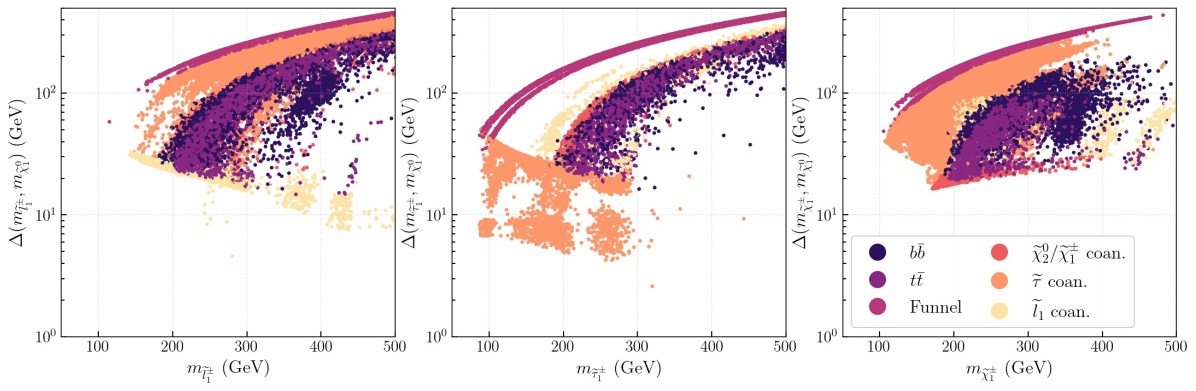
- RQ4共凝縮メカニズムおよび共鳴領域は、モデルにおける残り質量密度および微調整にどのように影響するか?
- RQ5ヒッグスキン成分がLSPに寄与する場合、$(g-2)_\mu$ 矯正および微調整に果たす役割は何か?
主な発見
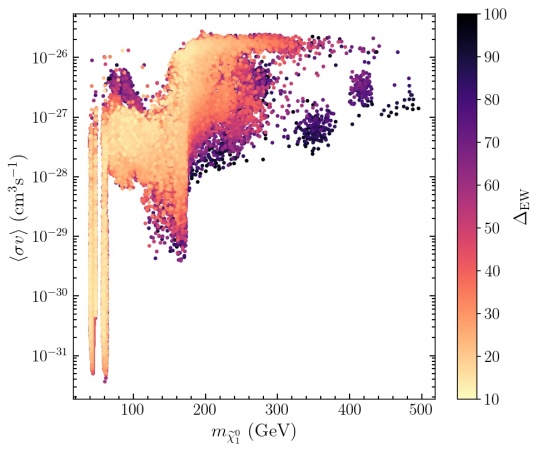
- すべての有効なスペクトルにおけるLSPは、主にバンディオ型であり、わずかなヒッグスキン成分を有する。このため、$\sigma_{\rm SD,p}$ と電磁的微調整 $\Delta_{\rm EW}$ の間に強い相関が生じる。
- すべての解において最小の電磁的微調整 $\Delta_{\rm EW}$ は約14.2であり、最大で100に達する。
- スピン依存性の直接検出実験(例:PICO-500)は、$\Delta_{\rm EW} < 62$ のすべての解を探査可能であり、LUX-ZEPLINは $\Delta_{\rm EW} < 100$ のすべての解を除外可能である。
- LHC探索は、$\widetilde{\chi}^{0}_{2}/\widetilde{\chi}^{\pm}_{1}$ 状態が軽く、ウィノ成分が顕著なスペクトルに対して最も感度が高く、一般のバンディオ-ヒッグスキン領域では限界がある。
- 軽いスタウとの共凝縮はLHC探索にとって特に困難であるため、質量の縮退を仮定しない専用の $\widetilde{\tau}^{\pm}$ 探索の必要性が示唆される。
- $\Delta a_\mu$ を説明する要件により、約600 GeVの重いヒッグスキン成分を有するLSPは除外され、$\sigma_{\rm SD,p}$–$\Delta_{\rm EW}$ 相関が制限される。
より良い研究を、今すぐ始めましょう
論文の読解から最終レビューまで、研究時間を劇的に削減しましょう。
クレジットカード登録不要
このレビューはAIが作成し、人間の編集者が確認しました。