
[論文レビュー] Data for "Phase transition in Random Circuit Sampling"
本論文は、Random Circuit Sampling (RCS) における回路深さと1サイクルあたりのノイズによって駆動される2つの相転移を実験的および理論的に示し、XEBを用いて非常に複雑で偽造が難しい領域と弱く相関した領域との転移をマッピングする。さらに67 qubits at 32 cycles での超古典的計算を証明する。
Purpose This dataset defines the Random Quantum Circuits (RQCs) used in our paper "Phase transition in Random Circuit Sampling" and lists the bitstrings observed in the experimental executions of the circuits on the Sycamore processor. See [1] for more details about the experiment. This data upload is modeled after that of [5]. Background Circuit parameters RQCs posted here are uniquely identifiedusing the following parameters: `n`: number of qubits (69, 70), `m`: number of cycles (04, 06, 08, ..., 28, 30), `s`: seed for the pseudo-random number generator (000, 001, ..., 595), `patches`: the number of patches, `p`: sequence of coupler activation patterns (`ABCD`, `ABCDCDAB`), `num_sq`: the number of distinct single-qubit gates (3, 8), the date on which the data was collected, included in yymmdd format in the filename, and `phase_match`: included in the file name if phase matching was performed. See Figure S25 in [2] and Figure 3 of [1] for the coupler activation patterns and Figure 4 of [1] for illustrations of the patches. Also see code snippets below for visualizing the patches and activation patterns from the provided circuits.When `num_sq` is 8, the single-qubit gates are chosen randomly from \(Z^p X^{1/2} Z^{-p}\), with \(p \in \{-1, -3/4, -1/2, -1/4, 0, 1/4, 1/2, 3/4 \}\), whereas when `num_sq` is 3, they are chosen randomly from among \(\sqrt X\), \(\sqrt Y\), and \(\sqrt W\). Phase matching is described in Appendix C.1 of [1]. Note that circuits which share the same seed `s` share the same initial gate sequence. Content description For each RQC there are four files in the dataset: * original RQC specification in QSIM format, named `circuit_\*.qsim`, * derived RQC specificaton as python code using cirq, named `circuit_\*.py`, * derived RQC specification in QASM format, named `circuit_\*.qasm`, * bitstrings observed in experiments, named `measurements_\*.txt`. The asterisk \* in the names above stands for a string specifying the parameters identifying a RQC. For example,`circuit_n70_m24_s00_patches3_pABCD_num_sq8_221014_phase_match.qasm` contains the definition of the 70-qubit, 24-cycle RQC with PRNG seed 0, 3 patches, a simplifiable sequence of coupler activation patterns (i.e. ABCD), and 8 distinct single-qubit gates, taken on October 14, 2022, with phase matching, in the QASM format. Files are grouped by parameters `n`, `m`, and `patches` and into compressed tarballs. For example, tarball `n69_m04_patches2.tar.gz` contains all RQCs and measurement files for circuits with 69 qubits, 4 cycles, and 2 patches. Circuit file formats QSIM format First line specifies the number of qubits n. Each subsequent line specifies a single gate and consists of moment number, gate name and one or two qubits as a number in 0..n-1 optionally followed by gate parameters. The circuits use the following gates: * `x_1_2`: parameter-free, single-qubit pi/2 rotation around the X axis of the Bloch sphere, see equation (45) in section VII of [2], * `y_1_2`: parameter-free, single-qubit pi/2 rotation around the Y axis of the Bloch sphere, see equation (46) in section VII of [2], * `hz_1_2`: parameter-free, single-qubit pi/2 rotation around the X+Y axis of the Bloch sphere, see equation (47) in section VII of [2], * `rz`: single-qubit rotation around the Z axis of the Bloch sphere through the angle specified in radians by the gate's sole parameter, * `fsim`: two-qubit gate corresponding to the composition of the iSWAP and CPHASE gates and taking two parameters in radians: theta (the negative iSWAP angle) and phi (the CPHASE angle), see equation (48) in section VII of [2]. Note that the two-qubit gates executed in our experiments on Sycamore belong to the five-parameter family of two-qubit gates that preserve the number of 0 and 1 states of the qubits. Each such gate can be decomposed into one fsim gate and four rz gates. Therefore, one cycle consisting of one application ofsingle-qubit gates and one application of two-qubit gates is represented in the file using four moments. The first moment contains `x_1_2`, `y_1_2` and `hz_1_2` gates. The other three moments use `rz` and `fsim` gates to describe the two-qubit gates used in the experiments. See section VII in [2] for more details about the Sycamore gates and their decomposition. Qubits are specified as numbers in 0..n-1 and hence do not directly indicate qubit location on the device. Python/cirq format Each python file defines two variables: QUBIT_ORDER and CIRCUIT. The former is a python list object containing `cirq.GridQubit` objects initialized with therow and column of each qubit on the device. The latter is a `cirq.Circuit` object initialized with all gate operations contained in the circuit. The files have been tested using cirq version 1.2.0.dev20230613162638. The following code snippet illustrates how one can use cirq and our circuit definitions to compute output state amplitudes: $ python -i circuit_n70_m24_s00_patches3_pABCD_num_sq8_221014_phase_match.py >>> cirq.final_wavefunction(CIRCUIT, qubit_order=QUBIT_ORDER) array([ 0.00263724+0.00337646j, 0.0009332 +0.00111853j, -0.0007809 +0.00386362j, ..., 0.00574739-0.00027827j, -0.00254766+0.00299345j, 0.00396056+0.00312335j], dtype=complex64) See [3] for more details about cirq. QASM format Each QASM file has been generated using cirq and specifies the RQC decomposed into CNOT and single-qubit gates. The files have been generated using cirq. See [4] for more details about the format. Measurements file format Each line contains the bitstring obtained in a single execution of the RQC on Sycamore. The first, left-most position corresponds to the qubit 0 in QSIM format and the first qubit in the `QUBIT_ORDER` list in the python/cirq files. To visualize the patches After loading `CIRCUIT` from the appropriate `.py` file, the following code snippet can be used to visualize the patches: import cirq import matplotlib.pyplot as plt pairs = set() for moment in CIRCUIT: for op in moment.operations: q = op.qubits if len(q) > 1: assert len(q) == 2 pairs.add(tuple(sorted(q))) d = {p:1 for p in pairs} heatmap = cirq.TwoQubitInteractionHeatmap(d) _, ax = plt.subplots(figsize=(8, 8)) _ = heatmap.plot(ax) Visualize the activation patterns The activation pattern sequence can also be visualized in a similar manner. After loading `CIRCUIT` from the appropriate `.py` pyle, the following code snippet can be used to visualize the activation patterns: import cirq import matplotlib.pyplot as plt def has_two_qubit_gates(moment): has = False for op in moment.operations: if len(op.qubits) > 1: has = True break return has def plot_pairs(moment): pairs = set() for op in moment.operations: q = op.qubits if len(q) > 1: assert len(q) == 2 pairs.add( tuple(sorted(q)) ) d = {p:1 for p in pairs} heatmap = cirq.TwoQubitInteractionHeatmap(d) _, ax = plt.subplots(figsize=(8, 8)) _ = heatmap.plot(ax) return ax moments = [_ for _ in CIRCUIT if has_two_qubit_gates(_)] moment_to_visualize = moments[0] # iterate through this manually plot_pairs(moment_to_visualize) Content listing The dataset includes the following tarball files: n69_m04_patches2.tar.gz (80 files) n69_m04_patches3.tar.gz (80 files) n69_m06_patches2.tar.gz (80 files) n69_m06_patches3.tar.gz (80 files) n69_m08_patches2.tar.gz (80 files) n69_m08_patches3.tar.gz (80 files) n69_m10_patches2.tar.gz (80 files) n69_m10_patches3.tar.gz (80 files) n69_m12_patches2.tar.gz (80 files) n69_m12_patches3.tar.gz (80 files) n69_m14_patches2.tar.gz (80 files) n69_m14_patches3.tar.gz (80 files) n69_m16_patches2.tar.gz (80 files) n69_m16_patches3.tar.gz (80 files) n69_m18_patches2.tar.gz (80 files) n69_m18_patches3.tar.gz (80 files) n69_m20_patches2.tar.gz (80 files) n69_m20_patches3.tar.gz (80 files) n69_m22_patches2.tar.gz (80 files) n69_m22_patches3.tar.gz (80 files) n69_m24_patches1.tar.gz (4 files) n69_m24_patches2.tar.gz (80 files) n69_m24_patches3.tar.gz (80 files) n69_m26_patches2.tar.gz (80 files) n69_m26_patches3.tar.gz (80 files) n69_m28_patches2.tar.gz (80 files) n69_m28_patches3.tar.gz (80 files) n69_m30_patches2.tar.gz (80 files) n69_m30_patches3.tar.gz (80 files) n70_m16_patches2.tar.gz (960 files) n70_m16_patches3.tar.gz (1040 files) n70_m16_patches9.tar.gz (160 files) n70_m18_patches2.tar.gz (960 files) n70_m18_patches3.tar.gz (1040 files) n70_m18_patches9.tar.gz (160 files) n70_m20_patches2.tar.gz (960 files) n70_m20_patches3.tar.gz (1040 files) n70_m20_patches9.tar.gz (160 files) n70_m22_patches2.tar.gz (960 files) n70_m22_patches3.tar.gz (1040 files) n70_m22_patches9.tar.gz (160 files) n70_m24_patches1.tar.gz (56 files) n70_m24_patches2.tar.gz (960 files) n70_m24_patches3.tar.gz (1040 files) n70_m24_patches9.tar.gz (160 files) n70_m26_patches1.tar.gz (4 files) n70_m26_patches2.tar.gz (880 files) n70_m26_patches3.tar.gz (960 files) n70_m26_patches9.tar.gz (160 files) Additionally, the file Figures 2 and 3 data.zip contains processed data (9 files in Pickle format) that are shown in Figures 2 and 3 of the paper. References [1] Google AI Quantum and collaborators, "Phase transition in Random Circuit Sampling". arXiv:2304.11119 [2] Google AI Quantum and collaborators, Supplementary information for “Quantum supremacy using a programmable superconducting processor”. arXiv:1910.11333 [3] Cirq: A Python framework for creating, editing, and invoking Noisy Intermediate Scale Quantum (NISQ) circuits, https://github.com/quantumlib/Cirq. [4] Cross, Andrew W.; Bishop, Lev S.; Smolin, John A.; Gambetta, Jay M. "Open Quantum Assembly Language", arXiv:1707.03429 [5] Martinis, John M. et al. (2022), "Quantum supremacy using a programmable superconducting processor", Dryad, Dataset, https://doi.org/10.5061/dryad.k6t1rj8
研究の動機と目的
- ノイズと回路深さが近期量子プロセッサの使用可能なヒルベルト空間をいかに制限するかを動機づける。
- XEB を用いて、RCS の振る舞いを実験的に明らかにし、二つの異なる相転移が支配することを示す。
- ノイズ駆動の遷移を解析的かつ実験的に識別する弱結合モデルを開発する。
- 67-qubit デバイス上での超古典的計算を示す。
- Fidelity と classical シミュレーションの実行可能性を論じる。
提案手法
- XEB(linear cross-entropy benchmarking)を用いて、回路深さ(サイクル)と系サイズの関数として忠実度と相転移の挙動を定量化する。
- Haar ランダムな単一量子ビットゲートと iSWAP様のエンタングラーを用いた1Dおよび2D超伝導量子ビット配置を実装する。
- 弱結合モデルを導入してサブシステムを分離し、ノイズとエンタングルメントダイナミクスを研究する。
- ノイズによる相転移を識別する秩序パラメータ F^d / XEB を定義・分析する。
- 67-qubit, 32-cycle の RCS 実験を実施し、Loschmidt echo およびパッチベースの XEB 検証によって忠実度を検証する。
- 実験結果を数値シミュレーション、テンソルネットワークの収縮、マトリックス積状態解析と比較する。
実験結果
リサーチクエスチョン
- RQ1回路深さと1サイクルあたりのノイズの関数として、RCS における相転移は何か。
- RQ2XEB は、全系にわたってエンタングルされた計算的に複雑な相とノイズ支配の領域の境界を信頼性高く診断できるのか。
- RQ3弱結合結合はノイズ下でのサブシステム間の遷移にどう影響するのか。
- RQ4 realistic なノイズ下で 67-qubit RCS 回路を 32 サイクルで走らせると古典的なシミュレーション能力を超えるのか。
- RQ51D と 2D の回路アーキテクチャは、これらの遷移の位置と性質にどのような影響を与えるのか。
主な発見
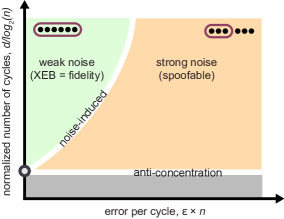
- XEB で観測可能な2つの相転移が存在する:回路深さとノイズ駆動の量子相転移によるダイナミカル転移を含む。
- XEB の転移は、相関が全系に広がる領域(ノイズが小さい場合)と、サブシステムが実質的に相関しない領域(ノイズが大きい場合)を示す。
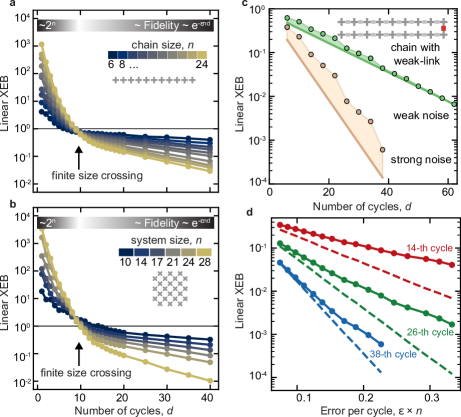
- 弱結合モデルはノイズ駆動の転移を捕捉し、XEB が忠実度を正確に反映しなくなる境界を予測する;実験はモデルと整合するクロスオーバー挙動を示す。
- 1D および 2D の配置では、XEB 曲線の交差点が特定のサイクル数で生じ、ダイナミカル相転移を示唆する;より多くのサイクルは反集中化を招き、次に忠実度が支配的な XEB となる。
- 67-qubit Sycamore 実験を 32 サイクルで実施すると、忠実度と難易度が超古典的性能と一致し、現実的なメモリ制約下で古典的シミュレーションコストは手ごわいと推定される。
- 数値および実験結果は、臨界ノイズ率 εn を共同に制約し、2D パターンは系サイズを超えてロバストな弱ノイズ領域を生み出すことを示す。
より良い研究を、今すぐ始めましょう
論文設計から論文執筆まで、研究時間を劇的に削減しましょう。
クレジットカード登録不要
このレビューはAIが作成し、人間の編集者が確認しました。