
[論文レビュー] Demonstration of Robust and Efficient Quantum Property Learning with Shallow Shadows
この論文は、浅いランダムな量子回路における実験的ノイズをモデル化・補正するためにベイズ推論を用いるノイズ低減型量子性質学習フレームワークであるロバスト・シャロウシャドウプロトコルを導入する。この手法により、標準的なランダム1キュービット測定よりも低いサンプル複雑性で、超伝導ハードウェア上での量子状態性質(fidelity、エンタングルメントエントロピー、期待値など)の正確な推定が可能になる。
Extracting information efficiently from quantum systems is a major component of quantum information processing tasks. Randomized measurements, or classical shadows, enable predicting many properties of arbitrary quantum states using few measurements. While random single-qubit measurements are experimentally friendly and suitable for learning low-weight Pauli observables, they perform poorly for nonlocal observables. Prepending a shallow random quantum circuit before measurements maintains this experimental friendliness, but also has favorable sample complexities for observables beyond low-weight Paulis, including high-weight Paulis and global low-rank properties such as fidelity. However, in realistic scenarios, quantum noise accumulated with each additional layer of the shallow circuit biases the results. To address these challenges, we propose the \emph{robust shallow shadows protocol}. Our protocol uses Bayesian inference to learn the experimentally relevant noise model and mitigate it in postprocessing. This mitigation introduces a bias-variance trade-off: correcting for noise-induced bias comes at the cost of a larger estimator variance. Despite this increased variance, as we demonstrate on a superconducting quantum processor, our protocol correctly recovers state properties such as expectation values, fidelity, and entanglement entropy, while maintaining a lower sample complexity compared to the random single qubit measurement scheme. We also theoretically analyze the effects of noise on sample complexity and show how the optimal choice of the shallow shadow depth varies with noise strength. This combined theoretical and experimental analysis positions the robust shallow shadow protocol as a scalable, robust, and sample-efficient protocol for characterizing quantum states on current quantum computing platforms.
研究の動機と目的
- 現実的なノイズ条件下におけるシャロウシャドウの実験的検証の不足を補う。
- 量子性質推定における浅い量子回路におけるノイズによって生じるバイアスを克服する。
- 非局所的およびグローバルな観測量(fidelity やエンタングルメントエントロピーなど)のロバストな推定を実現しつつ、低いサンプル複雑性を維持する。
- キャリブレーションデータからノイズモデルを学習する後処理フレームワークを開発し、測定バイアスを補正する。
- 実際の127キュービットの超伝導プロセッサ(ibm_kyiv)上で、プロトコルのスケーラビリティと効率性を実証する。
提案手法
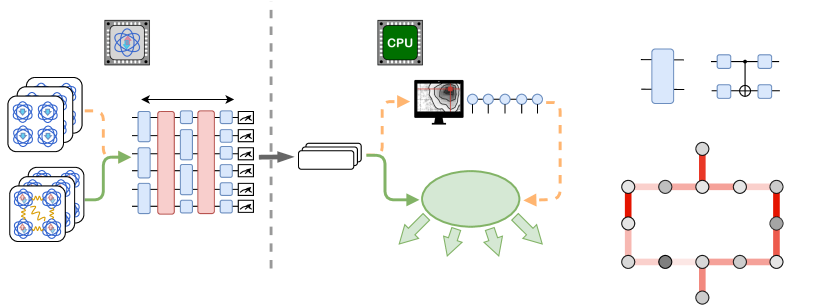
- 非局所的およびグローバルな観測量の効率的学習を可能にするために、1キュービット測定の前に浅いランダムな量子回路を付加する。
- 量子プロセッサ上で収集した実験的キャリブレーションデータから、装置固有のノイズモデルをベイズ推論を用いて学習する。
- バイアスと分散のバランスを取るために、ノイズに起因する推定器期待値のバイアスを補正する後処理を適用する。
- 複数キュービット回路における現実的なノイズ効果を捉えるために、空間的に相関のあるノイズモデルを構築する。
- クラシカルシャドウフレームワークを活用し、1つのデータセットから「1回測定、多数の性質を学べる」推定を可能にする。
- 理論的分析により、ノイズが最適な回路深さとサンプル複雑性に与える影響を定量化し、プロトコル設計を支援する。
実験結果
リサーチクエスチョン
- RQ1浅い量子回路におけるノイズは、クラシカルシャドウを用いた量子性質推定の正確さにどのように影響するか?
- RQ2現実的なノイズ条件下における浅いランダム回路の最適深さは何か? また、ノイズ強度に従ってどのようにスケーリングするか?
- RQ3ベイズ推論は、後処理において装置固有のノイズを効果的に学習・低減できるか?
- RQ4ロバスト・シャロウシャドウプロトコルは、1キュービットのランダム測定と比較して、どの程度サンプル複雑性を低減できるか?
- RQ5このプロトコルは、ノイズのある近位量子ハードウェア上で、fidelity やエンタングルメントエントロピーといったグローバルな性質を信頼性高く回復できるか?
主な発見
- ロバスト・シャロウシャドウプロトコルは、顕著なノイズが存在する127キュービットの超伝導プロセッサ(ibm_kyiv)上でも、期待値、fidelity、エンタングルメントエントロピーを含む量子状態性質を正常に回復した。
- 現実的なノイズ条件下でも、標準的な1キュービットのランダム測定方式よりも低いサンプル複雑性を維持した。
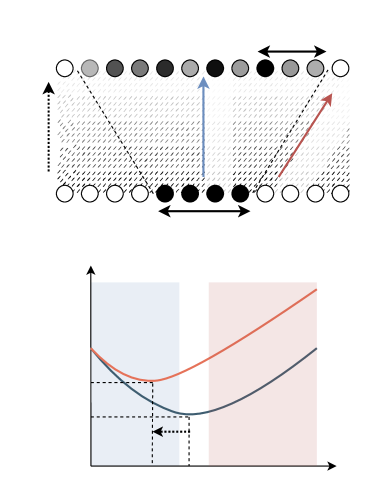
- 理論的分析により、ノイズ強度が増加するにつれて最適な浅い回路深さが減少することが示され、このトレードオフは定量的に特定された。
- ベイズノイズモデリングにより、ノイズに起因するバイアスの効果的低減が可能となったが、推定器の分散が増加するという代償があり、これは経験的に管理可能であった。
- モンテカルロシミュレーションとAKLT状態およびベル状態における実験データから、異なる量子状態および回路深さにおいて一貫した性能が確認された。
- このプロトコルは、fidelity やエンタングルメントエントロピーといった低ランクグローバル観測量を正確に推定でき、これは1キュービットのランダム測定ではうまく推定できない。
より良い研究を、今すぐ始めましょう
論文の読解から最終レビューまで、研究時間を劇的に削減しましょう。
クレジットカード登録不要
このレビューはAIが作成し、人間の編集者が確認しました。