
[論文レビュー] Determination of crossing-symmetric $ππ$ scattering amplitudes and the quark mass evolution of the $σ$ constrained by lattice QCD
本論文は、$\sigma$共鳴状態の極位置を格子QCDデータから制約するための分散関係アプローチを導入し、振幅パラメータ化に起因する系統的誤差を顕著に低減した。$m_\pi \sim 283$および$239$ MeVにおける$S$波振幅に、交差対称性と解析性を分散的制約で強制することで、極位置の曖昧さが解消され、クォーク質量が小さくなるに従い$\sigma$が仮想束縁状態から広い共鳴状態へと変化することが明らかになった。
Lattice QCD spectra can be used to constrain partial-wave scattering amplitudes that, while satisfying unitarity, do not have to respect crossing symmetry and analyticity. This becomes a particular problem when extrapolated far from real energies, e.g. in the case of broad resonances like the $σ$, leading to large systematic uncertainties in the pole position. In this manuscript, we will show how dispersion relations can implement the additional constraints, using as input lattice--determined $ππ$ partial-wave scattering amplitudes with isospin--0,1,2. We will show that only certain combinations of amplitude parameterizations satisfy all constraints, and that when we restrict to these, the $σ$ pole position is determined with minimal systematic uncertainty. The evolution of the now well-constrained $σ$ pole with varying light quark mass is presented, showing how it transitions from a bound-state to a broad resonance.
研究の動機と目的
- $I=0$ $S$波チャンネルにおける振幅パラメータ化の曖昧さに起因する、格子QCDによる$\sigma$極位置の大きな系統的誤差を解消すること。
- 分散関係を用いて、格子計算で得られた$\pi\pi$散乱振幅に交差対称性と解析性を強制し、恣意的なパラメータ化への依存度を低減すること。
- 二つの非物理的パイオン質量($m_\pi \sim 283$および$239$ MeV)における$\sigma$共鳴状態のクォーク質量依存性を制約すること。
- メトリックカットとオルソン和則との整合性チェックを用いて、非物理的な振幅パラメータ化を同定・除外すること。
- 軽いクォーク質量の変化に伴う$\sigma$極の進化を、初の第一原理的QCD的決定として提供すること。
提案手法
- 格子QCDの$\pi\pi$散乱スペクトルを用い、有限体積量子化によりユニタリティを満たす$S$波振幅を抽出する。
- 二回減算された分散関係を適用し、交差対称性と解析性を強制し、入力振幅を分散表現に変換する。
- メトリックカットを実装し、非物理的しきい値下の特異点やアドラー零点の不一致など、物理的制約に違反するパラメータ化を除外する。
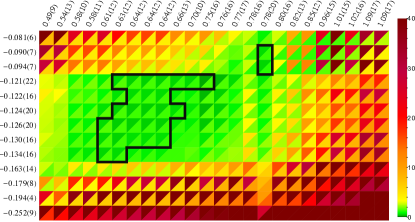
- 分散解における違反度を評価するために、$\left(\psi / \Delta\psi\right)^2$を計算し、オルソン和則との整合性をテストする。
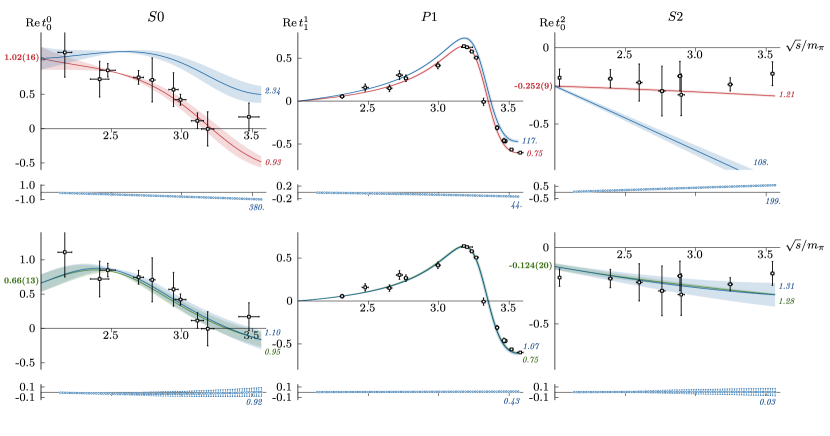
- $S0$および$S2$振幅パラメータ化の体系的スキャンを実施し、物理的制約およびメトリック制約をすべて満たすもののみを保持する。
- 最終的な一貫性のある分散振幅の集合から、$\sigma$極位置と残差を抽出する。特に、しきい値に近い仮想束縁状態の極に注目する。
実験結果
リサーチクエスチョン
- RQ1分散関係を用いることで、格子QCDにおける振幅パラメータ化の曖昧さに起因する$\sigma$極位置の系統的誤差を低減できるか?
- RQ2格子QCDにおける軽いクォーク質量を変化させたとき、$\sigma$共鳴状態は仮想束縁状態から広い共鳴状態へとどのように進化するか?
- RQ3$S0$および$S2$振幅パラメータ化のどの組み合わせが、交差対称性、ユニタリティ、およびオルソン和則を含むすべての物理的制約を満たすか?
- RQ4解析性と交差対称性を強制することで、複素エネルギー平面における$\sigma$極位置の分散の広がりにどのような影響が生じるか?
- RQ5$m_\pi \sim 239$ MeVにおいて、複数のパラメータ化が著しく異なる結果をもたらすという$\sigma$極位置の曖昧さが、分散的アプローチによって解消されるか?
主な発見
- 二回減算された分散関係の適用により、格子データからの$\sigma$極位置の系統的ばらつきが1桁以上低減され、最終的な誤差は統計誤差に支配されるようになった。
- メトリックカットとオルソン和則を満たすパラメータ化のわずかなサブセットのみが分散フィルタリングを通過したため、許容される形式に対して強い物理的制約があることが示された。
- $m_\pi \sim 283$ MeVでは、$\sigma$極が仮想束縁状態であることが判明し、主な解は複素エネルギー平面において$\pi\pi$しきい値のすぐ下に位置した。
- $m_\pi \sim 239$ MeVでも、$\sigma$極は依然として仮想束縁状態であったが、分散関係アプローチにより、制約なしのフィットで見られた大きな系統的散乱が排除された。
- 分散的アプローチにより、クォーク質量に伴う$\sigma$極の滑らかな進化が明らかになった。重い質量では束縁状態から、軽い質量では広い共鳴状態へと移行し、チャーミカル摂動論の予想と整合的であった。
- 極が左側のカットに近づくか、または一つの極に合体する場合にのみ、$\sigma$極の結合定数に大きな不確実性が生じることを確認し、極位置が特異点付近のパラメータ化に敏感であることを裏付けた。
より良い研究を、今すぐ始めましょう
論文の読解から最終レビューまで、研究時間を劇的に削減しましょう。
クレジットカード登録不要
このレビューはAIが作成し、人間の編集者が確認しました。