
[論文レビュー] Diffusion Cross-domain Recommendation
DiffCDRは拡散確率モデリングに基づくクロスドメイン推奨システムを導入し、豊富な補助ドメインからスパースなターゲットドメインへユーザー埋め込みを転送する。Diffusion ModuleとAlignment Moduleを用い、コールドスタートおよびウォームスタートの性能を達成する。
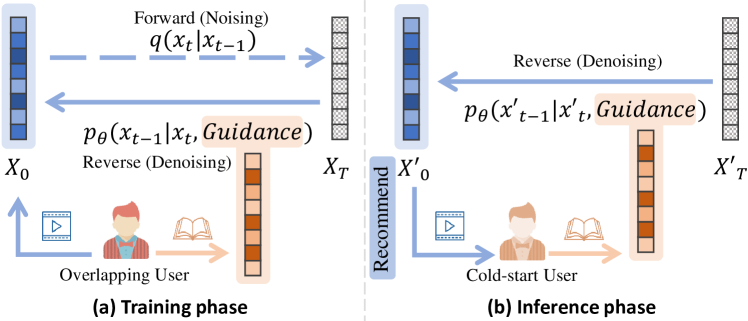
It is always a challenge for recommender systems to give high-quality outcomes to cold-start users. One potential solution to alleviate the data sparsity problem for cold-start users in the target domain is to add data from the auxiliary domain. Finding a proper way to extract knowledge from an auxiliary domain and transfer it into a target domain is one of the main objectives for cross-domain recommendation (CDR) research. Among the existing methods, mapping approach is a popular one to implement cross-domain recommendation models (CDRs). For models of this type, a mapping module plays the role of transforming data from one domain to another. It primarily determines the performance of mapping approach CDRs. Recently, diffusion probability models (DPMs) have achieved impressive success for image synthesis related tasks. They involve recovering images from noise-added samples, which can be viewed as a data transformation process with outstanding performance. To further enhance the performance of CDRs, we first reveal the potential connection between DPMs and mapping modules of CDRs, and then propose a novel CDR model named Diffusion Cross-domain Recommendation (DiffCDR). More specifically, we first adopt the theory of DPM and design a Diffusion Module (DIM), which generates user's embedding in target domain. To reduce the negative impact of randomness introduced in DIM and improve the stability, we employ an Alignment Module to produce the aligned user embeddings. In addition, we consider the label data of the target domain and form the task-oriented loss function, which enables our DiffCDR to adapt to specific tasks. By conducting extensive experiments on datasets collected from reality, we demonstrate the effectiveness and adaptability of DiffCDR to outperform baseline models on various CDR tasks in both cold-start and warm-start scenarios.
研究の動機と目的
- 補助ドメインデータを活用して、クロスドメイン推奨システムにおけるコールドスタートに対処する。
- 拡散ベースのマッピングモジュールを提案し、ドメイン間でユーザー埋め込みを転送する。
- Alignment Moduleでクロスドメイン転送を安定化させる。
- ターゲットドメインのラベルデータを取り入れて、拡散出力をタスク目標に合わせる。
- 実世界のAmazonドメインCDRタスクにおけるコールドスタートおよびウォームスタート設定での有効性を示す。
提案手法
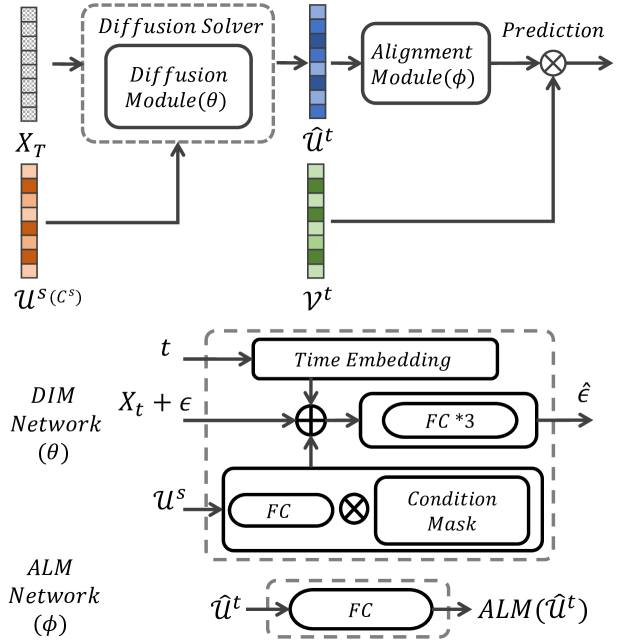
- Diffusion Module (DIM)を導入し、ソースドメイン埋め込みを条件に拡散を逆行させることでターゲットドメインのユーザー埋め込みを生成する。
- Alignment Module (ALM)を追加してランダム性を低減し、転送された埋め込みをターゲット埋め込みの真値と整合させる。
- DIM推論を効率化する高速な拡散ソルバーを使用する。
- 予測ノイズを真のノイズに一致させるDIM lossと、転送埋め込みをターゲットドメインの評価に結びつけるALM+タスク損失で訓練する。
- ALM出力とターゲットドメインの評価を組み合わせたタスク指向の損失を用いて特定のタスクへ適応する。
- DIM、ALM、およびタスク指向学習の寄与を分離するアブレーション研究を実施する。
実験結果
リサーチクエスチョン
- RQ1DiffCDRはコールドスタートおよびウォームスタート設定において、最先端のクロスドメインレコメンダーベースラインと比べてどう性能を示すか。
- RQ2DIMとALMの構成要素は性能にどう寄与するか、ターゲットラベルのタスク損失を含めるとどうなるか。
- RQ3拡散ベースの転送がクロスドメイン知識転送でなぜ改善をもたらすのか。
- RQ4DiffCDRの推論スループットは従来手法と比べてどうか。
主な発見
| Beta | CDR Task | Metric | TGT | CMF | EMCDR | SSCDR | LACDR | PTUPCDR | DiffCDR | Improve |
|---|---|---|---|---|---|---|---|---|---|---|
| 20% | Task1 Video → Music | MAE | 4.4546 | 1.4642 | 1.3596 | 1.1757 | 1.1295 | 1.1099 | 1.0435* | 6.0% |
| 20% | Task1 Video → Music | RMSE | 5.1338 | 1.9571 | 1.6615 | 1.4911 | 1.4358 | 1.4543 | 1.3840* | 3.6% |
| 20% | Task1 Video → Music | N@20 | 0.00253 | 0.00508 | 0.00977 | 0.00932 | 0.00984 | 0.00978 | 0.01026* | 4.3 % |
| 20% | Task1 Video → Music | H@20 | 0.00033 | 0.00084 | 0.00229 | 0.00212 | 0.00228 | 0.00236 | 0.00238* | 1.1 % |
| 50% | Task1 Video → Music | MAE | 4.4884 | 1.6710 | 1.6891 | 1.4320 | 1.3502 | 1.2842 | 1.2367* | 3.7% |
| 50% | Task1 Video → Music | RMSE | 5.1790 | 2.2076 | 2.0368 | 1.8248 | 1.7510 | 1.7340 | 1.6859* | 2.8% |
| 50% | Task1 Video → Music | N@20 | 0.00251 | 0.00403 | 0.00898 | 0.00793 | 0.00893 | 0.00828 | 0.00915* | 1.9% |
| 50% | Task1 Video → Music | H@20 | 0.00033 | 0.00068 | 0.00193 | 0.00164 | 0.00199 | 0.00179 | 0.00202* | 1.9% |
| 80% | Task1 Video → Music | MAE | 4.4959 | 2.2327 | 2.1980 | 1.8162 | 1.6886 | 1.6174 | 1.5606* | 3.5% |
| 80% | Task1 Video → Music | RMSE | 5.1830 | 2.8868 | 2.5713 | 2.3090 | 2.2238 | 2.2429 | 2.1754* | 2.2% |
| 80% | Task1 Video → Music | N@20 | 0.00248 | 0.00348 | 0.00622 | 0.00578 | 0.00606 | 0.00545 | 0.00665* | 6.9% |
| 80% | Task1 Video → Music | H@20 | 0.00033 | 0.00051 | 0.00124 | 0.00111 | 0.00124 | 0.00107 | 0.00136* | 9.7% |
| 20% | Task2 Book → Video | MAE | 4.1807 | 1.4742 | 1.1305 | 0.9774 | 0.9681 | 1.0728 | 0.9476* | 2.1% |
| 20% | Task2 Book → Video | RMSE | 4.7496 | 1.9180 | 1.4215 | 1.2356 | 1.2311 | 1.3745 | 1.2338* | -0.2% |
| 20% | Task2 Book → Video | N@20 | 0.00245 | 0.00578 | 0.01898 | 0.02066 | 0.01850 | 0.01821 | 0.02073 | 0.3% |
| 20% | Task2 Book → Video | H@20 | 0.00043 | 0.00124 | 0.0064 | 0.00676 | 0.0056 | 0.00594 | 0.00697* | 3.1% |
| 50% | Task2 Book → Video | MAE | 4.1951 | 1.5651 | 1.1863 | 1.0193 | 1.0077 | 1.1116 | 0.9953 | 1.2% |
| 50% | Task2 Book → Video | RMSE | 4.7693 | 2.0341 | 1.4993 | 1.3089 | 1.3051 | 1.4425 | 1.3155 | -0.8% |
| 50% | Task2 Book → Video | N@20 | 0.00274 | 0.00536 | 0.01924 | 0.02041 | 0.01875 | 0.01785 | 0.02047 | 0.3% |
| 50% | Task2 Book → Video | H@20 | 0.00044 | 0.00107 | 0.00642 | 0.00675 | 0.00535 | 0.00575 | 0.0068 | 0.7% |
| 80% | Task2 Book → Video | MAE | 4.2384 | 2.2379 | 1.3445 | 1.1469 | 1.1151 | 1.2072 | 1.0846* | 2.7% |
| 80% | Task2 Book → Video | RMSE | 4.8198 | 3.1740 | 1.6946 | 1.4871 | 1.4660 | 1.5968 | 1.4695 | -0.2% |
| 80% | Task2 Book → Video | N@20 | 0.00258 | 0.00412 | 0.01906 | 0.01949 | 0.01710 | 0.01520 | 0.01960 | 0.6% |
| 80% | Task2 Book → Video | H@20 | 0.00040 | 0.00073 | 0.00628 | 0.00636 | 0.00512 | 0.00484 | 0.00634 | -0.3% |
| 20% | Task3 Book → Music | MAE | 4.5190 | 1.7976 | 1.6425 | 1.3073 | 1.1945 | 1.2556 | 1.1220* | 6.1% |
| 20% | Task3 Book → Music | RMSE | 5.1838 | 2.3545 | 1.9873 | 1.6599 | 1.5771 | 1.6730 | 1.5390* | 2.4% |
| 20% | Task3 Book → Music | N@20 | 0.00196 | 0.00383 | 0.01193 | 0.01179 | 0.01367 | 0.01006 | 0.01374 | 0.5% |
| 20% | Task3 Book → Music | H@20 | 0.00035 | 0.00071 | 0.00323 | 0.00313 | 0.0037 | 0.00275 | 0.00382* | 3.2% |
| 50% | Task3 Book → Music | MAE | 4.4953 | 2.0002 | 1.9364 | 1.5183 | 1.3925 | 1.4304 | 1.3077* | 6.1% |
| 50% | Task3 Book → Music | RMSE | 5.1685 | 2.6001 | 2.2966 | 1.9467 | 1.8644 | 1.9475 | 1.8255* | 2.1% |
| 50% | Task3 Book → Music | N@20 | 0.00200 | 0.00341 | 0.00994 | 0.00964 | 0.01058 | 0.00804 | 0.01082* | 2.3% |
| 50% | Task3 Book → Music | H@20 | 0.00028 | 0.00059 | 0.00253 | 0.00247 | 0.00277 | 0.00206 | 0.00281* | 1.7% |
| 80% | Task3 Book → Music | MAE | 4.5133 | 2.5014 | 2.3448 | 1.8849 | 1.7107 | 1.7016 | 1.5871* | 6.7% |
| 80% | Task3 Book → Music | RMSE | 5.1960 | 3.1740 | 2.7035 | 2.3517 | 2.2468 | 2.3248 | 2.2110* | 1.6% |
| 80% | Task3 Book → Music | N@20 | 0.00170 | 0.00275 | 0.00705 | 0.00652 | 0.00658 | 0.00682 | 0.00722* | 2.3% |
| 80% | Task3 Book → Music | H@20 | 0.00027 | 0.00046 | 0.00176 | 0.00158 | 0.00165 | 0.00107 | 0.00179* | 1.6% |
- DiffCDRはコールドスタートおよびウォームスタートCDRタスクにおいて、Amazonデータセット上でCMF、EMCDR、SSCDR、LACDR、PTUPCDRなどのいくつかのベースラインを上回る。
- アブレーションにより、DIM、ALM、タスク指向学習の各要素が性能向上に寄与することが示された。
- DAT構成を完全に用いたDiffCDRは、複数タスクおよびコールドスタートレベルで最良の結果を達成し、 strongest baselines に対してMAE、RMSE、N@20、H@20で顕著な改善を示した。
- 高速DIMソルバーを用いると推論速度が大幅に向上し、精度の低下は小さかった。
- 可視化により、DiffCDRは他手法よりもターゲットドメインへユーザーファクターを一貫して転送することが示唆された。
より良い研究を、今すぐ始めましょう
論文設計から論文執筆まで、研究時間を劇的に削減しましょう。
クレジットカード登録不要
このレビューはAIが作成し、人間の編集者が確認しました。