
[論文レビュー] Diffusion Models for High-Resolution Solar Forecasts
本論文ではスコアベースの拡散モデルを用いて粗い数値天気予報を高解像度の確率的日射量予測へと超解像し、オアフ島の前日予報の雲量で実証している。
Forecasting future weather and climate is inherently difficult. Machine learning offers new approaches to increase the accuracy and computational efficiency of forecasts, but current methods are unable to accurately model uncertainty in high-dimensional predictions. Score-based diffusion models offer a new approach to modeling probability distributions over many dependent variables, and in this work, we demonstrate how they provide probabilistic forecasts of weather and climate variables at unprecedented resolution, speed, and accuracy. We apply the technique to day-ahead solar irradiance forecasts by generating many samples from a diffusion model trained to super-resolve coarse-resolution numerical weather predictions to high-resolution weather satellite observations.
研究の動機と目的
- Diffusion modelsを用いた高次元の天気変数の確率予測の動機付け。
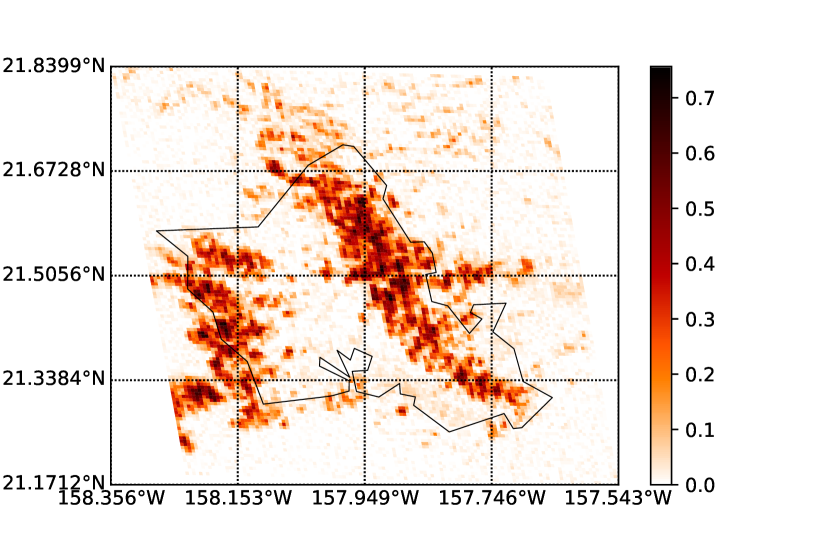
- 粗い数値天気予測の高解像度化を通じて衛星由来の雲量をスーパー解像することをデモンストレーション。
- オアフ島の日前日 solar forecast の不確実性と精度を定量化。
- 拡散モデルに基づくサンプルが現実的で多様かつ有用な予測分布を提供することを示す。
提案手法
- ERA5/GFS 大気 variables を条件とした二段階の拡散モデル(64x64 と 128x128)を用いる。
- 大気条件をフラットベクターとして注入した U-Net アーキテクチャ。
- 拡散モデルの学習には denoising score matching objective を用いる。
- 確率的予測を生成するために reverse-time ODE からサンプリングする。
- 衛星由来の雲量を用いた RMSE で ERA5 ベースラインと GFS ベースラインを評価する。
実験結果
リサーチクエスチョン
- RQ1スコアベースの拡散モデルは太陽関連変数の完全な確率的で高解像度の予測を提供できるか?
- RQ2粗い大気出力のスーパー解像はベースラインのダウンスケーリングより予測精度を改善するか?
- RQ3拡散モデルのサンプルは不確実性と空間パターン(地形起因の雲など)をオアフ島でどの程度捉えられるか?
主な発見
| 予測 | 天気モデル | 拡散 | 永続性 | ERA5 | GFS | p値 |
|---|---|---|---|---|---|---|
| 過去 | ERA5 | 0.207 ± 0.075 | 0.223 ± 0.090 | 0.362 ± 0.190 | — | <5×10^-4 |
| 未来(11時) | GFS | 0.198 ± 0.075 | 0.202 ± 0.089 | — | 0.358 ± 0.229 | 0.008 |
- 拡散モデルは歴史的予測で粗い ERA5 ベースラインより RMSE が低い(0.207 ± 0.075 vs. 0.362 ± 0.190, p < 5×10^-4)。
- 将来の11時予測を GFS で条件付けた場合、拡散モデルは粗い GFS ベースラインより RMSE が低い(0.198 ± 0.075 vs. 0.358 ± 0.229, p = 0.008)。
- より多くの拡散反復をサンプリングすると予測精度が向上する;歴史データには45件以上のサンプルを使用。
- サンプルは現実的で多様であり、サンプルの平均は入力された粗い予測よりも良い点推定を提供する。
- このアプローチは希少イベントのリスク評価やグリッド運用に適した迅速な確率的予測を可能にする。

より良い研究を、今すぐ始めましょう
論文設計から論文執筆まで、研究時間を劇的に削減しましょう。
クレジットカード登録不要
このレビューはAIが作成し、人間の編集者が確認しました。