
[論文レビュー] Direct observation of Floquet-Bloch states in monolayer graphene
本論文は、単層グラフェンにおける Floquet-Bloch 状態のエネルギー-運動量解像観測を、time- and angle-resolved photoemission spectroscopy (trARPES) を用いて直接報告し、偏光依存性が Floquet–Volkov カップリングを明らかにする replica バンドを示している。
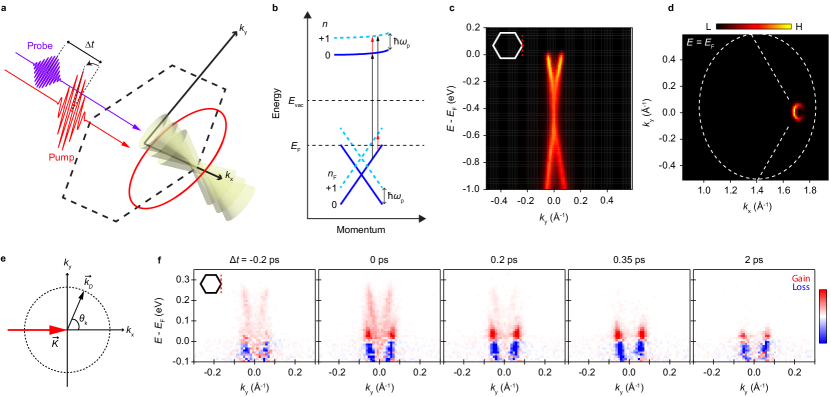
Floquet engineering is a novel method of manipulating quantum phases of matter via periodic driving [1, 2]. It has successfully been utilized in different platforms ranging from photonic systems [3] to optical lattice of ultracold atoms [4, 5]. In solids, light can be used as the periodic drive via coherent light-matter interaction. This leads to hybridization of Bloch electrons with photons resulting in replica bands known as Floquet-Bloch states. After the direct observation of Floquet-Bloch states in a topological insulator [6], their manifestations have been seen in a number of other experiments [7-14]. By engineering the electronic band structure using Floquet-Bloch states, various exotic phase transitions have been predicted [15-22] to occur. To realize these phases, it is necessary to better understand the nature of Floquet-Bloch states in different materials. However, direct energy and momentum resolved observation of these states is still limited to only few material systems [6, 10, 14, 23, 24]. Here, we report direct observation of Floquet-Bloch states in monolayer epitaxial graphene which was the first proposed material platform [15] for Floquet engineering. By using time- and angle-resolved photoemission spectroscopy (trARPES) with mid-infrared (mid-IR) pump excitation, we detected replicas of the Dirac cone. Pump polarization dependence of these replica bands unequivocally shows that they originate from the scattering between Floquet-Bloch states and photon-dressed free-electron-like photoemission final states, called Volkov states. Beyond graphene, our method can potentially be used to directly observe Floquet-Bloch states in other systems paving the way for Floquet engineering in a wide range of quantum materials.
研究の動機と目的
- 固体中の量子相を操作するルートとして Floquet 工学を動機づけ、特にグラフェンにおいてそうする。
- 単層グラフェンにおける Floquet-Bloch 状態のエネルギー-運動量解像観測を直接実証する。
- ポンプの偏光依存性を通じて Floquet-Bloch の寄与と Volkov 最終状態効果を区別する。
- 偏光回転下での replica-band の進化を解釈するための単純な解析モデルを開発・適用する。
提案手法
- ミッドインファレッドポンプ(246 meV)と26.4 eVプローブを用いた time- and angle-resolved photoemission spectroscopy (trARPES) でグラフェンの replica ディラックコーンを観測する。
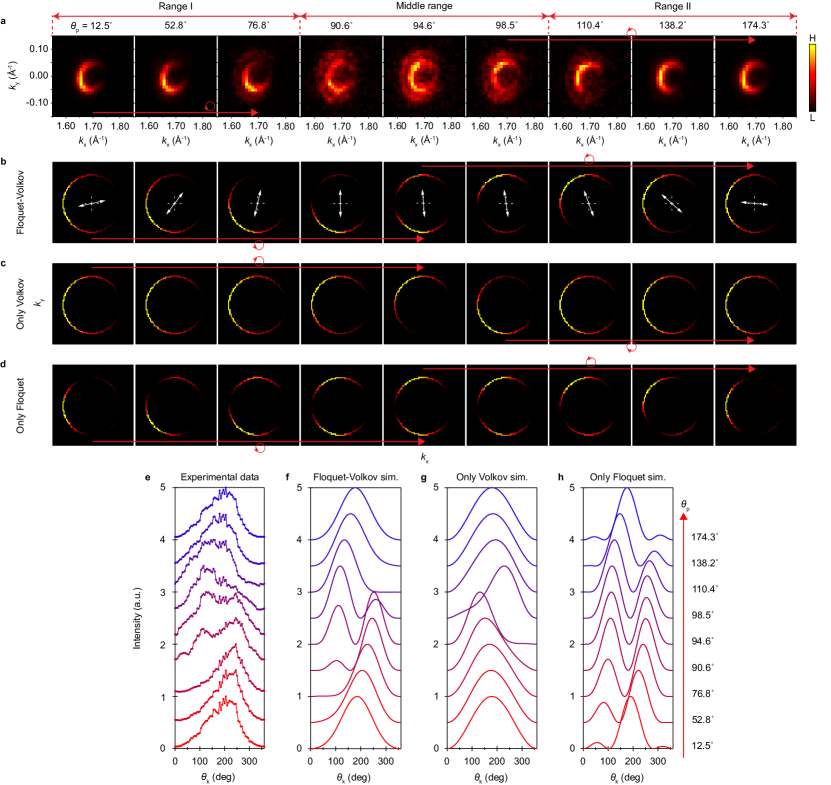
- ポンプ偏光を回転させてk空間で replica バンドの進化を追跡するように ARPES スペクトルを記録する。
- 実験的な偏光依存の replica-band の進化を、Floquet–Volkov カップリング、のみ Volkov 状態、のみ Floquet 状態という三つのシナリオに基づくシミュレーションと比較する。
- replica 強度 P1 が |M|^2 |γ|^2 に比例する散乱行列形式を用い、γ は Floquet および Volkov 相互作用パラメータ(α, β)をコード化する。
- ポンプ入射角と面内ベクトルポテンシャルを取り入れて γ とそれに起因する replica-band のダイナミクスをモデル化する(γ の方程式と関連項)。
- 前の研究に触発された解析モデルを用いて Floquet-Bloch の寄与と Volkov 効果を区別する。
実験結果
リサーチクエスチョン
- RQ1中赤外励起を伴う trARPES を用いて単層グラフェンで Floquet-Bloch 状態を直接観測できるか。
- RQ2観測された replica バンドは Floquet-Bloch 状態、Volkov 状態、またはそれらの結合に起因するか(ポンプ偏光依存性によって示される)?
- RQ3ポンプの偏光は replica バンドの進化にどう影響し、Floquet–Volkov 相互作用について何を意味するのか。
主な発見
- 中間赤外励起後、グラフェンに replica ディラックコーンのレプリカが現れ、フォトンでドレスアップされた状態を示唆している。
- ポンプ偏光回転による replica バンドの進化は Volkov 状態だけでは説明できず、Floquet–Volkov 散乱と整合する。
- Floquet-Bloch と Volkov 結合モデルは、偏光依存の弧の回転と二つの弧の共存とを再現し、実験的傾向と一致する。
- 純粋な Floquet または純粋な Volkov のシナリオでは、偏光角度全体にわたる replica バンドの進化を捉えきれない。
- 本結果はグラフェンにおける Floquet-Bloch 状態の直接的証拠を提供し、Floquet 工学を他の材料へ拡張する枠組みを提示する。
より良い研究を、今すぐ始めましょう
論文設計から論文執筆まで、研究時間を劇的に削減しましょう。
クレジットカード登録不要
このレビューはAIが作成し、人間の編集者が確認しました。