
[論文レビュー] Dis-inhibitory neuronal circuits can control the sign of synaptic plasticity
本論文は、上位から下位への抑制解除回路が誤差信号を符号化し、シナプス可塑性の符号を制御する生物学的に妥当な学習ルールを提案する。再帰的抑制に依存するハイブ型ルールを導出することで、明示的な誤差ニューロンを必要とせず勾配ベースの学習を自然に実装し、視覚ベンチマークにおいてバックプロパゲーションと同等の性能を達成するとともに、機能的理論と実験的可塑性ルールの両者を調和させる。
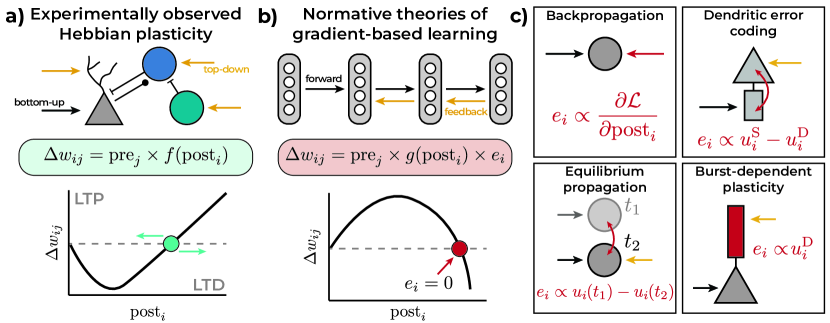
How neuronal circuits achieve credit assignment remains a central unsolved question in systems neuroscience. Various studies have suggested plausible solutions for back-propagating error signals through multi-layer networks. These purely functionally motivated models assume distinct neuronal compartments to represent local error signals that determine the sign of synaptic plasticity. However, this explicit error modulation is inconsistent with phenomenological plasticity models in which the sign depends primarily on postsynaptic activity. Here we show how a plausible microcircuit model and Hebbian learning rule derived within an adaptive control theory framework can resolve this discrepancy. Assuming errors are encoded in top-down dis-inhibitory synaptic afferents, we show that error-modulated learning emerges naturally at the circuit level when recurrent inhibition explicitly influences Hebbian plasticity. The same learning rule accounts for experimentally observed plasticity in the absence of inhibition and performs comparably to back-propagation of error (BP) on several non-linearly separable benchmarks. Our findings bridge the gap between functional and experimentally observed plasticity rules and make concrete predictions on inhibitory modulation of excitatory plasticity.
研究の動機と目的
- 勾配ベースの学習に関する規範的理論と脳における現象的ハイブ型可塑性ルールとの間にある矛盾を解消すること。
- 誤差信号が明示的な局所的誤差ニューロンではなく、上位からの抑制解除入力に符号化される仕組みを示すこと。
- 実験的に観察された可塑性ダイナミクスを説明できるとともに、深層ネットワークにおける有効なクレジット割り当てを可能にする生物学的に妥当な学習ルールを開発すること。
- 抑制依存型可塑性がランラムハイブ型学習を安定化させ、非線形分離不能なタスクを処理できることを示すこと。
提案手法
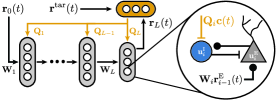
- 著者らは、上位からの入力が抑制性インターニューロンを標的とし、興奮を調整する抑制解除マイクロサーキットモチーフに、Deep Feedback Control(DFC)フレームワークを拡張した。
- 抑制性電流に明示的な依存関係を持つハイブ型可塑性ルールを導出し、抑制解除フィードバックによって可塑性の符号を制御できるようにした。
- ネットワークのヤコビアンからフィードバック重みを計算する制御理論フレームワークを用い、生物学的妥当性を高めるために即時のおよび平均ヤコビアンに基づくフィードバックを併用した。
- 数値シミュレーションでは、動的方程式を平衡状態まで解くために、ステップサイズを適応的に制御するTsitourasの5次ルンゲ=クッタ法を用い、その後ADAM最適化アルゴリズムで重みを更新した。
- 分類タスクでは、ソフトマックスの飽和を避けるために、正解クラスに0.99、他のクラスに0.01/(n−1)のソフトターゲットを用いた線形出力層と交差エントロピー損失を採用した。
- フィードバック重みは正規化ヤコビアンとして計算され、生物学的妥当性を検証するために、入力依存型および平均ヤコビアンの両方のバリアントをテストした。
実験結果
リサーチクエスチョン
- RQ1抑制解除マイクロサーキットは、明示的な誤差ニューロンを必要とせず、自然に誤差信号を符号化し、シナプス可塑性の符号を制御できるか?
- RQ2抑制依存型ハイブ型可塑性ルールは、実験的条件下で観察された可塑性ダイナミクスを再現できるか?
- RQ3このようなルールは、深層ネットワークにおいてバックプロパゲーションと同等の性能を達成できるか?
- RQ4この学習ルールは安定しており、非線形分離不能なタスクを処理できるか?
主な発見
- 抑制解除学習ルールは、正確な逆数フィードバック則を用いた3層ネットワークでMNISTにおいて97.5±0.19%の検証精度を達成し、バックプロパゲーションの98.2±0.14%と同等の性能を示した。
- 平均ヤコビアンフィードバックを用いることで、3層MNISTで96.9±1.6%の精度を達成し、生物学的に不実用的とされる入力依存型フィードバックに対しても頑健であることを示した。
- Fashion-MNISTでは、正確な逆数フィードバックを用いて90.0±0.38%の精度を達成し、同じタスクでバックプロパゲーションの90.3±0.34%と同等の性能を示した。
- 抑制依存型学習により、ランラムハイブ型可塑性が安定化され、制御不能な重みの増大が防止された。
- 導出された学習ルールは、模擬実験条件下で現象的可塑性モデルと定性的に一致し、文献における重要な不一致を解消した。
- このフレームワークは、特定のインターニューロンへの上位からの抑制解除入力が興奮性可塑性をゲート可能であると予測し、実験的検証が可能な仮説を提示した。
より良い研究を、今すぐ始めましょう
論文の読解から最終レビューまで、研究時間を劇的に削減しましょう。
クレジットカード登録不要
このレビューはAIが作成し、人間の編集者が確認しました。