
[論文レビュー] Discovery of the missing intermediate-mass helium stars stripped in binaries
本論文は、大・小マゼラン雲における過剰な紫外線発光を用いて、二重星相互作用によって水素殻が剥がれた中質量ヘリウム星(2–8 M⊙)という長年にわたって探求されてきた星の集団を同定した。高温(60–100 kK)、高表面重力(log g ≈ 5)、および径速度変動を示す25個のシステムの確認により、それらの存在が裏付けられ、質量関数の高い星の進化モデルにおける重要な空白が埋められた。
The theory of binary evolution predicts that many massive stars should lose their hydrogen-rich envelopes via interaction with a companion -- revealing hot helium stars with masses of $\sim$2--8M$_{\odot}$. However, only one candidate system had been identified, leaving a large discrepancy between theory and observation. Here, we present a new sample of stars -- identified via excess ultraviolet emission -- whose luminosities, colors, and spectral morphologies are consistent with predictions for the missing population. We detect radial velocity variations indicative of binary motion and measure high temperatures ($T_{ m eff}\sim60-100$kK), high surface gravities ($\log(g)\sim5$) and depleted surface hydrogen mass fractions ($X_{ m{H,surf}}\lesssim0.3$), which match expectations for stars with initial masses between 8--25 M$_{\odot}$ that have been stripped via binary interaction. These systems fill the helium star mass gap between subdwarfs and Wolf-Rayet stars, and are thought to be of large astrophysical significance as ionizing sources, progenitors of stripped-envelope supernovae and merging double neutron stars.
研究の動機と目的
- 二重星進化理論と観測結果の間にある長年の不一致に取り組む。理論的には、二重星相互作用によって水素殻が剥がれた中質量ヘリウム星(2–8 M⊙)が多数存在すると予測されていたが、観測された候補は1例にとどまっていた。
- これらの星を検出する際の観測バイアスを克服する。これらはしばしば明るい主系列星の同伴に覆い隠され、弱い風特徴を示すためである。
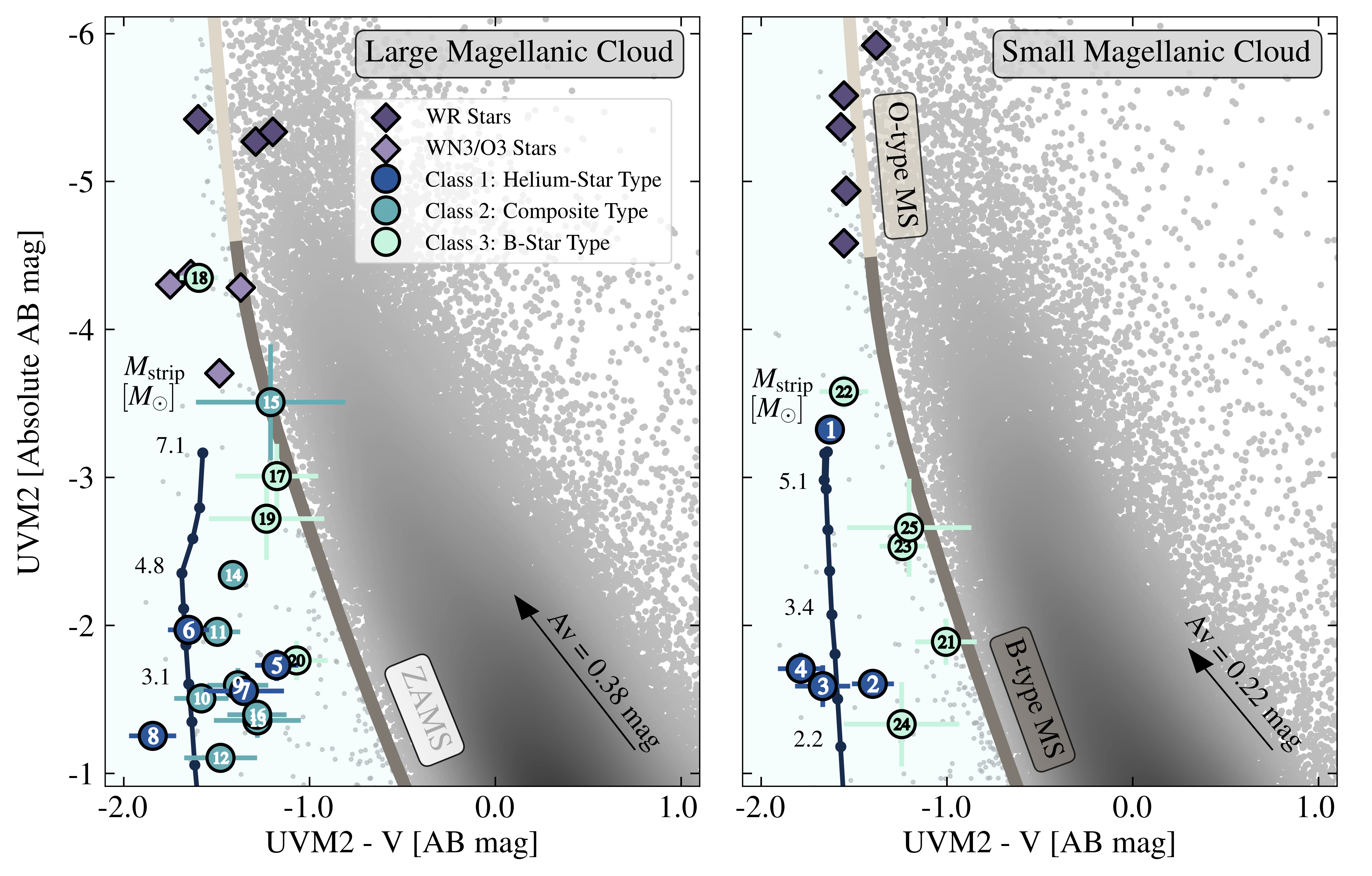
- 二重星系に剥がれたヘリウムコアを有するシステムを分離するために、UV-光学カラーマグニチュード図における過剰な紫外線発光を用いた新しい検出手法を特定する。
- 初期質量8–25 M⊙の質量関数の高い星が二重星相互作用によって剥がれ、ヘリウムコアを形成した星の集団が、低質量の亜超巨星と高質量のWolf-Rayet星の間の空白を埋めることを確認する。
- これらの星が、剥がれ殻超新星および合体する二重中性子星の前身星としての天体物理学的意義を確立し、硬い電離放射線を放出する源であることを示す。
提案手法
- 大・小マゼラン雲(LMC/SMC)に対して、Swift-UVOTを用いた深紫外光度測定を実施。3つの紫外フィルター(1928–2600 Å)を用い、約39 deg²の領域を2.5″の分解能でカバーした。
- マゼラン雲光度測定調査の既知の星位置を基に、The Tractorを用いた前向きモデリングを実施し、PSF強制光度測定を実行することで、混雑した領域における源抽出を向上させた。
- UV-光学カラーマグニチュード図における位置を基に候補システムを同定した。主系列の左に位置し、中程度の明るさ(−1 mag > M_UV > −4 mag)であることは、中質量ヘリウム星を有する二重星系の特徴である。
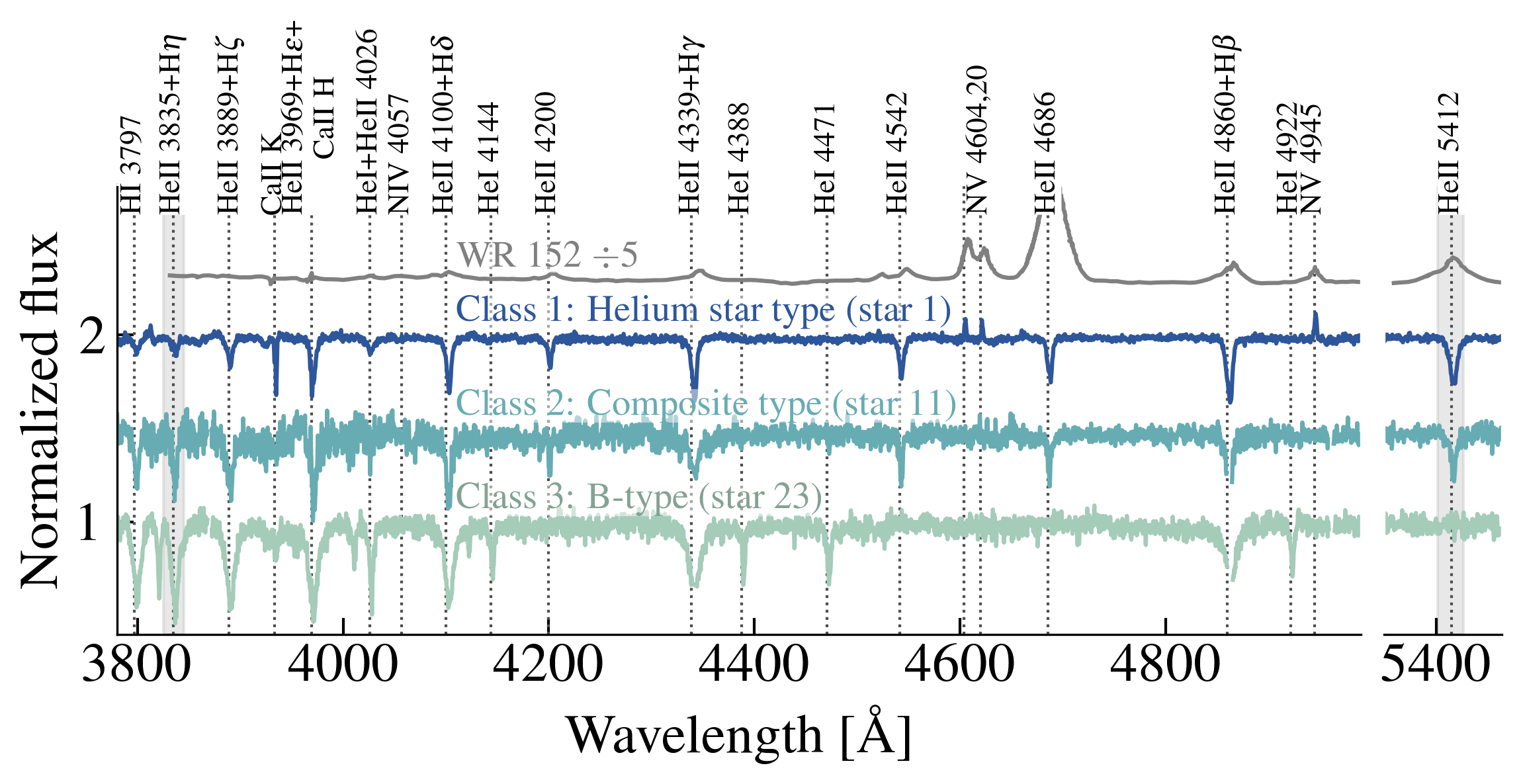
- 6.5mマゼラン・バーデス望遠鏡に搭載されたMagE分光計を用いて、各システムに対して1~30回の分光観測を実施し、径速度を測定し、二重星運動を確認した。
- Gaia DR3のアストロメトリー(視 parallax および固有運動)を用いて、径速度の一貫性と3次元運動を検証し、前景の混入星を除外した。
- 剥がれた星+主系列星の二重星系の理論スペクトルを合成し、UV-光学カラーマップを予測し、探索をガイドした。
実験結果
リサーチクエスチョン
- RQ1なぜ、理論的にも広く予測されていた二重星相互作用によって剥がれた中質量ヘリウム星(2–8 M⊙)の集団が、長年にわたり観測されていなかったのか?
- RQ2UV-光学カラーマグニチュード図における過剰な紫外線発光が、中質量ヘリウム星を有する二重星系を特定するための信頼できる診断指標として機能するか?
- RQ3径速度変動およびマゼラン雲星の運動学的一致性は、候補システムの二重星性および距離を確認するものか?
- RQ4これらの候補星の物理的性質(温度、重力、表面組成)は、初期質量8–25 M⊙の前身星から予測される剥がれ星のものと一致するか?
- RQ5これらの星が、電離放射線生成、剥がれ殻超新星、二重中性子星形成といった重要な天体物理学的プロセスにどの程度寄与しているか?
主な発見
- 過剰なUV発光、明るさ、色、スペクトル形態が中質量ヘリウム星(2–8 M⊙)の特徴と一致する25件の候補システムを同定した。これらは二重星相互作用によって水素殻が剥がれたものである。
- 複数の分光的エポックを持つ16件のシステムすべてで径速度変動を確認し、二重星性および軌道運動を裏付けた。
- 効果的温度60–100 kK、表面重力log g ≈ 5を測定し、高温でコンactなヘリウムコアの特徴と一致した。
- 表面水素質量分率が著しく低下(X_H,surf ≲ 0.3)しており、ヘリウムコア支配と二重星相互作用による剥がれが確認された。
- Gaia DR3を用いた運動学的分析により、25件中23件のシステムが、LMCおよびSMCに属するO型・B型星と一致する3次元運動を示した。これにより、マゼラン雲への所属が支持された。
- 低質量亜超巨星(≲1.5 M⊙)と高質量Wolf-Rayet星(≳8 M⊙)の間の重要な質量ギャップが埋められ、長年の質量関数の高い星の進化モデルにおける不一致が解消された。
より良い研究を、今すぐ始めましょう
論文の読解から最終レビューまで、研究時間を劇的に削減しましょう。
クレジットカード登録不要
このレビューはAIが作成し、人間の編集者が確認しました。