
[論文レビュー] Disk settling and dynamical heating: histories of Milky Way-mass stellar disks across cosmic time in the FIRE simulations
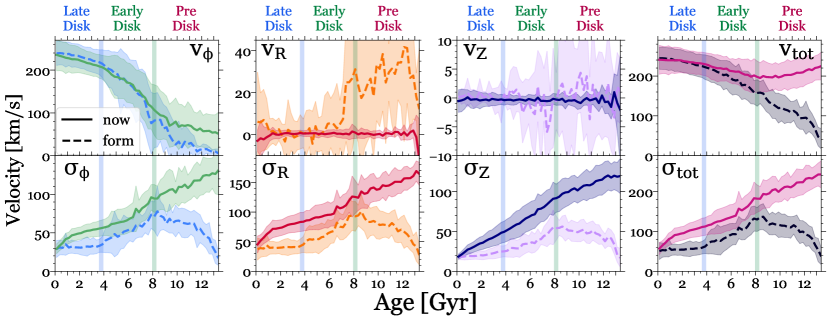
本研究では、FIRE-2宇宙論的シミュレーションを用いて、銀河系質量星ディスクの運動学的進化を、ディスクの安定化(宇宙論的進化)と形成後ダイナミカル加熱の違いに注目して分析している。星形成は3つの時代に分けられる:湍流的なディスク形成前期(σ_formが約8 Gyr前にピークに)、高分散を示す初期ディスク期、そして冷たい形成を示す後期ディスク期。特に重要なのは、10 Gyr未満の星では現在の速度分散の大部分が形成時に既に獲得されており、形成後の加熱は主に若い星の径方向分散を増加させることである。
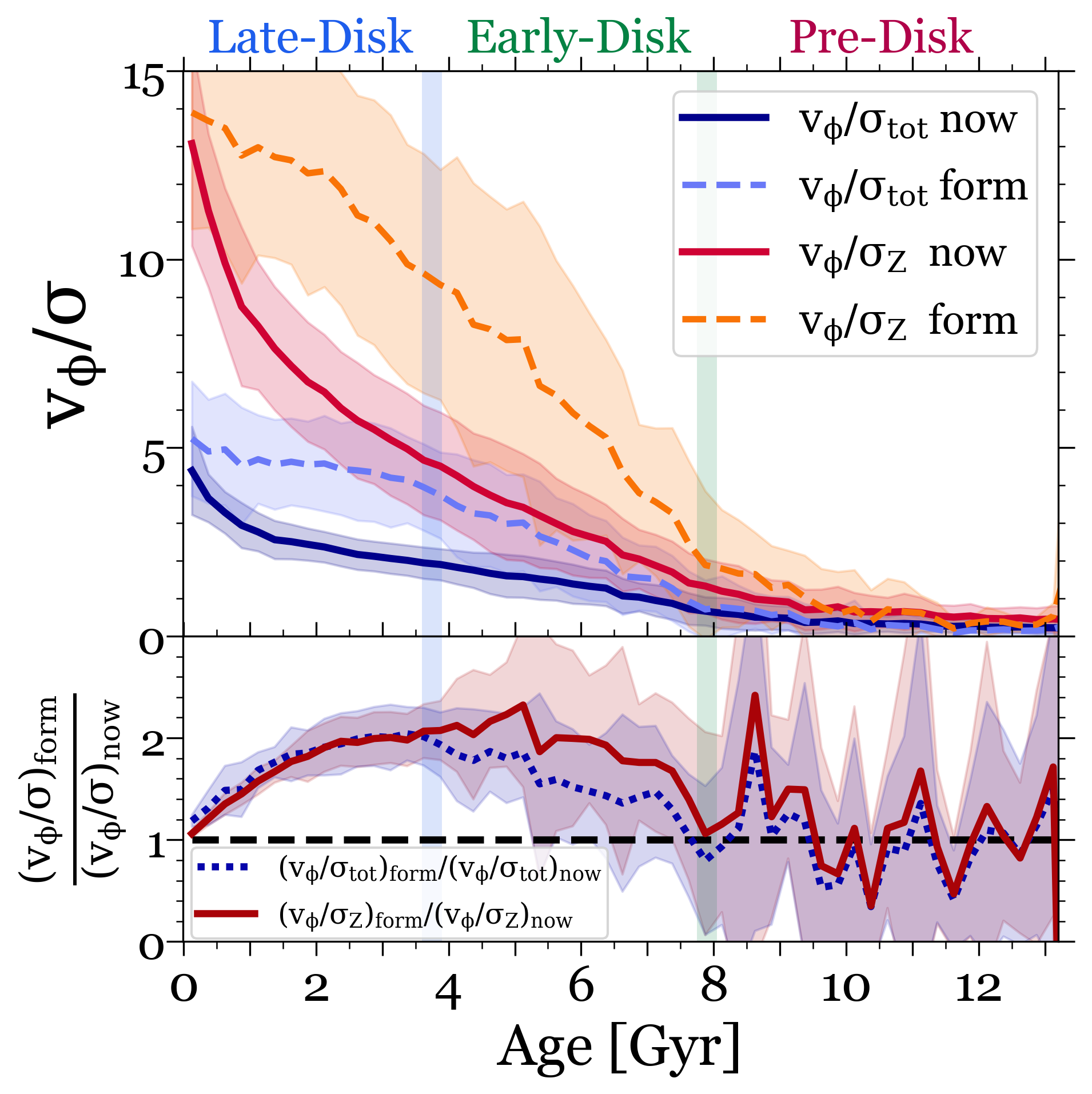
We study the kinematics of stars both at their formation and today within 14 Milky Way (MW)-mass galaxies from the FIRE-2 cosmological zoom-in simulations. We quantify the relative importance of cosmological disk settling and post-formation dynamical heating. We identify three eras: a Pre-Disk Era (typically >8 Gyr ago), when stars formed on dispersion-dominated orbits; an Early-Disk Era (~ 8 - 4 Gyr ago), when stars started to form on rotation-dominated orbits but with high velocity dispersion, sigma_form; and a Late-Disk Era (< 4 Gyr ago), when stars formed with low sigma_form. sigma_form increased with time during the Pre-Disk Era, peaking ~ 8 Gyr ago, then decreased throughout the Early-Disk Era as the disk settled and remained low throughout the Late-Disk Era. By contrast, the velocity dispersion measured today, sigma_now, increases monotonically with age because of stronger post-formation heating for Pre-Disk stars. Importantly, most of sigma_now was in place at formation, not added post-formation, for stars younger than ~ 10 Gyr. We compare the evolution of the three velocity components: at all times, sigma_R,form > sigma_phi,form > sigma_Z,form. Post-formation heating primarily increased sigma_R at ages < 4 Gyr but acted nearly isotropically for older stars. The kinematics of young stars in FIRE-2 broadly agree with the range observed across the MW, M31, M33, and PHANGS-MUSE galaxies. The lookback time that the disk began to settle correlates with its dynamical state today: earlier-settling galaxies currently form colder disks. Including stellar cosmic-ray feedback does not significantly change disk rotational support at fixed stellar mass.
研究の動機と目的
- 銀河系質量星ディスクの運動学的特性に及ぼす宇宙論的ディスク安定化と形成後ダイナミカル加熱の寄与を解明すること。
- 高解像度シミュレーションにおいて、形成時の速度分散(σ_form)と現在の速度分散(σ_now)が宇宙時間に伴ってどのように進化するかを定量化すること。
- シミュレートされた星の運動学と、銀河系、M31、M33、PHANGS-MUSE銀河の観測結果を比較し、シミュレーションの現実性を評価すること。
- 初期ディスク安定化が今日の冷たいディスクと相関しているか、また星の宇宙線フィードバックが回転支持に与える影響を調査すること。
- 観測されたディスク運動学的特性が初期条件に起因するのか、それとも後のダイナミカルプロセス(特に古い金属貧乏星の場合)に起因するのかを特定すること。
提案手法
- 星形成、フィードバック、宇宙論的進化を含むフル物理を備えた14個の高解像度FIRE-2宇宙論的ズームインシミュレーションを用い、銀河系質量銀河の解析に使用した。
- 個々の星を形成から現在まで追跡し、形成時の速度分散(σ_form)と現在の分散(σ_now)を測定することで、形成後加熱の影響を分離した。
- 軌道的ダイナミクスと分散の進化に基づき、星形成を3つの時代に分類した:ディスク前期(8 Gyr以上前)、初期ディスク期(8〜4 Gyr前)、後期ディスク期(4 Gyr以内前)。
- 径方向、方位方向、垂直方向の3つの速度成分を別々に分析し、加熱の非等方性を評価した。形成時における分散は σ_R,form > σ_φ,form > σ_Z,form を示した。
- σ_now と σ_form を比較することで、形成後加熱の影響を定量化した。古星では等方的加熱、若星では径方向に偏った加熱が見られた。
- シミュレートされた運動学と観測銀河(MW、M31、M33、PHANGS-MUSE)を比較し、星の宇宙線フィードバックを含めた場合の回転支持への影響を検証した。
実験結果
リサーチクエスチョン
- RQ1銀河系質量銀河において、形成時の速度分散(σ_form)は宇宙時間に伴ってどのように変化するのか。その変動を引き起こす要因は何か?
- RQ2現在の星の速度分散(σ_now)は、初期条件(σ_form)に起因する割合がどの程度で、形成後ダイナミカル加熱の寄与はどれほどか?
- RQ3ディスク前、初期ディスク、後期ディスクの各時代に形成された星の運動学的特性(σ_form と σ_now)は、どのように比較できるか?
- RQ4ディスク安定化の時期と今日のディスクの冷たさ(低σ_now)には相関があるのか。この相関はシミュレーション全体にわたって一貫性があるか?
- RQ5銀河系に観測された古い金属貧乏星の運動学的挙動は、主に形成時の初期条件に起因するのか、それとも後の合体や非対称性によるトルクに起因するのか?
主な発見
- 形成時の速度分散(σ_form)は約8 Gyr前にディスク前時代にピークに達し、その後ディスクの安定化に伴い低下した。後期ディスク時代にはσ_formは低く保たれた。
- 10 Gyr未満の星では、現在の速度分散(σ_now)の大部分が形成時に既に獲得されており、形成後加熱がその運動学的特性にほとんど寄与していないことが示された。
- 形成後加熱は年齢とともにσ_nowを単調に増加させ、4 Gyr未満の星では主に径方向分散(σ_R)に影響を与えたが、古星ではほぼ等方的加熱が見られた。
- 形成時、速度分散はσ_R,form > σ_φ,form > σ_Z,form の順序を示し、湍流的なISMにおける非等方的初期条件を示した。
- 早期に安定化した銀河は今日、より冷たいディスクを示しており、早期のディスク安定化と低σ_nowの強い相関が確認された。
- シミュレーションに星の宇宙線フィードバックを含めても、固定された星質量におけるディスクの回転支持に顕著な変化はなく、これはディスク運動学的特性において支配的要因ではないことを示唆した。
より良い研究を、今すぐ始めましょう
論文の読解から最終レビューまで、研究時間を劇的に削減しましょう。
クレジットカード登録不要
このレビューはAIが作成し、人間の編集者が確認しました。