
[論文レビュー] DUVET: sub-kiloparsec resolved star formation driven outflows in a sample of local starbursting disk galaxies
この論文は、Keck/KCWIを用いて局所的に星形成が活発なディスク銀河10個におけるアウトフローをサブキロパーセク解像で測定し、アウトフロー特性が局所のSFRと星質量表面密度にどのようにスケールするかを確立します。
We measure resolved (kiloparsec-scale) outflow properties in a sample of 10 starburst galaxies from the DUVET (Deep near-UV observations of Entrained gas in Turbulent galaxies) sample, using Keck/KCWI observations of H$β$ and [OIII]~$λ$5007. We measure $\sim460$ lines-of-sight that contain outflows, and use these to study scaling relationships of outflow velocity ($v_{ m out}$), mass-loading factor ($η$; mass outflow rate per SFR) and mass flux ($\dotΣ_{ m out}$; mass outflow rate per area) with co-located SFR surface density ($Σ_{ m SFR}$) and stellar mass surface density ($Σ_{\ast}$). We find strong, positive correlations of $\dotΣ_{ m out} \propto Σ_{ m SFR}^{1.2}$ and $\dotΣ_{ m out} \propto Σ_{\ast}^{1.5}$. We also find shallow correlations between $v_{ m out}$ and both $Σ_{ m SFR}$ and $Σ_{\ast}$. Our resolved observations do not suggest a threshold in outflows with $Σ_{ m SFR}$, but rather we find that the local specific SFR ($Σ_{ m SFR}/Σ_\ast$) is a better predictor of where outflows are detected. We find that outflows are very common above $Σ_{ m SFR}/Σ_\ast\gtrsim 0.1$~Gyr$^{-1}$ and rare below this value. We argue that our results are consistent with a picture in which outflows are driven by supernovae, and require more significant injected energy in higher mass surface density environments to overcome local gravity. The correlations we present here provide a statistically robust, direct comparison for simulations and higher redshift results from JWST.
研究の動機と目的
- 局所的で高SFRのサンプルのアウトフロー特性を分解して測定することにより、星形成駆動アウトフローがディスクをどのように制御するかを動機づけ、制約を与える。
- アウトフローの質量流量と速度が局所の星形成率表面密度(Sigma_SFR)および星質量表面密度(Sigma_*)に対してどのようにスケールするかを定量化する。
- Sigma_SFRの閾値がアウトフローを支配するかを評価し、局所でのアウトフロー出現の最良の予測因子を特定する。
- 観測されたスケーリング関係を、超新星駆動-対する放射駆動アウトフローモデルおよびシミュレーションと比較する。
提案手法
- サブ角秒分解能で、正面視のDUVET銀河10個に対してKCWI赤側の積分場データを取得する。
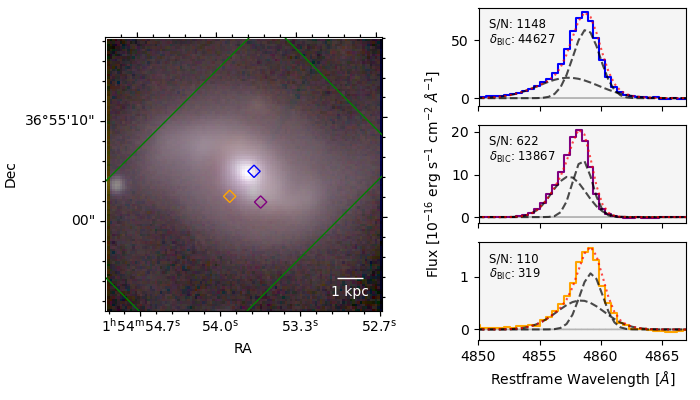
- spaxelごとにHβおよび [OIII] 5007 の放射を単一・二重ガウスでフィットし、BIC基準を用いてアウトフロー成分を同定する。
- gaussianフィットから v_out を |v_narrow−v_broad|+2σ_broadとして計算し、必要に応じて機器分散と銀河の傾斜を補正する。
- 塗抹修正済みHβ および Hα/Hβスケーリングから spaxelごとにSFRを導出し、局所的なSFRおよび星質量表面密度を計算する。
- 直交距離回帰を用いて dotΣ_out, η, v_out の Σ_SFR および Σ_* へのべき乗スケーリングを調べる。
実験結果
リサーチクエスチョン
- RQ1アウトフロー特性(速度、質量流量、質量負荷)と局所のガス/星形成特性(Σ_SFR、Σ_*)との解像された関係はどうなるか?
- RQ2星形成の盛んなディスクの局所領域は、Σ_SFRに対するアウトフロー駆動効率に閾値を示すか、それとも連続的な傾向を示すか?
- RQ3これら銀河において、アウトフローの有無と強さを最もよく予測する局所パラメータは何か?
- RQ4観測されたスケーリング関係は、エネルギー駆動対運動量駆動のアウトフローモデルおよびシミュレーションとどう比較されるか?
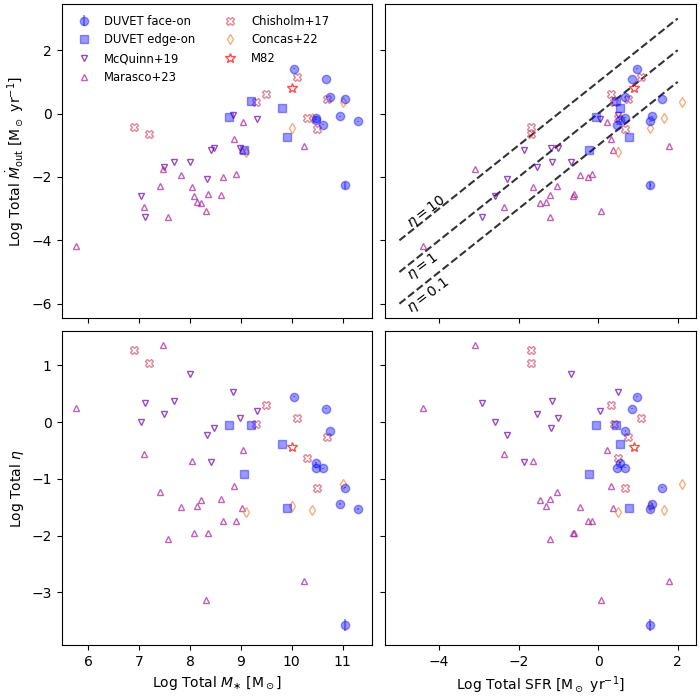
- RQ5解像された局所測定は、文献の全球的な銀河アウトフロ relation とどう比較されるか?
主な発見
- DotΣ_out は Σ_SFR に対して、塗抹修正済みで約 Σ_SFR^1.2、補正なしでは約 Σ_SFR^1.0–1.25(方法による)にスケールする。
- DotΣ_out は Σ_* に対しても、塗抹修正済みで約 Σ_*^1.7 にスケールする。
- v_out は Σ_SFR および Σ_* の両方に対して浅い依存を示し、強い閾値は見られない。
- 局所の特定SFR(Σ_SFR/Σ_*)は、アウトフロー検出の予測因子として、単独の Σ_SFR よりも優れている。
- Σ_SFR/Σ_* ≳ 0.1 Gyr^-1 を上回る領域でアウトフローは一般的であり、この値を下回ると稀である。
- 結果は局所の重力を超えるために高い表面密度環境を必要とする超新星駆動アウトフロー像を支持し、定量的スケーリングはシミュレーションやJWST時代の比較に利用できる。
より良い研究を、今すぐ始めましょう
論文設計から論文執筆まで、研究時間を劇的に削減しましょう。
クレジットカード登録不要
このレビューはAIが作成し、人間の編集者が確認しました。