
[論文レビュー] Dynamic Field of View Reduction Related to Subjective Sickness Measures in an HMD-based Data Analysis Task
本論文は HMD タスクにおける健康状態駆動の視野角(FoV)削減を試験し、 cybersickness の有意な低減やプレゼンスの変化を示さなかったが、 drastic FoV shift で探索が増加したことを示す。
Various factors influence the degree of cybersickness a user can suffer in an immersive virtual environment, some of which can be controlled without adapting the virtual environment itself. When using HMDs, one example is the size of the field of view. However, the degree to which factors like this can be manipulated without affecting the user negatively in other ways is limited. Another prominent characteristic of cybersickness is that it affects individuals very differently. Therefore, to account for both the possible disruptive nature of alleviating factors and the high interpersonal variance, a promising approach may be to intervene only in cases where users experience discomfort symptoms, and only as much as necessary. Thus, we conducted a first experiment, where the field of view was decreased when people feel uncomfortable, to evaluate the possible positive impact on sickness and negative influence on presence. While we found no significant evidence for any of these possible effects, interesting further results and observations were made.
研究の動機と目的
- 動的で健康状態に基づく FoV 減少が、HMD ベースのデータ分析タスクにおいてプレゼンスを損なうことなく cybersickness を低減できるかを探る。
- 自己申告による幸福感に基づく大幅な FoV 減少を適用する際の実現可能性とユーザー認識を評価する。
- 動的 FoV 条件下で主観的な sickness 指標、プレゼンス、およびタスク遂行の相関を調査する。
提案手法
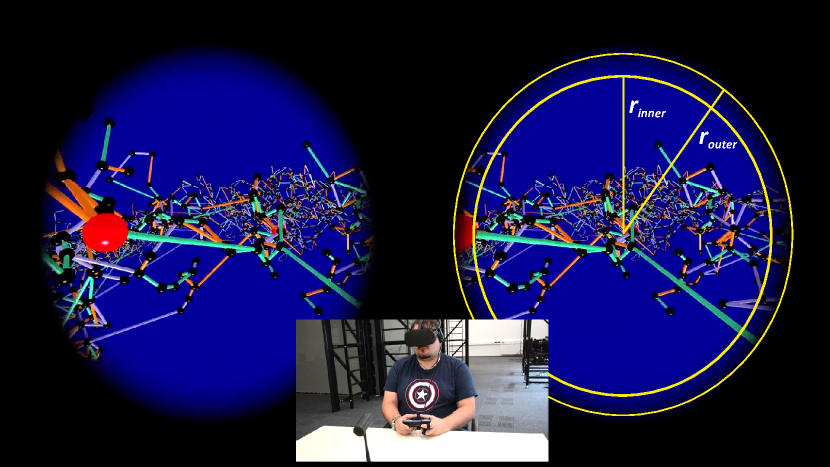
- 画面全体を黒色シェーダーで処理する FoV 減少を実装し、内半径と外半径を調整してスクリーン空間の透明性を持つ動的な視野を作成する。
- 4 DoF のゲームパッド操作を用いた座位デスク VR タスク(グラフ探索)を実施し、被験者グループは自己申告による健康状態に基づく動的 FoV 変化を経験、対照群は FoV 変化を行わない。
- 各タスク後に健康/幸福感の評価と事前/事後の SSQ、およびセッション後のプレゼンス測定を収集する。
- 分散が異なる場合 Welch 调整を用いた独立標本 t 検定で実験群と対照群を比較する。
- FoV 操作下での行動変化を評価するため、タスクパフォーマンス指標、移動距離、および head/virtual 回転を記録する。
実験結果
リサーチクエスチョン
- RQ1健康駆動 FoV 減少は FoV 変更のない対照条件と比較して cybersickness 指標を低減するか。
- RQ2動的 FoV 減少は標準 FoV に比べてプレゼンスやタスク遂行に影響を与えるか。
- RQ3動的 FoV 減少に対して参加者は気づくか、あるいは不快感を感じるか。
主な発見
| Measure (Group Comparison) | Mean | Std. Dev. | p-value |
|---|---|---|---|
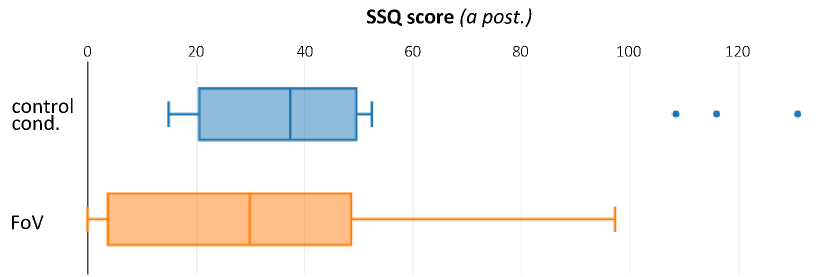
| SSQ score (a post.) | 47.6 | 38.5 | - |
| FoV | 31.7 | 29.3 | .212 |
| Delta SSQ score | 35.7 | 35.2 | .190 |
| last health score | 4.7 | 2.4 | .197 |
| FoV (health-based) | 3.4 | 2.9 | .197 |
| Delta health score | 2.9 | 1.9 | .542 |
| presence | 95.8 | 17.0 | .813 |
| # correct tasks | 10.7 | 4.7 | .483 |
| task error in % | 22.3 | 23.4 | .417 |
| distance traveled in m | 1,343.4 | 462.1 | .038* |
| head rotation in deg | 8,259.5 | 4,082.4 | .017* |
| virtual rotation in deg | 6,583.6 | 3,789.4 | .182 |
- 研究群と対照群の SSQ スコア、主観的 sickness 指標、プレゼンス、またはタスク遂行に有意差は見られなかった。
- 研究群は対照群よりも移動距離が有意に長く、周囲を見回す頻度も多かった。
- 頭部回転は群間で差があり、研究群で回転が大きく、他の回転指標には有意な変化は見られなかった。
- いくつかの主観指標(例:対話の自然さ)は対照群で異なり、サイバーサイエンス低減以外の副作用を示唆した。
- 主観的な健康/脆弱性は sickness 指標と相関していた一方、年齢や VR 経験は一貫した相関を示さなかった。
より良い研究を、今すぐ始めましょう
論文設計から論文執筆まで、研究時間を劇的に削減しましょう。
クレジットカード登録不要
このレビューはAIが作成し、人間の編集者が確認しました。