
QUICK REVIEW
[論文レビュー] Dynamic transition in an atomic glass former: a molecular dynamics evidence
Estelle Pitard, Vivien Lecomte|Springer Link (Chiba Institute of Technology)|May 12, 2011
Glass properties and applications被引用数 7
ひとこと要約
本研究は、Lennard-Jones原子系のガラス形成体(Kob-Andersen混合系)に対して、軌道活性度のための大偏差形式を用いて、1次的な動的相転移の分子動力学的証拠を提示する。転移点は s_c(∞) ≈ 0 に位置し、実験的にも観測可能であることが示され、運動的制約モデル理論が原子系においても有効であることが裏付けられる。
ABSTRACT
We find that a Lennard-Jones mixture displays a dynamic phase transition between an active regime and an inactive one. By means of molecular dynamics simulations and of a finite-size study, we show that the space time dynamics in the supercooled regime coincides with a dynamic first order transition point.
研究の動機と目的
- 有限サイズスケーリングを用いて、原子系のガラス形成体における動的相転移の存在を確立すること。
- 熱力学的極限における動的転移点を高精度に特定すること。実験的に測定可能かどうかを検証すること。
- 現象論的仮定を避けるために、有効力に基づく物理的に明確な活性度観測量を定義すること。
- 運動的制約モデル理論における動的相転移の状況が、現実の原子系に対しても有効であることを確認すること。
提案手法
- 活性度の大きな偏差を示すレア軌道をサンプリングするため、クローン化アルゴリズムの分子動力学版を採用した。
- 活性度を時間平均された有効力として定義し、粒子間の物理的力と関連づけた。
- さまざまな系サイズにおける軌道活性度の統計を分析するため、積率生成関数 ψ(s) を用いた。
- スプラインフィッティングと2階微分の最大化を用いた有限サイズスケーリングにより、サイズNにおける転移点 s_c(N) を特定した。
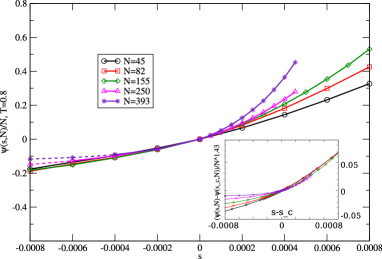
- 自由エネルギー ψ(s) のスケーリング挙動を解析し、s<0 では ∼N、s>0 では ∼N^{1+α}(α≈0.43)のスケーリングを確認。これは、異なる動的相が存在することを示唆する。
- スケーリングと有限サイズ外挿法を用いて、無限大系における転移点 s_c(∞) を推定した。
実験結果
リサーチクエスチョン
- RQ1Kob-Andersen Lennard-Jones混合系のような原子系ガラス形成体において、動的相転移が存在するか?
- RQ2この動的相転移の臨界点は、熱力学的極限においてどこに位置するのか。実験的に測定可能か?
- RQ3動的活性度の概念を、現象論的構築物ではなく物理的力に基づいて定義できるか?
- RQ4自由エネルギーの系サイズ依存性が、活性相と不活性相をどのように区別するか?
- RQ5大偏差集合における不活性状態の幾何学的・位相的性質は何か?
主な発見
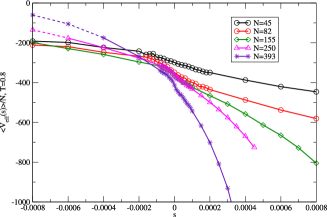
- 系は、活性状態と不活性状態の間で1次的な動的相転移を示す。活性度分布の二峰性と自由エネルギー ψ(s) のかぎれがそれを裏付けている。
- 転移点 s_c(N) は系サイズNの増大に伴い減少し、無限大系極限において0付近に収束することが確認された。
- 自由エネルギー ψ(s) は、s<0(活性相)で ∼N、s>0(不活性相)で ∼N^{1+α}(α≈0.43)のスケーリングを示し、不活性状態に非自明な幾何構造が存在することを示唆する。
- 非整数の指数 α≈0.43 は、不活性相に長距離有効相互作用と複雑な空間的構造が存在することを示唆する。
- 転移点は s_c(∞)≈0 に位置し、軌道統計を測定する実験で観測可能である可能性がある。
- 有効力に基づいて定義された活性度観測量は、物理的に明確で、動的不均一性の測定可能な特徴付けを提供する。
より良い研究を、今すぐ始めましょう
論文の読解から最終レビューまで、研究時間を劇的に削減しましょう。
クレジットカード登録不要
このレビューはAIが作成し、人間の編集者が確認しました。