
[論文レビュー] Dynamics and Resilience of the Charge Density Wave in a bilayer kagome metal
この論文は ARPES、DFT、時間分解光学分光法を用いて、 bilayer ScV6Sn6 の CDW が主に格子駆動で、電子ギャップは限られていること、約1.42 THz の振幅モードが高光励起下でも持続することを示している。
Long-range electronic order descending from a metallic parent state constitutes a rich playground to study the intricate interplay of structural and electronic degrees of freedom. With dispersive and correlation features as multifold as topological Dirac-like itinerant states, van-Hove singularities, correlated flat bands, and magnetic transitions at low temperature, kagome metals are located in the most interesting regime where both phonon and electronically mediated couplings are significant. Several of these systems undergo a charge density wave (CDW) transition, and the van-Hove singularities, which are intrinsic to the kagome tiling, have been conjectured to play a key role in mediating such an instability. However, to date, the origin and the main driving force behind this charge order is elusive. Here, we use the topological bilayer kagome metal ScV6Sn6 as a platform to investigate this puzzling problem, since it features both kagome-derived nested Fermi surface and van-Hove singularities near the Fermi level, and a CDW phase that affects the susceptibility, the neutron scattering, and the specific heat, similarly to the siblings AV3Sb5 (A = K, Rb, Cs) and FeGe. We report on our findings from high-resolution angle-resolved photoemission, density functional theory, and time-resolved optical spectroscopy to unveil the dynamics of its CDW phase. We identify the structural degrees of freedom to play a fundamental role in the stabilization of charge order. Along with a comprehensive analysis of the subdominant impact from electronic correlations, we find ScV6Sn6 to feature an instance of charge density wave order that predominantly originates from phonons. As we shed light on the emergent phonon profile in the low-temperature ordered regime, our findings pave the way for a deeper understanding of ordering phenomena in all CDW kagome metals.
研究の動機と目的
- bilayer kagome 金属 ScV6Sn6 におけるCDWの起源と駆動力を調査する。
- CDW形成とダイナミクスにおいて構造的(格子)および電子自由度の結合を特徴づける。
- フェルミ面で電子ギャップが開くかを決定し、CDW転移を通じたスペクトル重みの変化を評価する。
提案手法
- 高分解 ARPES で対称点方向に沿ったTCDW の上部と下部の電子構造を高分解でマップする。
- バンド構造、van-Hove特異点、CDW によるギャップを予測するための密度汎関数理論計算。
- 電子と格子の応答のダイナミクスを探り、緩和時間と振幅を抽出するための時間分解分光法。
- CDW 振幅モードの周波数と温度依存性を推定するためのDFTベースの格子振動解析。
- 電子部と格子寄与を飽和、減衰、振幅モードの周波数シフトを観察して分離するための照度依存性 TR-OS。
実験結果
リサーチクエスチョン
- RQ1ScV6Sn6 は CDW の秩序化に伴いフェルミエネルギー付近に有意なギャップを示すのか、それとも CDW は主に格子自由度によって媒介されるのか。
- RQ2この bilayer kagome 系における格子振動と電子-格子結合が CDW の安定化に果たす役割は何か。
- RQ3光励起後に電子応答と格子応答は時間的にどう解離するのか、駆動機構について何を示唆するのか。
- RQ4CDW に最も結合する電子状態のエネルギー規模はどれほどで、それが観測された光学・ARPES 特性とどう related するのか。
主な発見
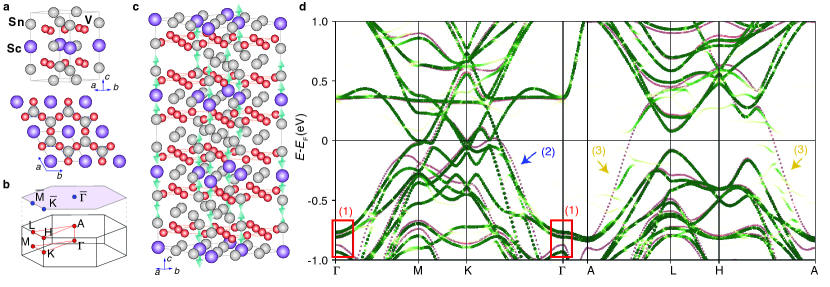
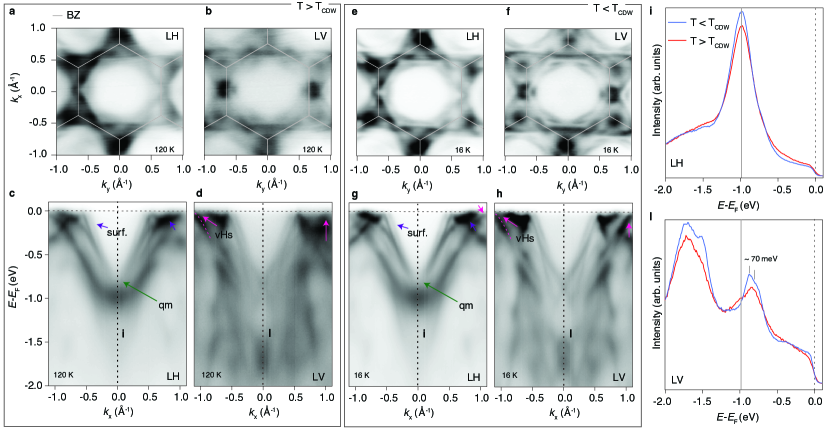
- DFTと ARPES は、Dirac様状態とEF近傍の van-Hove 奇点が CDW によって大きく影響を受けず、主要な変化は特定の k 路が離れた場所に局在している。
- CDW は A-H および A-L 方向にいくつかのエネルギーギャップを誘発するが、スペクトル重みはCDW転移前のバンドの極(極点)の近くに留まり、ギャップを実験的に解像するのは難しい。
- TR-OS は ~1.45 THz の振幅モードを明らかにし、TCDW に近づくほど約6% の軟化と振動減衰が増大する、CDW AM 振る舞いと一致。
- 非協調的電子緩和(tau1)は温度とともに増加し、TCDW で発散しない。これは従来型ではない、格子頑健な CDW メカニズムを示唆。
- 照度依存測定は電子部分が適度な照度で飽和する一方、AM の振動は約700 μJ/cm2 まで持続し、約1000 μJ/cm2 付近でのみ消えることを示し、格子の頑健性を示す。
より良い研究を、今すぐ始めましょう
論文設計から論文執筆まで、研究時間を劇的に削減しましょう。
クレジットカード登録不要
このレビューはAIが作成し、人間の編集者が確認しました。