
[論文レビュー] Earliest Galaxies in the JADES Origins Field: Luminosity Function and Cosmic Star-Formation Rate Density 300 Myr after the Big Bang
この研究は JWST/JADES Origins Field データを使用して z = 11.5–15 の銀河候補を特定し、進化する UV 光度関数を前方モデル化し、z ~ 14–15 までの宇宙の星形成率密度を制約する。
We characterize the earliest galaxy population in the JADES Origins Field (JOF), the deepest imaging field observed with JWST. We make use of the ancillary Hubble optical images (5 filters spanning $0.4-0.9μ\mathrm{m}$) and novel JWST images with 14 filters spanning $0.8-5μ\mathrm{m}$, including 7 medium-band filters, and reaching total exposure times of up to 46 hours per filter. We combine all our data at $>2.3μ\mathrm{m}$ to construct an ultradeep image, reaching as deep as $\approx31.4$ AB mag in the stack and 30.3-31.0 AB mag ($5σ$, $r=0.1"$ circular aperture) in individual filters. We measure photometric redshifts and use robust selection criteria to identify a sample of eight galaxy candidates at redshifts $z=11.5-15$. These objects show compact half-light radii of $R_{1/2}\sim50-200$pc, stellar masses of $M_{\star}\sim10^7-10^8 M_{\odot}$, and star-formation rates of $\mathrm{SFR}\sim0.1-1\,M_{\odot}\,\mathrm{yr}^{-1}$. Our search finds no candidates at $15
研究の動機と目的
- JWST と補助的な HST データを用いて JADES Origins Field (JOF) の最も初期の銀河集団を特徴づける。
- 光度法経紅shiftを測定し、混入を最小限に抑えた堅牢な z>11 銀河候補を選択する。
- 赤方偏移や光度のビニングを用いずに進化する UV 光度関数を前方モデル化する。
- z~20 までの UV 光度密度とその進化を推定し、初期構造形成への影響を議論する。
提案手法
- 14フィルターの JWST/NIRCam 撮影(0.8–5 μm)と HST 光学データ(0.4–0.9 μm)を組み合わせて、>2 μm で最も深いイメージングを作成する。
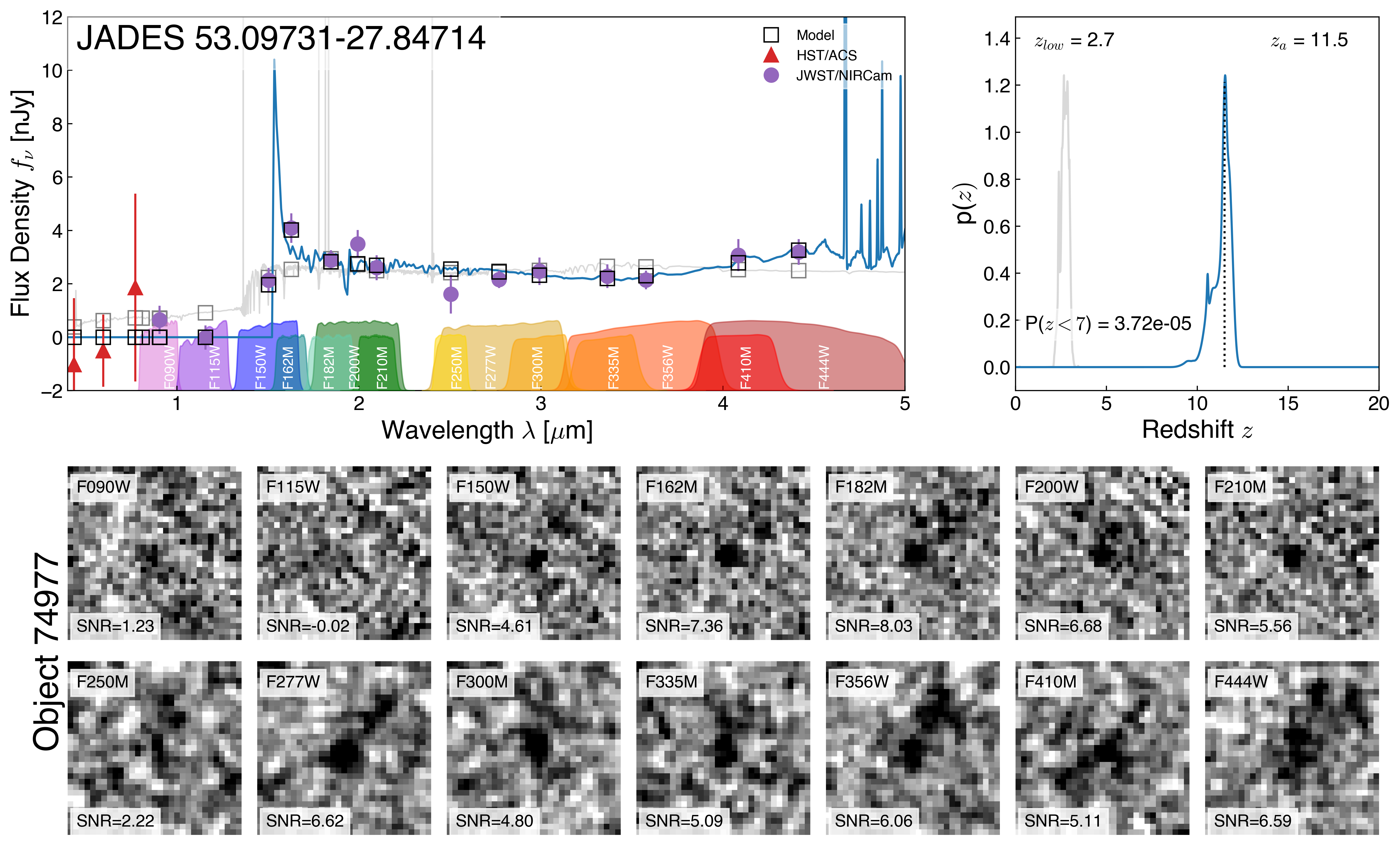
- EAZY を用いて、強い発光線と様々な UV 連続スペクトルを含むテンプレートを使い、フォトメトリック赤方偏移推定を行う。
- 非検出を考慮しつつ、厳密な高-z 選択基準を適用して堅牢な z>11 候補を同定する。
- 銀河集団を前方モデル化して、フォトメトリック赤方偏移の不確かさを周辺化しつつ、進化する光度関数を推定する。
- Forcepho を用いて表面輝度分布をモデル化し、構造パラメータ(例:半光半径)を抽出する。
- 0点チェック、PSF モデリング、および独立した HST 解析とのクロスチェックによりフォトメトリを検証する。
実験結果
リサーチクエスチョン
- RQ1What is the abundance and properties of galaxies at z>12 in the JOF given the deepest JWST/NIRCam data?
- RQ2How does the UV luminosity function evolve from z~12 to higher redshifts (z~14–20)?
- RQ3What is the corresponding UV luminosity density and implied cosmic star-formation rate density in the earliest epochs?
- RQ4Do the observed abundances align with predictions from dark matter halo mass function evolution and galaxy formation models?
主な発見
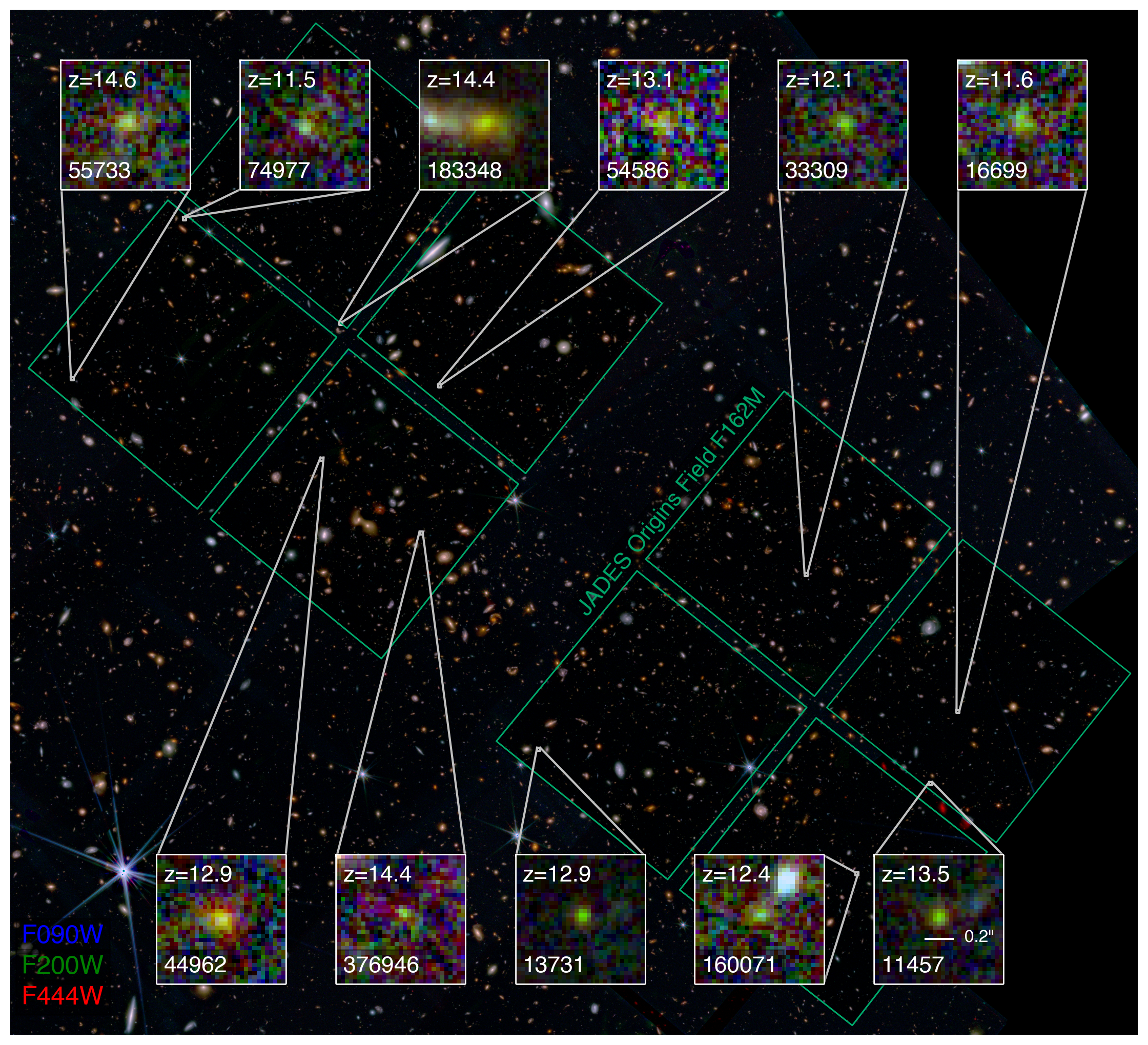
- Identified eight galaxy candidates at z=11.5–15 within the JOF Main Sample after quality cuts.
- Measured compact half-light radii of R1/2 ~ 50–200 pc and stellar masses M⋆ ~ 10^7–10^8 Msun with star-formation rates ~0.1–1 Msun yr^−1.
- No candidates found at 15<z<20, yielding upper limits in this redshift range.
- Forward-modeling indicates the z=12 UV luminosity function is in good agreement with prior results, and the UV luminosity density declines by a factor of ~2.5 from z=12 to z=14.
- The inferred luminosity function normalization evolves with redshift, informing the early growth of the galaxy population and its connection to the dark matter halo mass function.
- Field-area considerations: effective survey area after quality cuts is approximately 7.06 square arcminutes, with auxiliary/contributing samples at lower redshifts.
より良い研究を、今すぐ始めましょう
論文設計から論文執筆まで、研究時間を劇的に削減しましょう。
クレジットカード登録不要
このレビューはAIが作成し、人間の編集者が確認しました。