
[論文レビュー] Effective bi-layer model Hamiltonian and density-matrix renormalization group study for the high-Tc superconductivity in La$_{3}$Ni$_{2}$O$_{7}$ under high pressure
論文は高圧下の La3Ni2O7 に対する効果的な二層二軌道モデルを提案し、最小設定で DMRG を用いて競合する CDW 傾向とスピン-singlet 超伝導相関を示し、層内および層間のペアリングチャネルを示唆している。
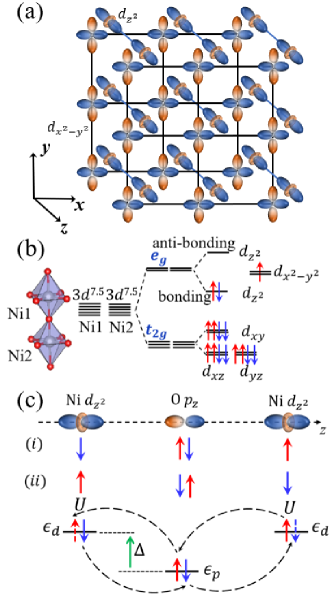
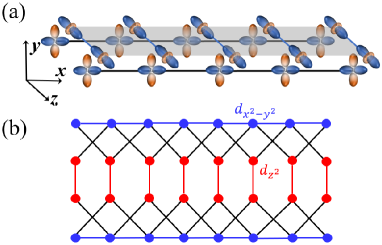
High-Tc superconductivity with possible $T_{c}\approx 80K$ has been reported in the single crystal of $ ext{La}_{3} ext{Ni}_{2} ext{O}_{7}$ under high pressure. Based on the electronic structure given from the density functional theory calculations, we propose an effective bi-layer model Hamiltonian including both $3d_{z^{2}}$ and $3d_{x^{2}-y^{2}}$ orbital electrons of the nickel cations. The main feature of the model is that the $3d_{z^{2}}$ electrons form inter-layer $σ$-bonding and anti-bonding bands via the apical oxygen anions between the two layers, while the $3d_{x^{2}-y^{2}}$ electrons hybridize with the $3d_{z^{2}}$ electrons within each NiO$_2$ plane. The chemical potential difference of these two orbital electrons ensures that the $3d_{z^{2}}$ orbitals are close to half-filling and the $3d_{x^{2}-y^{2}}$ orbitals are near quarter-filling. The strong on-site Hubbard repulsion of the $3d_{z^{2}}$ orbital electrons gives rise to an effective inter-layer antiferromagnetic spin super-exchange $J$. Applying pressure can self-dope holes on the $3d_{z^{2}}$ orbitals with the same amount of electrons doped on the $3d_{x^{2}-y^{2}}$ orbitals. By performing numerical density-matrix renormalization group calculations on a minimum setup and focusing on the limit of large $J$ and small doping of $3d_{z^{2}}$ orbitals, we find the superconducting instability on both the $3d_{z^{2}}$ and $3d_{x^{2}-y^{2}}$ orbitals by calculating the equal-time spin singlet pair-pair correlation function. Our numerical results have provided useful insights in the high-Tc superconductivity in single crystal La$_3$Ni$_2$O$_7$ under high pressure.
研究の動機と目的
- 軌道分解された二層フレームワークを通じて、高圧下の La3Ni2O7 における高Tc 超伝導性の探索を動機づける。
- DFT の知見に基づき、3d_{z^2} および 3d_{x^2−y^2} 軌道を組み込んだ効果的な二層モデルを構築する。
- 単純化した幾何において、数値的 DMRG による基底状態の性質と可能な超伝導不安定性を調査する。
提案手法
- 3d_{z^2} の層間シグマ結合と 3d_{x^2−y^2} の層内物理を含む、効果的な二層ハミルトニアンを導出し、3d_{z^2} に対して強いオンサイト U を含める。
- 3d_{z^2} スピン間の層間交換 J と、同一層内で二つの軌道を結合する有限の混成 t_{x^{2}-y^{2},z^{2}} を含める。
- t_{z^{2}} をエネルギー単位として設定し、t_{x^{2}-y^{y2}}=0.8、t_{x^{2}-y^{2},z^{2}}=0.4 とする。z^2 の層内ホッピングは無視し、z^2 に対する二重占有を禁止する。
- 最小の1D設定(L=32)でDMRGを用い、電荷密度、スピン密度、および等時スピン対対相関 D(i,j) を計算する。
- 大きな J および小さな z^2 ドーピング極限を分析して、可能な CDW パターンと超伝導不安定性を特定する。
実験結果
リサーチクエスチョン
- RQ1提案された二層モデルは、大きな J および低 z^2 ドーピング領域で超伝導相関を支持するか?
- RQ2二つの軌道における電荷密度波パターンの特徴は何か、そしてそれらは潜在的なペアリングチャネルとどのように相互作用するか?
- RQ3どの軌道が主に超伝導性を駆動し、このフレームワークでのペアリングの性質は(層内 vs 層間)どのようか?
- RQ4圧力誘起の自己ドーピングは、3d_{z^2} と 3d_{x^2−y^2} 軌道間のホール/電子分布にどう影響するか?
主な発見
- CDW ordering appears with wavelength 5 in 3d_{z^2} electrons and roughly wavelength 3 in 3d_{x^2−y^2} electrons in the DMRG minimum setup.
- The local spin density remains short-range and paramagnetic for both orbitals, under a pinning field, indicating no long-range magnetic order.
- Equal-time spin-singlet pair-pair correlations decay algebraically on both orbitals, with exponents K_sc = 1.51(1) for 3d_{z^2} and K_sc = 0.74(7) for 3d_{x^2−y^2}, suggesting quasi-long-range superconducting tendencies.
- The 3d_{z^2} pairing is attributed to inter-layer singlet formation, while 3d_{x^2−y^2} pairing arises from hybridization between the two orbitals.
- Intra-layer pairing is stronger for 3d_{x^2−y^2} than inter-layer pairing for 3d_{z^2}, consistent with a pairing scenario where coherence is gained via hybridization with itinerant electrons.
より良い研究を、今すぐ始めましょう
論文設計から論文執筆まで、研究時間を劇的に削減しましょう。
クレジットカード登録不要
このレビューはAIが作成し、人間の編集者が確認しました。