
[論文レビュー] Effective model and pairing tendency in bilayer Ni-based superconductor La$_3$Ni$_2$O$_7$
本論文は La3Ni2O7 の二層二軌道モデルを構築し、FRG と多軌道 t-J 枠組みを用いて結合傾向を分析し、dz2 軌道によって駆動される s±波対称性を見出す。
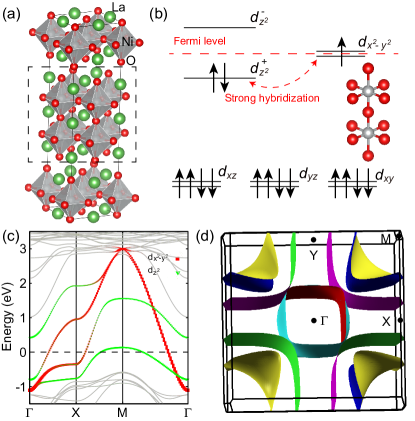
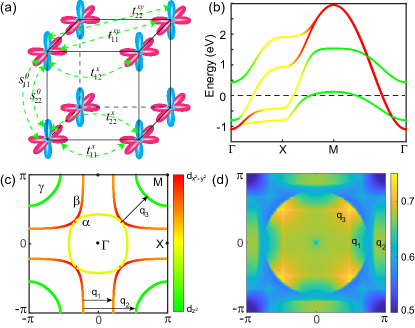
Since the discovery of cuprate, the origin of high-T$_c$ superconductivity has been an outstanding puzzle. Recently, high-T$_c$ superconductivity was observed in a bilayer nickelate La$_3$Ni$_2$O$_7$ under pressure, whose structure hosts the apical oxygen between two layers, distinct from multi-layer cuprates. Motivated by this discovery, we investigate its electronic structure using first-principle calculations and superconducting instabilities from both weak-coupling and strong-coupling perspective. Based on the first-principle band structures, we construct a bilayer two-orbital model on a square lattice, consisting of $d_{x^2-y^2}$ and $d_{z^2}$ orbitals, which accurately captures the low-energy electronic properties. Within this model, we study pairing instability using both functional renormalization group approach and multi-orbital t-J model. An $s_{\pm}$-wave pairing with sign-reversal gaps on different Fermi surfaces is revealed, reminiscent of iron based superconductors. The Ni-$d_{z^2}$ orbital and its associated interlayer and intralayer exchange couplings are found to be crucial for the high-T$_c$ superconductivity. Our study provides valuable insights into unique nature of electronic structure and superconductivity in La$_3$Ni$_2$O$_7$ and contributes to the understanding of unconventional superconductors.
研究の動機と目的
- 高温超伝導機構を cuprates を超える bilayer ニッケラートにおける高Tc の探索へ動機づける。
- フェルミエネルギー近傍の低エネルギー電子構造を捉える bilayer 二軌道モデルを構築する。
- 弱〜中程度結合の FRG と強結合の t-J アプローチを用いて超伝導不安定性を調べる。
- dz^2 軌道が超伝導性を促進する役割とペアリング対称性を特定する。
提案手法
- 一つの平方格子上で d_x2-y2 および d_z2 軌道の bilayer 二軌道つり合いバンギングモデルを第一原理バンド構造から構築する。
- 必要に応じて高エネルギー dz2 抗結合状態を無視して簡略化した三帯モデルを得る。
- 有効頂点関数の進化を追跡するために関数的再正規化群を適用し、主要な不安定性を同定する。
- 強結合からのペアリングを調べるために多軌道 t-J モデルを用い、ギャップ構造を得るため平均場分離を行う。
- スピンゆらぎ媒介のペアリングを分析し、ギャップ対称性と運動量依存性を抽出する。
- 三次元効果とドーピングがペアリング傾向に与える影響を論じる。
実験結果
リサーチクエスチョン
- RQ1高圧下での La3Ni2O7 の低エネルギー電子構造はどうなるか。
- RQ2 bilayer 二軌道フレームワークにおける弱〜中程度結合からどのようなペアリング傾向が現れるか。
- RQ3 dz^2 軌道は超伝導性にどのように寄与し、結果としてのギャップ対称性はどうなるか。
- RQ4 dz^2 および dx^2−y^2 チャネルにおける層間・層内交換結合はペアリングにどのように影響するか。
- RQ5 電子ドーピングまたはホールドーピングは Tc とペアリング対称性にどのような影響を与えるか。
主な発見
- FRG および t-J 分析の両方で、異なる Fermi サーフェス間の符号反転ギャップを伴う s±-wave ペアリングが見つかる。
- dz^2 軌道とその層間および層内交換結合は高 Tc 超伝導性にとって重要である。
- dz^2 結合状態由来の γ ポケットと層間 dx^2−y^2 抗結合状態由来の β ポケットが支配的なペアリングチャネルを駆動する。
- 対角線方向にノードを持つ亜支配的な dx^2−y^2 波ペアリングが現れる。
- 電子ドーピングはペアリング対称性を変えずに Tc を高める可能性があり、ポケット間の符号構造は保存される。
- s± 状態は α, β, γ ポケット間の符号変化を伴い、ポケット間散乱パターンと整合する。
より良い研究を、今すぐ始めましょう
論文設計から論文執筆まで、研究時間を劇的に削減しましょう。
クレジットカード登録不要
このレビューはAIが作成し、人間の編集者が確認しました。