
[論文レビュー] Efficient reference-less transmission matrix retrieval for a multimode fiber using fast Fourier transform
本論文は、フーリエ変換に基づくプローブ行列と並列非線形最適化アルゴリズムを用いて、多重モード光ファイバの伝送行列(TM)を参照なしで高速に回復する手法を提案する。高速フーリエ変換(FFT)を活用することで、1200倍の高速化を達成し、32コアのCPUを用いて2286×8192のTMを124.9秒で回復した。また、焦点が合っていない強度画像を用いて位相オフセット誤差を補正し、正確な3次元パターン生成を実現した。
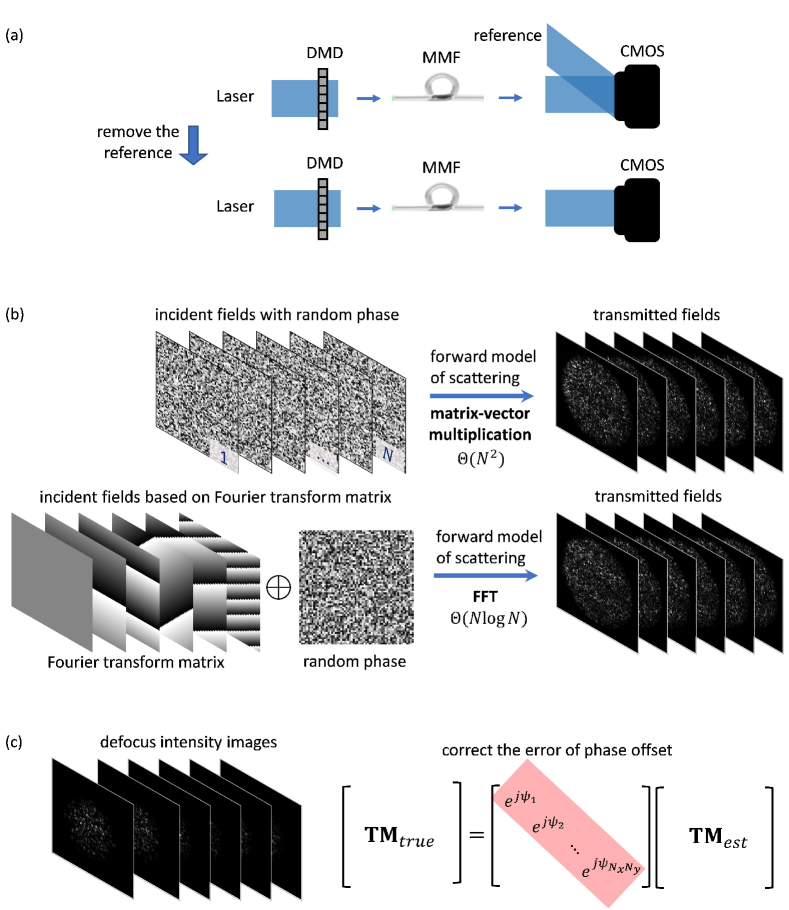
Transmission matrix (TM) linearly maps the incident and transmitted complex fields, and has been used widely due to its ability to characterize scattering media. It is computationally demanding to reconstruct the TM from intensity images measured by a reference-less experimental setup. Removing reference beam for interference gains the advantage of simple experimental setup. However, the long computational time still limits its practical application. We propose an efficient reference-less TM retrieval method for multimode fiber (MMF). Our method adopts a data acquisition scheme which employs Fourier transform matrix in the design of the incident fields. We develop a nonlinear optimization algorithm to solve the TM retrieval problem in a parallel manner. The data acquisition scheme allows the algorithm to be implemented with fast Fourier transform (FFT), and hence achieves great efficiency improvement. Further, our method acquires intensity images at a defocus plane and correct the error of relative phase offset of TM recovered from the intensity images measured at one fixed plane. We validate the proposed TM retrieval method with both simulations and experiments. By using FFT, our TM retrieval algorithm achieves 1200x speed-up in computational time, and recovers $2286 imes 8192$ TM of a 0.22 NA and $50 \ μm$ diameter MMF with 124.9 seconds by a computer of 32 CPU cores. With the advantages of efficiency and the correction of phase offset, our method paves the way for the application of reference-less TM retrieval in real practice.
研究の動機と目的
- 多重モード光ファイバ(MMF)における参照なしの伝送行列(TM)回復における計算ボトルネックを解消し、実用的応用を可能にする。
- 外部または内部の参照ビームの必要性を排除することで、実験設定を簡素化し、安定性を向上させる。
- 単一平面での強度測定のみから回復されたTMにおける相対的位相オフセット誤差を補正し、3次元光パターン生成を可能にする。
- 内視鏡イメージングや光通信分野におけるリアルタイム応用に適した、効率的で高スルーレートのTM回復を実現する。
- 外部参照ビームを取得することが実用的でない長距離ファイバに応用可能な手法を開発する。
提案手法
- プローブ場の生成にフーリエ変換行列を用いることで、高速フーリエ変換(FFT)を活用した計算の効率化を実現する。
- 測定された強度画像からTMを回復するための非線形最適化アルゴリズムを開発し、プローブ行列の構造によりFFTに基づく逆行列計算が可能となる。
- 複数のCPUコアにわたる並列処理により計算を高速化し、大規模なTMに対しては時間数時間から2分未塔まで短縮した。
- 焦点が合っていない強度画像を取得し、回復されたTMにおける相対的位相オフセットを補正する。これは3次元光パターン生成に不可欠である。
- 全位相シフトに関する最適化問題として位相補正を定式化し、解析的導関数を用いた勾配降下法により反復的に解く。
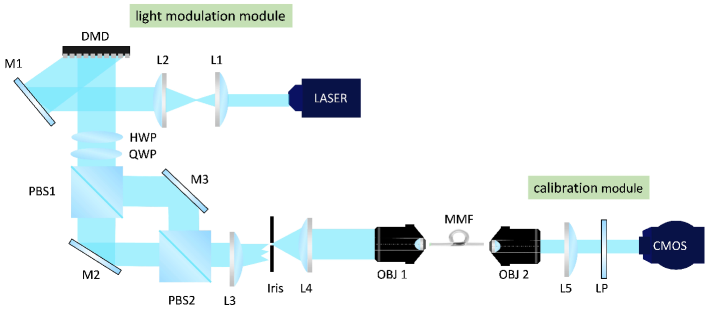
- デジタルミラー素子(DMD)を用いた実験セットアップとカメラによる強度測定を用いて、0.22 NA、50 µm径のMMFで手法を実証した。
実験結果
リサーチクエスチョン
- RQ1多重モード光ファイバにおける参照なしTM回復手法は、正確性を損なわず、高い計算効率を達成できるか?
- RQ2強度測定のみで回復されたTMにおける位相オフセット誤差は、どのように補正可能か? 3次元光パターン生成を可能にするために不可欠である。
- RQ3フーリエ変換に基づくプローブ行列の使用により、FFTに基づく逆行列計算が可能となり、計算時間の著しい短縮が図れるか?
- RQ4本手法は、実用的なMMF応用に一般的に見られる大規模なTMにどの程度スケーラブルか?
- RQ5外部参照ビームを取得することが困難な光通信分野における長距離ファイバに、本手法を適用可能か?
主な発見
- 提案手法は、従来の参照なしTM回復手法と比較して計算時間で1200倍の高速化を達成し、32コアCPUを用いて2286×8192のTMを124.9秒で回復した。
- フーリエ変換に基づくプローブ行列の使用により、最適化アルゴリズムが高速フーリエ変換(FFT)を用いて実装可能となり、計算複雑度が顕著に低減された。
- 焦点が合っていない強度画像を用いて、回復されたTMにおける相対的位相オフセットを効果的に補正し、実験的に3次元焦点の生成に成功した。
- TM回復誤差が最小限に抑えられ、補正済みのTMは伝送場の振幅と位相を正確に予測でき、3次元パターン制御に不可欠である。
- 50 µm径、0.22 NAの多重モードファイバを用いた実験的検証により、内視鏡的およびイメージング応用への実現可能性が示された。
- アルゴリズムはスケーラブルであり、より多くの並列CPUコアを搭載したシステムでもさらなる高速化が可能であり、リアルタイム応用に適している。
より良い研究を、今すぐ始めましょう
論文の読解から最終レビューまで、研究時間を劇的に削減しましょう。
クレジットカード登録不要
このレビューはAIが作成し、人間の編集者が確認しました。