
[論文レビュー] Energy Extraction from Spinning Stringy Black Holes
本研究は、Kerr-Sen(dilaton-axion)時空における回転するストリング的ブラックホールへの磁化プラズマ降着について、初めての3次元GRMHDシミュレーションを実施し、非ケルン重力でもBlandford-Znajek機構が相対論的ジェットを駆動することを示した。非回転ストリング的ブラックホールでは、フレームドラッグのない環境下で重力的束縛エネルギーの解放によりエネルギー抽出が起こり、その結果、シュヴァルツシルトブラックホールに比べて約250%強力なアウトフローが発生する。
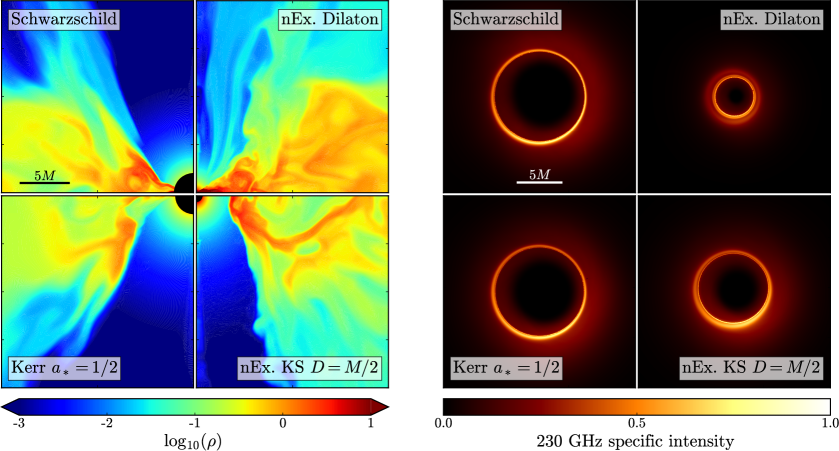
We perform the first numerical simulations modeling the inflow and outflow of magnetized plasma in the Kerr-Sen spacetime, which describes classical spinning black holes (BHs) in string theory. We find that the Blandford-Znajek (BZ) mechanism, which is believed to power astrophysical relativistic outflows or ``jets'', is valid even for BHs in an alternate theory of gravity, including near the extremal limit. The BZ mechanism releases outward Poynting-flux-dominated plasma as frame-dragging forces magnetic field lines to twist. However, for nonspinning BHs, where the frame-dragging is absent, we find an alternate powering mechanism through the release of gravitational potential energy during accretion. Outflows from non-spinning stringy BHs can be approximately $250\%$ more powerful as compared to Schwarzschild BHs, due to their relatively smaller event horizon sizes and, thus, higher curvatures. Finally, by constructing the first synthetic images of near-extremal non-Kerr BHs from time-dependent simulations, we find that these can be ruled out by horizon-scale interferometric images of accreting supermassive BHs.
研究の動機と目的
- ストリング理論重力における回転ブラックホールのエネルギー抽出メカニズムを調査すること。特に、Kerr-Sen(dilaton-axion)時空を対象とする。
- 特に極限近辺での状況を想定した非一般相対性理論的ブラックホール時空においても、Blandford-Znajek機構が有効であるかどうかを特定すること。
- フレームドラッグが存在しない非回転ストリング的ブラックホールにおける代替的エネルギー抽出経路を探索すること。
- 時間依存シミュレーションから合成されたホライズンスケールの画像を構築し、EHT観測結果と照合すること。
- 非ケルンブラックホールの特徴を観測可能かどうかを、シャドウサイズや形状の違いから評価すること。
提案手法
- Kerr-Sen計量を用いて、回転する非ケルンブラックホールへの高温で磁化された降着流の42件の高分解能、完全3次元一般相対論的磁気流体力学(GRMHD)シミュレーションを実施する。
- ジェット出力の定量的評価に、Blandford-Znajek(BZ)出力規則 $ P_{\rm BZ} \propto \phi_{\rm H}^2 \Omega_{\rm max}^2 $ を用いる。
- 特に非回転系においては、安定円軌道の内側境界(ISCO)における束縛エネルギーを、利用可能な降着エネルギーの代理指標として用いる。
- EHT観測結果と比較するため、時間平均化された230 GHzの合成画像をシミュレーションから計算する。
- 粘性散逸からアウトフローへのエネルギー転送メカニズムを特定するため、磁気圧および熱圧のプロファイルを解析する。これは、降着支配型降着流(ADAFs)に特有の現象である。
- EHTによるM87*の測定値($ \delta = -0.01 \pm 0.17 $)と比較し、非ケルンモデルの制約を求める。
実験結果
リサーチクエスチョン
- RQ1Kerr-Sen(ストリング的)計量で記述される回転ブラックホールにおいて、Blandford-Znajek機構は極限近辺でも有効に機能するか?
- RQ2フレームドラッグが存在しない非回転ストリング的ブラックホールでは、どのようなエネルギー抽出機構がアウトフローを駆動するか?
- RQ3dilaton-axionブラックホールでは、イベントホライズンサイズの縮小が、束縛エネルギーおよびアウトフロー出力にどのように影響を与えるか?
- RQ4時間依存GRMHDシミュレーションにより、現在のEHT分解能で非ケルンブラックホールとケルンブラックホールの合成画像を区別できるか?
- RQ5磁気圧および熱圧勾配は、非ケルンブラックホール周囲の降着支配型降着流におけるジェット発生にどの程度寄与しているか?
主な発見
- Blandford-Znajek機構は、極限近辺でさえもKerr-Sen時空に記述される回転ストリング的ブラックホールにおいても、依然として活性的かつ効果的である。
- 非回転dilatonブラックホールでは、エネルギー抽出が重力的束縛エネルギーの解放によって起こり、シュヴァルツシルトブラックホールに比べてアウトフローが約250%強力である。
- dilaton電荷の増加に伴いイベントホライズンサイズが小さくなることで、時空曲率が強化され、ISCOにおける束縛エネルギーが増大し、結果としてアウトフロー出力が上昇する。
- 時間依存シミュレーションからの合成画像では、近極限非ケルンブラックホールが $ \delta = -0.615 $ の分数的偏差を示すシャドウ直径を生成するが、これはEHTによるM87*の観測結果($ \delta = -0.01 \pm 0.17 $)と矛盾し、除外される。
- 磁気圧および熱圧は、ホライズン面積の減少に伴い $ A_{\rm H}^{-1.7} $ の割合で増加しており、降着支配型流れにおいて、粘性散逸から磁気的および熱的エネルギーへの顕著なエネルギー転送が生じていることが示唆される。
- ISCOにおける束縛エネルギーとアウトフロー出力との強い相関関係は、非回転ストリング的ブラックホールでは、回転エネルギーではなく降着エネルギーの放出が風を駆動していることを確認する。
![Figure 2: The Blandford-Znajek [BZ 52 ] mechanism predicts the correct jet power even for non general-relativistic BHs. We find that the total outflow power $\eta$ matches the predicted BZ power $\eta_{\rm BZ}=(k/4\pi)(\Omega_{\rm H}\phi_{\rm H})^{2}$ (see eq. 1 ) well when the jets dominate the out](https://ar5iv.labs.arxiv.org/html/2310.20040/assets/x2.png)
より良い研究を、今すぐ始めましょう
論文の読解から最終レビューまで、研究時間を劇的に削減しましょう。
クレジットカード登録不要
このレビューはAIが作成し、人間の編集者が確認しました。