
[論文レビュー] Engineering Software Systems for Quantum Computing as a Service: A Mapping Study
本論文は QCaaS 研究の系統的マッピング研究を実施し、モデリング表記法、パターン、言語、デプロイメントプラットフォーム、そして新たに現れる動向を特定する。
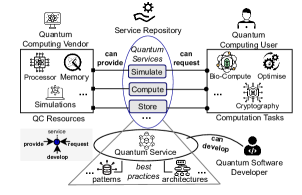
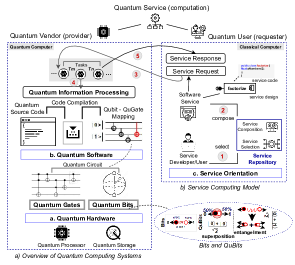
Quantum systems have started to emerge as a disruptive technology and enabling platforms - exploiting the principles of quantum mechanics - to achieve quantum supremacy in computing. Academic research, industrial projects (e.g., Amazon Braket), and consortiums like 'Quantum Flagship' are striving to develop practically capable and commercially viable quantum computing (QC) systems and technologies. Quantum Computing as a Service (QCaaS) is viewed as a solution attuned to the philosophy of service-orientation that can offer QC resources and platforms, as utility computing, to individuals and organisations who do not own quantum computers. To understand the quantum service development life cycle and pinpoint emerging trends, we used evidence-based software engineering approach to conduct a systematic mapping study (SMS) of research that enables or enhances QCaaS. The SMS process retrieved a total of 55 studies, and based on their qualitative assessment we selected 9 of them to investigate (i) the functional aspects, design models, patterns, programming languages, deployment platforms, and (ii) trends of emerging research on QCaaS. The results indicate three modelling notations and a catalogue of five design patterns to architect QCaaS, whereas Python (native code or frameworks) and Amazon Braket are the predominant solutions to implement and deploy QCaaS solutions. From the quantum software engineering (QSE) perspective, this SMS provides empirically grounded findings that could help derive processes, patterns, and reference architectures to engineer software services for QC.
研究の動機と目的
- Quantum Computing as a Service (QCaaS) を実現・強化する既存の解決策を調査する。
- QCaaS の機能的側面、設計モデル、パターン、プログラミング言語、デプロイプラットフォーム、および運用化を特徴づける。
- 将来の QCaaS 研究と実践を指針づける新たな動向とギャップを特定する。
- 量子ソフトウェア工学の観点から QC のソフトウェアサービスを設計・工学するための経験的根拠に基づく指針を提供する。
提案手法
- エビデンスベースのソフトウェア工学手法を用いて系統的マッピング研究 (SMS) を実施した。
- 主要な電子データソース(IEEE Xplore、ACM DL、SpringerLink、ScienceDirect、Wiley Online Library)と Google Scholar を横断検索し、ソースごとに検索文字列をカスタマイズした。
- 種研究からのフォワード・スノーボーリングを適用して候補セットを拡大した。
- 定義済み基準 (S1-S4, Q1-Q5) を用いて研究をスクリーミングおよび品質評価し、最終分析のために 9 件の研究を選定した。
- 適応した IBM SOA ライフサイクル (Conception, Modeling, Assembly, Deployment) に沿って構造化データ抽出を行った。
- 機能的側面、モデリング表記、パターン、言語、デプロイメントプラットフォームの観点で結果を報告した。
実験結果
リサーチクエスチョン
- RQ1RQ1: 文献には Quantum Computing as a Service の開発を支援するためにどのような解決策が報告されているか?
- RQ2RQ2: QCaaS に関する研究の新たな動向は何か?
主な発見
- QCaaS に対して三つのモデリング表記法が特定された(UML、グラフベースのモデル、プロセスモデル)。
- QCaaS の設計パターン五種のカタログが報告された(API Gateway、Layered Architecture、Classic-Quantum Split、Service Wrapping、Repository)。
- Python(ネイティブまたはフレームワーク経由)と Amazon Braket が QCaaS ソリューションの主要な実装/デプロイの選択肢である。
- QCaaS の適用分野として四つ:Optimisation、Process Automation、Mathematics、Quantum Simulation が特定され、ツール/言語の選択に影響を与える。
- デプロイのために強調された三つの量子ベンダー/プラットフォームは Amazon Braket、IBM Quantum、Rigetti。
- 新興動向には非機能的側面の重視、モデル駆動型エンジニアリングとローコード手法、量子ドメイン工学(QSRs)、人間の役割、および QCaaS のプロセス中心の開発が含まれる。
より良い研究を、今すぐ始めましょう
論文設計から論文執筆まで、研究時間を劇的に削減しましょう。
クレジットカード登録不要
このレビューはAIが作成し、人間の編集者が確認しました。