
[論文レビュー] Entanglement and charge-sharpening transitions in U(1) symmetric monitored quantum circuits
本稿はU(1)対称性を持つモニタリング付き量子回路を研究し、測定が全電荷を効率的に明らかにできるか否かに応じて区別される、スキャッタリング相における体積則エンタングルメントを特徴づける新たな電荷鋭化転移を明らかにした。正確な数値計算と制約付きハードコアランダムウォーカーへの写像を用いて、任意の有限測定レート下でRényiエントロピーが時間とともに力学的(ballistically)に増加することを示し、特徴的な臨界行動として出現するローレンツ不変性とスケーラブルな局所アンシラプローブによる診断法を同定した。
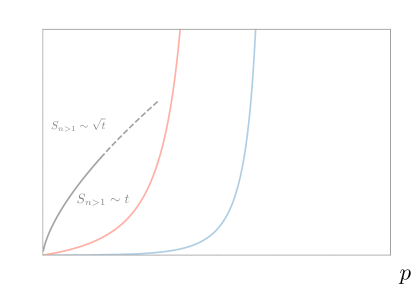
Monitored quantum circuits can exhibit an entanglement transition as a function of the rate of measurements, stemming from the competition between scrambling unitary dynamics and disentangling projective measurements. We study how entanglement dynamics in non-unitary quantum circuits can be enriched in the presence of charge conservation, using a combination of exact numerics and a mapping onto a statistical mechanics model of constrained hard-core random walkers. We uncover a charge-sharpening transition that separates different scrambling phases with volume-law scaling of entanglement, distinguished by whether measurements can efficiently reveal the total charge of the system. We find that while Rényi entropies grow sub-ballistically as $\sqrt{t}$ in the absence of measurement, for even an infinitesimal rate of measurements, all average Rényi entropies grow ballistically with time $\sim t$. We study numerically the critical behavior of the charge-sharpening and entanglement transitions in U(1) circuits, and show that they exhibit emergent Lorentz invariance and can also be diagnosed using scalable local ancilla probes. Our statistical mechanical mapping technique readily generalizes to arbitrary Abelian groups, and offers a general framework for studying dissipatively-stabilized symmetry-breaking and topological orders.
研究の動機と目的
- 非ユニタリ量子回路における電荷保存がエンタングルメントダイナミクスに与える影響を理解すること。
- U(1)対称性を持つモニタリング付き回路における新たな電荷鋭化転移を同定・特徴づけること。
- 異なるスキャッタリング相において測定が全電荷を効率的に明らかにできるかどうかを特定すること。
- 電荷鋭化転移およびエンタングルメント転移の臨界行動と普遍性クラスを確立すること。
- 出現する臨界ダイナミクスを診断するためのスケーラブルなツールとしての局所アンシラプローブの開発
提案手法
- モニタリング付きU(1)回路を制約付きハードコアランダムウォーカーの統計力学モデルに写像する。
- 有限サイズ系におけるRényiエントロピー、電荷分散、アンシラダイナミクスを正確な数値シミュレーションで計算する。
- 有限サイズスケーリングを適用し、ansatz R(p,L) = a_R + b_R(p−p_0)L^{1/ν} + c_R(p−p_0)^2L^{2/ν} + d_R/L^ω を用いて臨界点と指数を抽出する。
- 非線形フィッティングを用いてスケーリングansatzを適合させ、p_0, ν, ω などの臨界パラメータを誤差付きで抽出する。
- 局所アンシラプローブを用いて臨界ダイナミクスを診断し、普遍スケーリング関数 A_O(x) と B(x) を抽出する。
- 観測量の長時間減衰率を分析し、臨界状態における指数的緩和と普遍スケーリングを確認する。
実験結果
リサーチクエスチョン
- RQ1U(1)電荷保存は、モニタリング付き量子回路におけるエンタングルメントおよび電荷鋭化転移にどのように影響を及えるか?
- RQ2体積則エンタングルメントを示すスキャッタリング相において、全電荷の測定可能性に差を生じるのはどのような点か?
- RQ3電荷鋭化転移は出現するローレンツ不変性と普遍スケーリング行動を示すか?
- RQ4局所アンシラプローブは、電荷鋭化転移およびエンタングルメント転移の臨界ダイナミクスを信頼性高く診断できるか?
- RQ5臨界点の性質は何か?また、有限サイズ効果は臨界指数の抽出にどのように影響を及えるか?
主な発見
- 無限小の測定レートでさえも、測定なしの √t 増加とは対照的に、すべての平均Rényiエントロピーが時間とともに ∼t に比例して力学的に増加する。
- 電荷鋭化転移は、測定が全電荷を効率的に明らかにできるか否かに応じて区別される相を分離し、エンタングルメントスケーリング行動が顕著に異なる。
- 臨界状態では、ν = 2.15 および p_# = 0.088 を用いたデータのスケーリングと収縮により、出現するローレンツ不変性が裏付けられる。
- 長時間臨界ダイナミクスは、単一の減衰率 ξ_t による指数的緩和に支配され、普遍的な指数的減衰則が成立する。
- 局所アンシラプローブは、N_0 のようなグローバルな観測量よりも早く臨界行動に到達するため、臨界性のスケーラブルな診断が可能になる。
- 有限サイズスケーリング解析により、非無視可能な無関係スケーリング場 v が存在することが確認され、交差点のシフトを引き起こし、スケーリングansatzにおける高次項の必要性が示された。

より良い研究を、今すぐ始めましょう
論文の読解から最終レビューまで、研究時間を劇的に削減しましょう。
クレジットカード登録不要
このレビューはAIが作成し、人間の編集者が確認しました。