
[論文レビュー] Evaluating Correctness and Faithfulness of Instruction-Following Models for Question Answering
この論文は、質問応答における指示従いモデルの評価を、正しさのための再現率(Recall)と忠実性のためのK-適合率(K-Precision)という新しい指標を提案することで行い、F1 や EM といった従来の指標よりも人間の判断とより整合性があることを示している。GPT-3.5 は正しさにおいて優れた性能を示すが、Flan-T5 は忠実性において優れている。しかし、すべてのモデルが関連のない知識が与えられた場合に答えを拒否する能力に欠けている。
Retriever-augmented instruction-following models are attractive alternatives to fine-tuned approaches for information-seeking tasks such as question answering (QA). By simply prepending retrieved documents in its input along with an instruction, these models can be adapted to various information domains and tasks without additional fine-tuning. While the model responses tend to be natural and fluent, the additional verbosity makes traditional QA evaluation metrics such as exact match (EM) and F1 unreliable for accurately quantifying model performance. In this work, we investigate the performance of instruction-following models across three information-seeking QA tasks. We use both automatic and human evaluation to evaluate these models along two dimensions: 1) how well they satisfy the user's information need (correctness), and 2) whether they produce a response based on the provided knowledge (faithfulness). Guided by human evaluation and analysis, we highlight the shortcomings of traditional metrics for both correctness and faithfulness. We then propose simple token-overlap based and model-based metrics that reflect the true performance of these models. Our analysis reveals that instruction-following models are competitive, and sometimes even outperform fine-tuned models for correctness. However, these models struggle to stick to the provided knowledge and often hallucinate in their responses. We hope our work encourages a more holistic evaluation of instruction-following models for QA. Our code and data is available at https://github.com/McGill-NLP/instruct-qa
研究の動機と目的
- F1 や正確一致(EM)といった従来の評価指標が、質問応答における指示従いモデルの評価において抱える限界を是正すること。
- モデルの性能を、ユーザーの情報ニーズを満たす「正しさ」と、提供された知識に基づいているかの「忠実性」という二つの次元から調査すること。
- リtrieval増強型QAにおける正しさと忠実性について、人間の判断とより相関の高い自動指標を同定すること。
- 関連のない知識が与えられた場合のモデルの挙動、特に幻覚的または不適切な回答を生成する傾向を評価すること。
- 指示チューニング済みモデルにおいて、正しさと忠実性の両方を考慮した包括的な評価フレームワークの提唱
提案手法
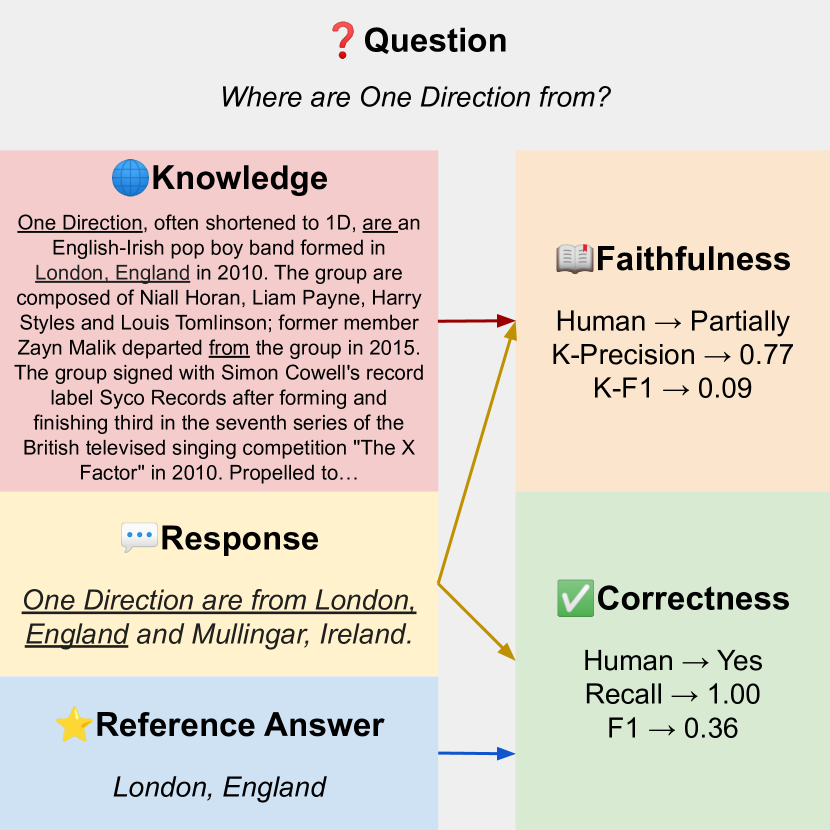
- 正しさのためのトークンオーバーラップ指標として、再現率(Recall)を提案。これは、参照回答に含まれるトークンのうち、モデルの出力に含まれる割合を測定する。
- 忠実性のための指標として、K-適合率(K-Precision)を導入。これは、モデル出力に含まれるトークンのうち、提供された知識スニペットに現れる割合を計算する。
- 正しさと忠実性の基準となる真値を確立するために、900件のモデル出力について人間による評価を実施。これにより、自動指標と人間の判断との相関分析が可能になる。
- 語彙的指標(再現率、F1、EM、K-適合率)とモデルベースの指標(GPT-4を用いた評価、LLMCritic)を、人間の判断と比較する。
- GPT-3.5、Llama-2、Flan-T5、Alpaca といった複数の指示従いモデルを、自然質問(オープンドメイン)、HotpotQA(マルチホップ)、TopiOCQA(会話型)という3つのQAデータセットで評価する。
- 関連のないパassageを挿入することで敵対的状況をテストし、拒否行動と知識の根拠の信頼性を評価する。
実験結果
リサーチクエスチョン
- RQ1F1 や EM といった従来の指標は、説明的で長めの指示従いモデル出力において、人間の正しさの判断とどの程度相関しているか?
- RQ2既存の指標は、モデル出力が提供された知識に基づいているか、すなわち「忠実性」をどの程度適切に捉えているか?
- RQ3語彙的指標(lexical)とモデルベースの指標(model-based)のうち、正しさと忠実性について人間によるアノテーションと最も整合性の高いのはどれか?
- RQ4関連のない、あるいは情報のない知識が与えられた場合、指示従いモデルはどの程度、答えを拒否する傾向を示すか?
- RQ5再現率やK-適合率といったシンプルでアクセスしやすい指標は、高価なLLMベースの評価に代わる信頼できる代替手段として機能できるか?
主な発見
- 再現率は、言い換えや詳細な説明を含む出力においても、人間の判断と最も高い相関を示し、F1 や EM を上回る性能を示す。
- K-適合率は、幻覚的または根拠のない主張を検出するうえで、他のトークンオーバーラップ指標を上回り、人間の判断と最も強い相関を示す。
- GPT-3.5 は、再現率と人間評価の両方において、3つのデータセットすべてで最も高い正しさの性能を示している。
- Flan-T5 は、全データセットで一貫して高いK-適合率スコアを示しており、提供された知識に基づいた出力が強く保証されている。
- GPT-3.5 や Flan-T5 を含むすべてのモデルが、関連のない知識が与えられた場合に、答えを確実に拒否する能力に欠けている。Llama-2 は自然質問(NQ)および HotpotQA で最も高い拒否率(99%)を示した。
- GPT-4を用いた評価やLLMCriticといったモデルベースの指標は、人間の判断と強い相関を示すが、コストが高く、バイアスの影響を受ける可能性がある。これにより、再現率やK-適合率といったアクセスしやすい代替指標の必要性が浮き彫りになった。
より良い研究を、今すぐ始めましょう
論文の読解から最終レビューまで、研究時間を劇的に削減しましょう。
クレジットカード登録不要
このレビューはAIが作成し、人間の編集者が確認しました。