
[論文レビュー] Evidence for multiple nucleosynthetic processes from carbon enhanced metal-poor stars in the Carina dwarf spheroidal galaxy
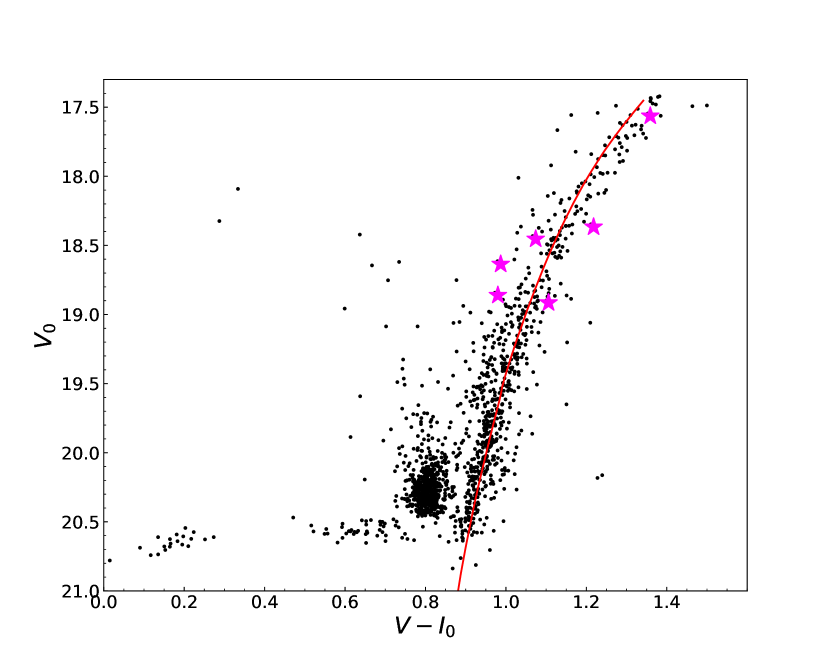
本研究は、矮小球状銀河における炭素強化低金属量星(CEMP)の、これまでで最も大規模な高分解能の元素組成解析を実施し、カイナ dSph に6顆の CEMP 星を同定した。複数の核合成過程が同定された:低中性子捕獲元素を示す1顆の CEMP-no 星と、s-およびr-過程元素が強化された5顆の CEMP-s/r/s 星であり、中性子捕獲パターンは金属貧困 AGB モデルからの i-過程の予測と最もよく一致する。これは、i-過程が CEMP-r/s 星の元素組成パターンの主要因であることを支持する。
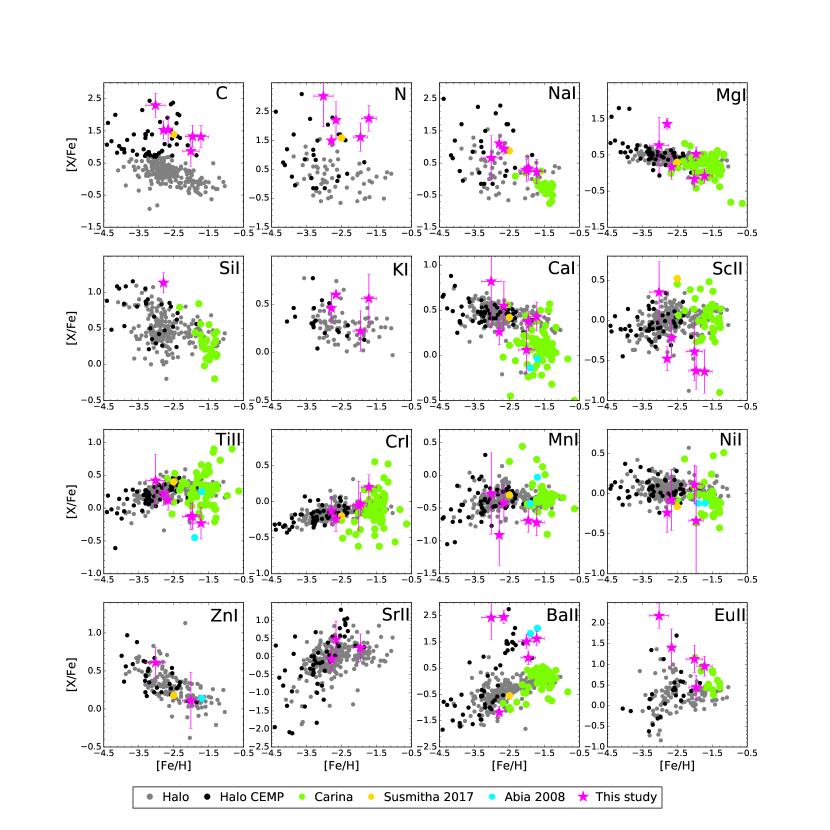
Context: Carbon Enhanced Metal-Poor (CEMP) stars ($\mathrm{[C/Fe]} > 0.7$) are known to exist in large numbers at low metallicity in the Milky Way halo and are important tracers of early Galactic chemical evolution. However, very few such stars have been identified in the classical dwarf spheroidal (dSph) galaxies, and detailed abundances, including neutron-capture element abundances, have only been reported for 12 stars. Aims: We aim to derive detailed abundances of six CEMP stars identified in the Carina dSph and compare the abundances to CEMP stars in other dSph galaxies and the Milky Way halo. This is the largest sample of CEMP stars in a dSph galaxy analysed to date. Methods: 1D LTE elemental abundances are derived via equivalent width and spectral synthesis using high-resolution spectra of the six stars obtained with the MIKE spectrograph at Las Campanas Observatory. Results: Abundances or upper limits are derived for up to 27 elements from C to Os in the six stars. The analysis reveals one of the stars to be a CEMP-no star with very low neutron-capture element abundances. In contrast, the other five stars all show enhancements in neutron-capture elements in addition to their carbon enhancement, classifying them as CEMP-$s$ and -$r/s$ stars. The six stars have similar $α$ and iron-peak element abundances as other stars in Carina, except for the CEMP-no star, which shows enhancement in Na, Mg, and Si. We explore the absolute carbon abundances ($A( m C)$) of CEMP stars in dSph galaxies and find similar behaviour as is seen for Milky Way halo CEMP stars, but highlight that CEMP-$r/s$ stars primarily have very high $A( m C)$ values. We also compare the neutron-capture element abundances of the CEMP-$r/s$ stars in our sample to recent $i$-process yields, which provide a good match to the derived abundances.
研究の動機と目的
- カイナ dSph に存在する CEMP 星の詳細な元素組成を特定すること。この銀河は、これまでの CEMP 星に関する研究が限られている。
- カイナ dSph の CEMP 星の元素組成パターンを、ミルキーウェイのハロー銀河および他の dSph 銀河のそれと比較すること。
- CEMP 星における中性子捕獲元素の強化の起源を調査すること、特に i-過程の役割を特定すること。
- dSph の CEMP-r/s 星が、ミルキーウェイのハロー銀河のそれらと同じ核合成経路を経由しているかどうかを評価すること。
- dSph の CEMP 星における絶対的炭素組成傾向と、初期銀河進化に与える示唆を検討すること。
提案手法
- カイナス・カムパニャス天文台に設置された6.5mマゼラン望遠鏡を用いたMIKE分光計による高分解能分光測定。
- CからOsまでの最大27元素について、等価幅法およびスペクトル合成法による1次元LTEの元素組成解析。
- 観測された中性子捕獲元素パターンを、金属貧困低質量 AGB モデルからの最新の i-過程予測(Choplin et al. 2022)と比較。
- 星におけるBaおよびEuの組成に一致させるために i-過程の予測値をスケーリングし、BaからDyへの平均偏差を補正。
- 絶対的炭素組成(A(C))の導出および、CEMP 種別および金属量ごとの比較。
- [Ba/Fe]、[Eu/Fe]、[Ba/Eu] の比に基づき、星を CEMP-no、CEMP-s、および CEMP-r/s に分類。
実験結果
リサーチクエスチョン
- RQ1カイナ dSph の CEMP 星は、ミルキーウェイのハロー銀河のそれらと同様の元素組成パターンを示すか?
- RQ2カイナの CEMP 星における観測された中性子捕獲元素の強化を引き起こす核合成過程は何か?
- RQ3i-過程は、カイナの CEMP-r/s 星における観測された元素組成パターンを再現できるか?
- RQ4dSph の CEMP 星における絶対的炭素組成(A(C))は、ミルキーウェイのハロー銀河のそれらと比べてどうか?
- RQ5dSph の CEMP-r/s 星は、CEMP-s 星とは区別できる明確な元素組成特徴を示すか?
主な発見
- 6顆の CEMP 星のうち1顆は、[Ba/Fe] < 0.0 で中性子捕獲元素の組成が低い CEMP-no 星と分類された。
- 残りの5顆は CEMP-s または CEMP-r/s 星であり、炭素および中性子捕獲元素の両方で強化が見られた。
- CEMP-r/s 星は絶対的炭素組成(A(C))が 7.5 以上であり、CEMP 星の中で最も高い A(C) 範囲に位置する。
- CEMP-r/s 星の中性子捕獲元素の組成パターンは、特に Ba から Dy の元素において、金属貧困 AGB モデルからの i-過程予測と良好に一致した。
- i-過程モデルは観測値に比べて炭素をわずかに過小予測しており、予測される logε(C) 値は 9.26–9.29 であったのに対し、補正済みの観測値は 7.24–7.80 であった。
- CEMP-no 星は Na、Mg、Si に顕著な強化を示しており、これは一部のハロー CEMP-no 星でも観測される特徴であり、共通の核合成起源を示唆している。
この論文を読む
Nubintのビューアで原文を開き、読みながら気になる箇所をすぐに質問できます。
Nubintでこの論文を読むこのレビューはAIが論文の原文をもとに作成しました。引用する前に原文をご確認ください。