
[論文レビュー] Exact power spectrum in a minimal hybrid model of stochastic gene expression oscillations
本論文は、離散的遺伝子スイッチングと連続的タンパク質ダイナミクスを組み合わせた最小限のハイブリッドモデルにおける、確率的遺伝子発現の揺らぎのスペクトルの正確な解析的解を提示する。タンパク質濃度のためのフォッカー・プランク方程式を解くことで、自己相関関数およびパワー・スペクトルの正確な表現式が導出され、負のフィードバックループにおける三相性の確率的分岐が明らかになり、持続的ノイズ誘発振動の出現を説明する。
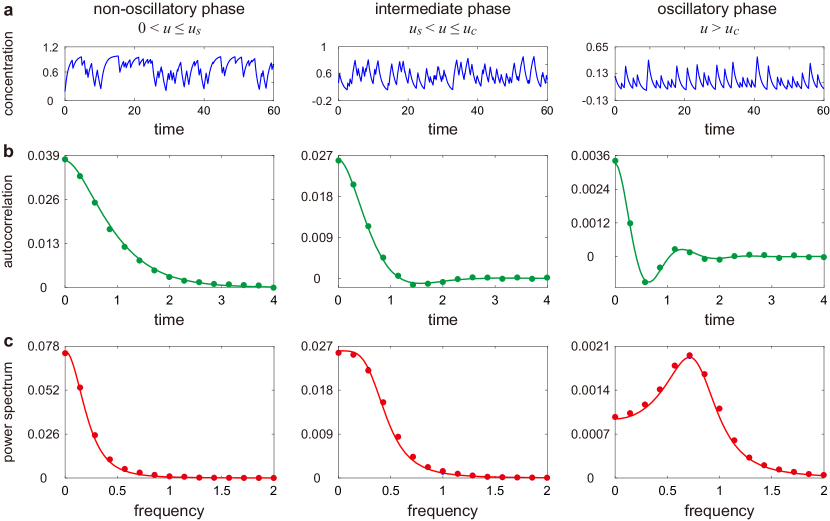
Stochastic oscillations in individual cells are usually characterized by a non-monotonic power spectrum with an oscillatory autocorrelation function. Here we develop an analytical approach of stochastic oscillations in a minimal hybrid model of stochastic gene expression including promoter state switching, protein synthesis and degradation, as well as a genetic feedback loop. The oscillations observed in our model are noise-induced since the deterministic theory predicts stable fixed points. The autocorrelated function, power spectrum, and steady-state distribution of protein concentration fluctuations are computed in closed form without making any approximations. Using the exactly solvable model, we illustrate sustained oscillations as a circular motion along a stochastic hysteresis loop induced by gene state switching. A triphasic stochastic bifurcation upon the increasing strength of negative feedback is observed, which reveals how stochastic bursts evolve into stochastic oscillations. In our model, oscillations tend to occur when the protein is relatively stable and when gene switching is relatively slow. Translational bursting is found to enhance the robustness and broaden the region of stochastic oscillations. These results provide deeper insights into R. Thomas' two conjectures for single-cell gene expression kinetics.
研究の動機と目的
- 近似手法(線形ノイズ近似など)の制限を克服するため、遺伝子発現における確率的振動の正確な解析的フレームワークを構築すること。
- 特にフィードバックループを伴う状況において、単一細胞における確率的振動の正確な理論の長年の欠落を解消すること。
- 最小限のハイブリッドモデルを用いて、レーニー・トーマスのフィードバックと振動に関する仮説のメカニスティックな説明を提供すること。
- 遺伝子状態のスイッチングによって駆動される確率的ヒステリシスループが、どのようにノイズによって駆動される持続的振動を支持するかを定量化すること。
- 翻訳のバーストを含めるための解析を拡張し、遺伝子発現の生物学的に重要な特徴を捉えること。
提案手法
- 遺伝子状態のスイッチングは離散的であり、タンパク質濃度は確率的微分方程式に従って連続的に変化するハイブリッド確率的モデルを定式化する。
- タンパク質濃度と遺伝子状態の同時確率密度関数のためのフォッカー・プランク方程式を導出し、モーメントの正確な計算を可能にする。
- タンパク質濃度の一次および二次モーメントのための線形常微分方程式系を解くことで、自己相関関数およびパワー・スペクトルを計算する。
- 行列指数関数法および固有値分解を用いて、自己相関関数を指数関数の和として閉形式の表現式に導出する。
- 自己相関関数にフーリエ変換を適用し、周波数領域における正確な解析的パワー・スペクトルを取得する。
- バーストサイズおよびバースト頻度の一般化されたジャンプ測度をモーメント方程式に組み込むことで、翻訳バーストを含めるフレームワークを拡張する。

実験結果
リサーチクエスチョン
- RQ1フィードバックを伴う最小限のハイブリッドモデルにおける確率的遺伝子発現振動の正確な解析的パワー・スペクトルを導出できるか?
- RQ2内在的ノイズの存在下で、負のフィードバックの強さが持続的振動の出現にどのように影響するか?
- RQ3遺伝子状態のスイッチングが、振動を支持する確率的ヒステリシスループを生成する役割を果たすか?
- RQ4翻訳バーストはタンパク質濃度の揺らぎの自己相関関数およびパワー・スペクトルにどのように影響するか?
- RQ5正確な解が、フィードバックと振動に関するトーマスの二つの仮説のメカニスティックな根拠を説明できるか?
主な発見
- 正確なパワー・スペクトルは、モーメントダイナミクス行列の二つの固有値に対応する二つのローレンツ型ピークの和として得られ、振動的挙動の正確な特徴付けを可能にする。
- フィードバックが存在しない、あるいは正のフィードバックの場合、持続的振動は出現せず、ノイズ誘発振動には負のフィードバックが必要であることが確認される。
- 負のフィードバックの下で、三相性の確率的分岐が明らかになる:フィードバック強度を増加させると、最初にノイズが抑制され、次に振動が誘発され、最後に減衰する。中程度の強度でパワー・スペクトルにピークが現れる。
- 自己相関関数は t=0 で単調に減少しており、短時間での揺らぎが反相関的であることを示し、振動的ダイナミクスの特徴となる。
- 定常状態におけるタンパク質濃度の分散は、フィードバック強度、分解速度、バーストパラメータを含む閉形式の式で与えられ、システムサイズおよびノイズ強度の正確な依存関係を示す。
- 翻訳バーストの導入により、モーメント方程式にバーストサイズの二次モーメントが追加され、低周波成分が強化された修正されたパワー・スペクトルが得られる。
より良い研究を、今すぐ始めましょう
論文の読解から最終レビューまで、研究時間を劇的に削減しましょう。
クレジットカード登録不要
このレビューはAIが作成し、人間の編集者が確認しました。