
[論文レビュー] Exciton states in monolayer MoSe2 and MoTe2 probed by upconversion spectroscopy
本研究では、ヘキサゴナル窒化ホウ素(hBN)でカプセル化されたモノレイヤーMoSe2およびMoTe2を用いてアップコンバージョン分光法を実施し、これまでに解明されなかった励起状態の励起子状態を解明した。1.5 meV未満の線幅を達成した。著者らは、共鳴する励起子-励起子アウジェー散乱メカニズムを特定し、基底状態から200 meV以上高い励起子状態へのバイアス制御によるアクセスを可能にした。反射分光法および光励起分光法による直接的確認がなされた。
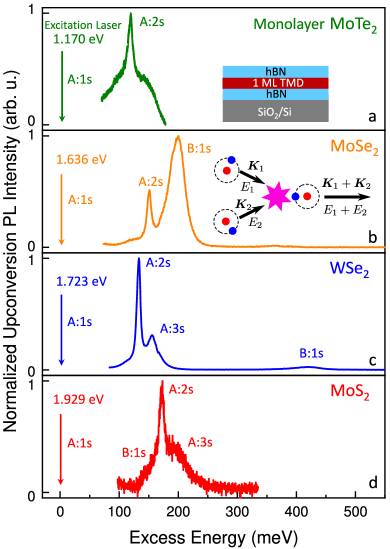
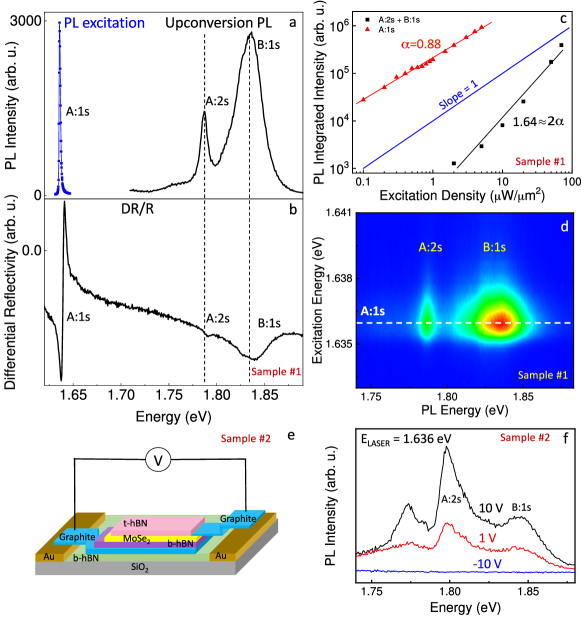
Transitions metal dichalcogenides (TMDs) are direct semiconductors in the atomic monolayer (ML) limit with fascinating optical and spin-valley properties. The strong optical absorption of up to 20 % for a single ML is governed by excitons, electron-hole pairs bound by Coulomb attraction. Excited exciton states in MoSe$_2$ and MoTe$_2$ monolayers have so far been elusive due to their low oscillator strength and strong inhomogeneous broadening. Here we show that encapsulation in hexagonal boron nitride results in emission line width of the A:1$s$ exciton below 1.5 meV and 3 meV in our MoSe$_2$ and MoTe$_2$ monolayer samples, respectively. This allows us to investigate the excited exciton states by photoluminescence upconversion spectroscopy for both monolayer materials. The excitation laser is tuned into resonance with the A:1$s$ transition and we observe emission of excited exciton states up to 200 meV above the laser energy. We demonstrate bias control of the efficiency of this non-linear optical process. At the origin of upconversion our model calculations suggest an exciton-exciton (Auger) scattering mechanism specific to TMD MLs involving an excited conduction band thus generating high energy excitons with small wave-vectors. The optical transitions are further investigated by white light reflectivity, photoluminescence excitation and resonant Raman scattering confirming their origin as excited excitonic states in monolayer thin semiconductors.
研究の動機と目的
- 従来の測定法における不均一な幅拡大と低オシレーター強度のため、これまでに解明されなかったモノレイヤーMoSe2およびMoTe2の励起状態の励起子状態を解明すること。
- ヘキサゴナル窒化ホウ素(hBN)カプセル化が励起子線幅を著しく狭めることが示され、励起状態の高分解能分光法が可能になること。
- 遷移金属ジ chalcogenide モノレイヤーにおけるアップコンバージョンの微視的メカニズムを特定し、特に励起子-励起子散乱の役割を解明すること。
- 非線形光学的手法としてのアップコンバージョン分光法を確立し、基底状態を超える全励起子スペクトルのプローブを可能にすること。
- 白色光反射分光法および光励起分光法(PLE)を用いた補足的技術により、アップコンバージョン信号の起源を検証すること。
提案手法
- hBNカプセル化されたモノレイヤーMoSe2およびMoTe2のA:1s励起子遷移に合わせてチューナブルなTi: Sapphireレーザーを用いて、共鳴する光励起分光法によるアップコンバージョン分光法を実施した。
- hBNカプセル化により、1.5 meV未満(MoSe2では1.5 meV、MoTe2では3 meV)の線幅を達成し、微細な励起子特徴の分解能が可能になった。
- 白色光反射分光法および光励起分光法(PLE)を用いて、アップコンバージョン発光ピークのエネルギー位置を独立して確認した。
- 有効質量およびk·p理論に基づく行列要素を用いて、励起状態の伝導帯に寄与する励起子-励起子アウジェー散乱に基づく理論的モデルを構築した。
- エネルギー保存則、運動量分布、交換相互作用を組み込んだ多体アプローチを用いて、アウジェー再結合率を計算した。
- アップコンバージョン過程を、一つの励起子が消滅し、エネルギーと運動量をもう一つの高エネルギー励起子に転送する共鳴的二励起子散乱事象としてモデル化した。
実験結果
リサーチクエスチョン
- RQ1共鳴励起されたモノレイヤーMoSe2およびMoTe2で観測されるアップコンバージョン発光の原因は何か。その背後にある物理的メカニズムは何か。
- RQ2なぜMoSe2およびMoTe2の励起状態の励起子状態は、標準的な光励起分光法では観測しにくいのか。どのようにしてそれらにアクセスできるか。
- RQ3hBNカプセル化は、これらの2次元半導体でこれまでに解明されなかった励起子状態の観測をどのように可能にするか。
- RQ4外部電気的ゲーティングによって、アップコンバージョン過程の効率をどの程度制御できるか。
- RQ5クーロン相互作用およびバンド構造は、モノレイヤーTMDにおける効率的な励起子-励起子散乱をどのように可能にするか。
主な発見
- hBNカプセル化により、MoSe2におけるA:1s励起子の線幅が1.5 meV未満、MoTe2では3 meV未満にまで狭められ、高分解能分光法が可能になった。
- アップコンバージョン分光法により、励起エネルギーから200 meV以上高い励起状態の励起子状態が明らかになった。両材料にA:2sおよびB:1s状態が存在することが確認された。
- アップコンバージョン過程は、印加ゲート電圧によって効率的に制御可能であり、非線形光学応答のチューナビリティが示された。
- アップコンバージョンの起源は、励起状態の伝導帯に寄与する共鳴的励起子-励起子アウジェー散乱プロセスであると特定された。このプロセスは、高エネルギーで運動量が小さい励起子を効率的に生成する。
- 理論的モデリングにより、強いクーロン相互作用と励起帯への共鳴的結合がアウジェー散乱率を増強し、他の緩和経路よりも優勢であることが確認された。
- 通常の条件(T = 4 K、nX = 10^9 cm⁻²)下で、測定されたアウジェー再結合時間は約25 psであり、観測されたアップコンバージョン効率と整合的であった。
より良い研究を、今すぐ始めましょう
論文設計から論文執筆まで、研究時間を劇的に削減しましょう。
クレジットカード登録不要
このレビューはAIが作成し、人間の編集者が確認しました。