
[論文レビュー] Explainable AI for clinical risk prediction: a survey of concepts, methods, and modalities
本調査は、臨床リスク予測における説明可能なAI(XAI)の包括的フレームワークを提案し、マルチモodalな医療データ全体にわたり、解釈可能性、公平性、透明性を統合する。合成データセットを用いたエンドツーエンドの検証、複数手法の説明可能性、オープンサイエンスの実践を提唱することで、信頼性、信頼性、臨床応用の向上を図る。
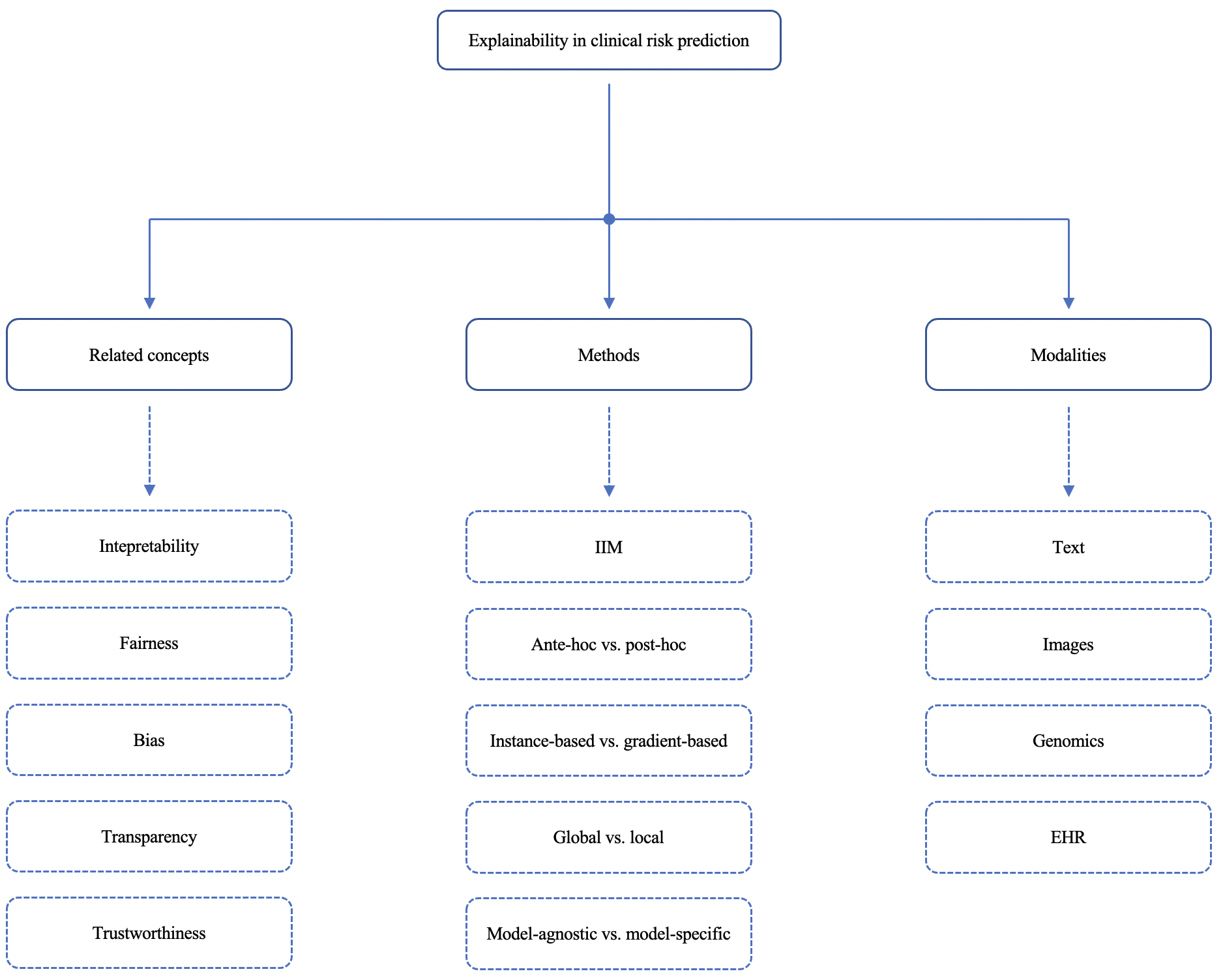
Recent advancements in AI applications to healthcare have shown incredible promise in surpassing human performance in diagnosis and disease prognosis. With the increasing complexity of AI models, however, concerns regarding their opacity, potential biases, and the need for interpretability. To ensure trust and reliability in AI systems, especially in clinical risk prediction models, explainability becomes crucial. Explainability is usually referred to as an AI system's ability to provide a robust interpretation of its decision-making logic or the decisions themselves to human stakeholders. In clinical risk prediction, other aspects of explainability like fairness, bias, trust, and transparency also represent important concepts beyond just interpretability. In this review, we address the relationship between these concepts as they are often used together or interchangeably. This review also discusses recent progress in developing explainable models for clinical risk prediction, highlighting the importance of quantitative and clinical evaluation and validation across multiple common modalities in clinical practice. It emphasizes the need for external validation and the combination of diverse interpretability methods to enhance trust and fairness. Adopting rigorous testing, such as using synthetic datasets with known generative factors, can further improve the reliability of explainability methods. Open access and code-sharing resources are essential for transparency and reproducibility, enabling the growth and trustworthiness of explainable research. While challenges exist, an end-to-end approach to explainability in clinical risk prediction, incorporating stakeholders from clinicians to developers, is essential for success.
研究の動機と目的
- 臨床リスク予測に用いられる複雑なAIモデルにおける説明可能性の増大するニーズに対応すること。これは、意思決定が患者の結果に直接影響を与えるためである。
- 臨床AIシステムにおける説明可能性、解釈可能性、公平性、バイアス、透明性の相互作用を明確にすること。
- EHR、医療画像、テキストなどの多様な臨床モダリティを用いて、XAI手法の評価と検証を定量的および臨床的アセスメントを通じて行うこと。
- 外部検証、合成データセットのテスト、コード共有を提唱することで、XAI研究における信頼性と再現可能性を向上させること。
- 臨床医や患者から開発者に至るまでステークホルダーを含めたエンドツーエンドのアプローチを推進することで、信頼性と実世界での有用性を確保すること。
提案手法
- 臨床AIにおける説明可能性、解釈可能性、公平性、透明性の概念を体系的にレビューし、それらを明確に区別する。
- 後処理手法(例:LIME、SHAP)、本質的に解釈可能なモデル(例:XGBoost、決定木)、ルールベースのシステムを含む、多様なXAI技術を分析する。
- XAI手法の信頼性を、事前に臨床的導入前に厳密にテストするために、既知の生成要因を持つ合成データセットの使用を提言する。
- 特徴量のランク付けや欠損に基づく耐性テストに適応された、AUROCやF1スコアなどの定量的評価指標を統合する。
- 複数のXAI手法を組み合わせることで、耐性を高め、バイアスを低減するための「複数手法の説明可能性」の必要性を強調する。
- 透明性、再現可能性、信頼性を確保するため、オープンアクセスとコード共有の重要性を強調する。
実験結果
リサーチクエスチョン
- RQ1異なるデータモダリティにおいて、臨床リスク予測の分野でXAI手法が信頼性と妥当性について体系的に評価される方法は何か?
- RQ2AI駆動の臨床意思決定において、解釈可能性、公平性、透明性、信頼の関係は何か?
- RQ3既知の下位要因を持つ合成データセットを、医療分野におけるXAI手法の検証にどの程度活用できるか?
- RQ4臨床医や患者が、説明可能なAIシステムの設計と評価に意味的に関与できる方法は何か?
- RQ5規制フレームワークとオープンサイエンスの実践は、医療分野における信頼的かつ再現可能なXAIを進展させる上で果たす役割は何か?
主な発見
- XAIは、モデルの誤りやバイアスが高リスクの結果をもたらす可能性があるため、臨床リスク予測モデルにおける信頼を築くために不可欠である。
- 後処理の説明手法だけでは不十分であり、包括的なモデル理解を得るためには、複数の解釈可能性技術の組み合わせが必要である。
- 既知の生成要因を持つ合成データセットを用いたXAI手法のテストは、信頼性と検証の自信を著しく向上させる。
- 欠損特徴量を用いた定量的評価フレームワークとランク付け指標(例:AUROC、F1)は、特徴量の重要度の説明を効果的に評価できる。
- オープンアクセスとコード共有は、再現可能性とXAI研究における長期的信頼性を確保する上で不可欠であり、とくに医療分野のような感受性の高い分野において重要である。
- 進展は見られるものの、臨床AIにおける説明可能性に関する多くの主張は誇張されており、厳密な検証とステークホルダー参加がなければ、実世界での臨床的受容は限定的である。
より良い研究を、今すぐ始めましょう
論文の読解から最終レビューまで、研究時間を劇的に削減しましょう。
クレジットカード登録不要
このレビューはAIが作成し、人間の編集者が確認しました。