
[論文レビュー] Extracting higher central charge from a single wave function
本稿では、2+1次元ボソン的トポロジカルオーダーの境界をギャップさせない障害である、より高い中心電荷を、波動関数1つから部分回転演算子の期待値を用いて抽出する手法を提案する。この手法は、コンformal field theory(CFT)およびν=1/2ラウフリン状態とキタエフヘキサゴナル格子モデルにおける数値シミュレーションにより検証されており、量子計算可能に評価可能であり、chiral central charge c₋ に依存しないアーベル的トポロジカルオーダーのギャップ可能性を完全に決定可能である。
A (2+1)D topologically ordered phase may or may not have a gappable edge, even if its chiral central charge c_{-} is vanishing. Recently, it was discovered that a quantity regarded as a "higher" version of chiral central charge gives a further obstruction beyond c_{-} to gapping out the edge. In this Letter, we show that the higher central charges can be characterized by the expectation value of the partial rotation operator acting on the wave function of the topologically ordered state. This allows us to extract the higher central charge from a single wave function, which can be evaluated on a quantum computer. Our characterization of the higher central charge is analytically derived from the modular properties of edge conformal field theory, as well as the numerical results with the ν=1/2 bosonic Laughlin state and the non-Abelian gapped phase of the Kitaev honeycomb model, which corresponds to U(1)_{2} and Ising topological order, respectively. The Letter establishes a numerical method to obtain a set of obstructions to the gappable edge of (2+1)D bosonic topological order beyond c_{-}, which enables us to completely determine if a (2+1)D bosonic Abelian topological order has a gappable edge or not. We also point out that the expectation values of the partial rotation on a single wave function put a constraint on the low-energy spectrum of the bulk-boundary system of (2+1)D bosonic topological order, reminiscent of the Lieb-Schultz-Mattis-type theorems.
研究の動機と目的
- 2+1次元ボソン的トポロジカルオーダーにおけるより高い中心電荷の微視的・波動関数ベースの特徴付けを確立すること。
- 従来、トポロジカル量子場理論を介して定義されていたが、トポロジカル波動関数とより高い中心電荷との間の直接的な微視的リンクの欠如を克服すること。
- chiral central charge c₋ が示唆するもの以上の範囲で、トポロジカルオーダーが境界をギャップ可能かどうかを特定する、数値的に実行可能かつ量子計算可能なプロトコルを提供すること。
- 1つの波動関数を用いて、アーベル的トポロジカルオーダーのギャップ可能性を完全に決定する一般の数値的手法を導出すること。
提案手法
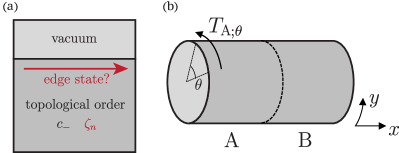
- 本稿では、波動関数の部分系に作用する部分回転演算子の期待値を用いて、より高い中心電荷 ζₙ を抽出する手法を提案する。
- この手法は、エッジの conformal field theory のモジュラー性に依拠し、与えられた anyon セクター a に対して、関係式 ζₙ = exp(2πi/n × (hₐ − c₋/24 − ηₕL²/(2πℏ))) を通じて部分回転振幅の位相とより高い中心電荷を結びつける。
- トポロジカル波動関数の行列積状態(MPS)表現を用いて数値的に実装され、部分回転は部分系上のユニタリ操作として実装される。
- 運動量偏極技術を用いて、共形次元 hₐ と chiral central charge c₋ を抽出し、これらを部分回転の位相と組み合わせて ζₙ を計算する。
- 有限サイズ補正を、ℓ_B²/L_y² の比に関して実施し、ζₙ,a の熱力学的極限値を抽出する。
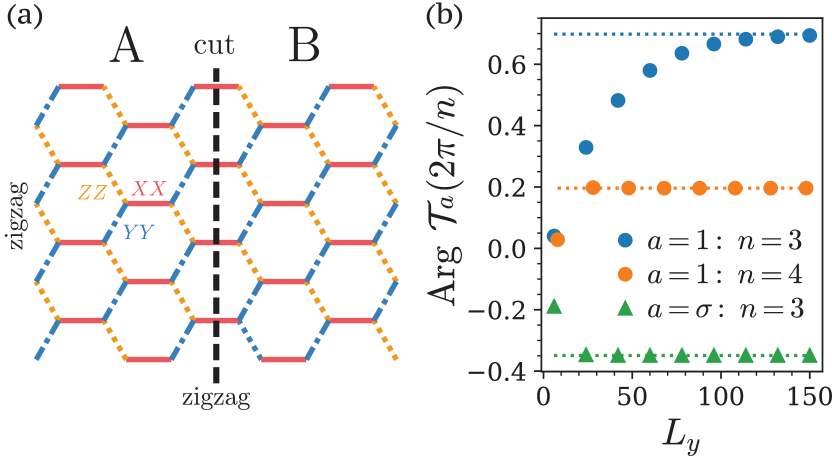
- 本手法は、ν=1/2 ボソン的ラウフリン状態およびキタエフヘキサゴナル格子モデルの非アーベル的相に対してテストされ、CFTの予測と比較されている。
実験結果
リサーチクエスチョン
- RQ1c₋ を超えるエッジのギャップ化を妨げるより高い中心電荷が、1つの微視的波動関数から抽出可能か?
- RQ2量子計算と整合する波動関数期待値に基づく、より高い中心電荷の直接的な操作的定義は存在するか?
- RQ3部分回転演算子の期待値が、さまざまな anyon セクターおよび系サイズに対して ζₙ を信頼性高く抽出可能か?
- RQ4本手法により、c₋ に依存しないアーベル的トポロジカルオーダーのギャップ可能性が完全に決定可能か?
- RQ5運動量偏極と比較して、より高い中心電荷を信頼性高く抽出するための数値的スケーリング要件と精度制約は何か?
主な発見
- 1つの波動関数上で部分回転演算子の期待値をとることで、より高い中心電荷 ζₙ が得られ、振幅の位相が conformal field theory を通じて ζₙ と直接関係づけられる。
- ν=1/2 ボソン的ラウフリン状態では、c₋ = 1 および hₛ = 1/4 が正しく抽出され、トポロジカルシフト 𝒮 = 1.998 が得られ、CFTの予測値 𝒮 = 2 と非常に良好に一致する。
- ねじれ付きのより高い中心電荷 ζₙ,ₐ は、系サイズ L_y が増加するに従い、期待される値(例:U(1)₂×U(1)₋₄ に対して ζ₃ = −1)に収束し、本手法の正確性が確認される。
- 部分回転の期待値の誤差は L_y に対して2次的に増加するが、ζₙ,a の誤差はそうではないため、本手法は運動量偏極と比較して、はるかに低い結合次元 χ および局所ボソン切断数 N_Boson を必要とする。
- n ≥ 5 に対して ζₙ,a を信頼性高く抽出するためには、L_y ≥ 64ℓ_B の系サイズが必要であり、これは L_y > n²ξ_r を満たす必要がある。ここで、ラウフリン状態では ξ_r ≈ √(2/3)πℓ_B である。
- c₋ と ζₙ,a を組み合わせることで、アーベル的トポロジカルオーダーのギャップ可能性が完全に決定可能であり、特に gcd(n, N_FS/gcd(n,N_FS)) = 1 のとき、十分条件が成立する。
より良い研究を、今すぐ始めましょう
論文の読解から最終レビューまで、研究時間を劇的に削減しましょう。
クレジットカード登録不要
このレビューはAIが作成し、人間の編集者が確認しました。