
[論文レビュー] Extreme damped Lyman-$α$ absorption in young star-forming galaxies at $z=9-11$
JWSTの観測は z ≈ 9–11 付近の3つの銀河に周囲でログ N_HI > 22 の極端なダンプド Lyα 吸収体を示し、局所的な HI ガスが豊富で初期銀河形成と再電離への影響を示唆します。
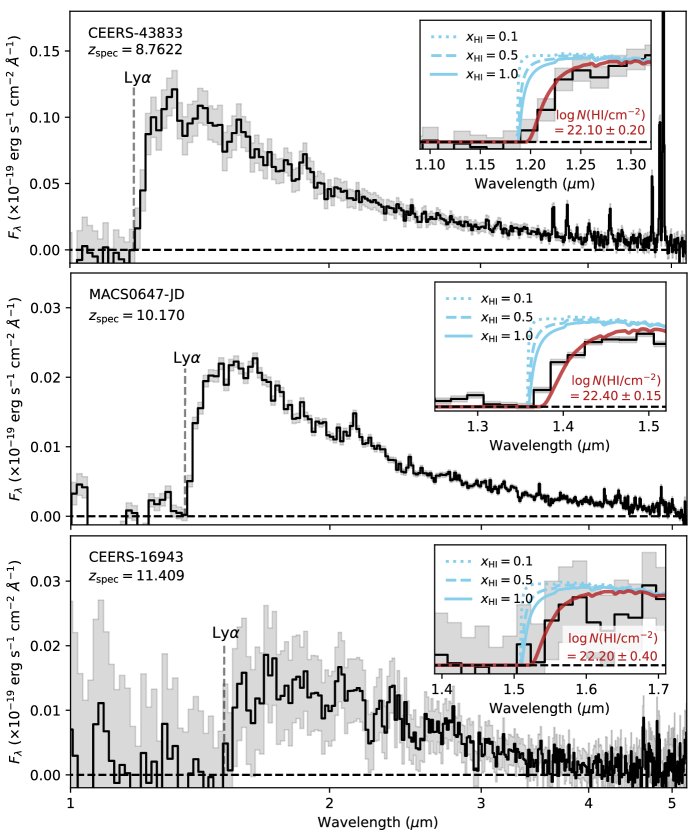
The onset of galaxy formation is thought to be initiated by the infall of neutral, pristine gas onto the first protogalactic halos. However, direct constraints on the abundance of neutral atomic hydrogen (HI) in galaxies have been difficult to obtain at early cosmic times. Here we present spectroscopic observations with JWST of three galaxies at redshifts $z=8.8 - 11.4$, about $400-600$ Myr after the Big Bang, that show strong damped Lyman-$α$ absorption ($N_{ m HI} > 10^{22}$ cm$^{-2}$) from HI in their local surroundings, an order of magnitude in excess of the Lyman-$α$ absorption caused by the neutral intergalactic medium at these redshifts. Consequently, these early galaxies cannot be contributing significantly to reionization, at least at their current evolutionary stages. Simulations of galaxy formation show that such massive gas reservoirs surrounding young galaxies so early in the history of the universe is a signature of galaxy formation in progress.
研究の動機と目的
- 再電離時代(z>8)における銀河環境における中性水素(HI)の豊富さと分布を調査する。
- IGM と局所的な HI(ISM/halo)寄与を区別しつつ、ダンピング翼 Lyα 吸収の特徴を特徴づける。
- 親銀河の物理的性質(SFR、金属量、ガス質量、ガス分率)を導出し、再電離と銀河形成への含意を評価する。
- 観測された HI 貯蔵とシミュレーションを比較し、初期宇宙におけるガス供給史を理解する。
提案手法
- Robust なエミッション線赤方偏移を持つ z>8 銀河系の JWST/NIRSpec プリズムスペクトルを取得する。
- IGM ガン・ペテルソン・ダンピングと局所的な DLA (Voigt) プロファイルを組み合わせて Lyα 吸収をモデル化し N_HI を適合させる。
- ベイズ多模態ネスティッドサンプリング(PyMultiNest)を用いて自由度パラメータ:A_V、x_HI、N_HI を制約する。
- intrinsic continua を BPASS+Cloudy テンプレートで固定し、テンプレート選択に対する頑健性を評価する(Δlog N_HI ≲ 0.1 dex)。
- IGM のシナリオ(x_HI = 0.1、0.5、1.0)を探索し、 sightline シミュレーションと比較して吸収を局所 HI around galaxies に帰属させる。
実験結果
リサーチクエスチョン
- RQ1z≈9–11 で形成される銀河の immediate environments における HI のカラム密度はどれくらいか。
- RQ2これら銀河の周囲の局所 HI(DLAs) は Lyα ダンピング翼にどの程度寄与し、IGM と比較してどれくらいの割合か。
- RQ3これら銀河の物理的性質(SFR、金属量、星形成質量、ガス含有量)はどのようで、低赤方偏移の類似例とどのように比較されるか。
- RQ4観測された HI 貯蔵は再電離期のガス accretion とガス分率のシミュレーションと整合するか。
主な発見
| R.A. | Decl. | z_spec | log N_HI / cm^-2 | 12+log(O/H) | SFR Hβ/[OII] /(M_sun yr^-1) | O32 | log(M*/M_sun) | SFR_SED /(M_sun yr^-1) | log U | A_V / mag |
|---|---|---|---|---|---|---|---|---|---|---|
| 14h19m45.27s | 52d54m42.3s | 8.7622 ± 0.0004 | 22.10 ± 0.20 | 7.46 ± 0.09 | 14.5^{+14.4}_{-7.2} | 11.4 ± 1.7 | 8.72 ± 0.03 | 2.3^{+0.2}_{-0.2} | −1.91^{+0.10}_{-0.15} | 0.04 ± 0.02 |
| 06h47m53.12s | 70d14m22.98s | 10.170 ± 0.003 | 22.40 ± 0.15 | 7.40 ± 0.30 | 1.4 ± 0.2 | 30 ± 6 | 8.10 ± 0.30 | 8 ± 3 | −1.90 ± 0.20 | 0.07 ± 0.06 |
| 14h19m46.36s | 52d56m32.8s | 11.409 ± 0.001 | 22.20 ± 0.40 | 7.70 ± 0.30 | 4.3^{+4.2}_{-2.1} | – | 8.90 ± 0.08 | 4.8^{+0.7}_{-0.8} | −1.99^{+0.62}_{-0.64} | 0.04^{+0.03}_{-0.02} |
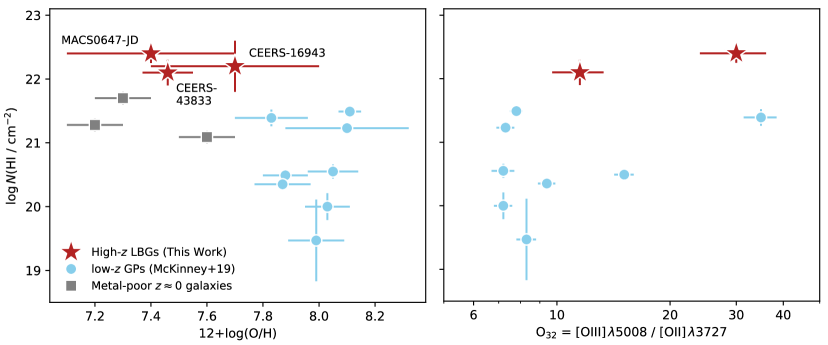
- 全ての z=9–11 銀河は極端な DLA を示し、log10(N_HI/cm^-2) = 22.10 ± 0.20 (CEERS-43833)、22.20 ± 0.40 (CEERS-16943)、および 22.40 ± 0.15 (MACS0647-JD)。
- DLA は IGM のダンピング翼を超えて Lyα 吸収の支配的要因となり、HI が局所的な銀河環境に存在することを示し、IGM の中性性のみによるものではないことを示唆する。
- 推定された HI 質量は顕著な周縁銀河ガスを意味し、ガス質量は約 10^7.5–10^9 M_sun の範囲、ガス分率 M_gas/M_* はサンプル全体で約 5。
- SFR は約 1.4 から 14.5 M_sun/yr の範囲(ニュートラル線から)、星形成質量は約 10^8–10^9 M_sun、金属量は低く(12+log(O/H) ≈ 7.4–7.7)。
- DLA から推定されるガス表面密度は高く、DLA 単独では推定されるよりも大きな総ガス貯蔵量を示唆し、KS 一致の総ガス質量を要する可能性がある。
- シミュレーション(Astraeus)は、高赤方偏移系における観測結果と概ね一致するガス質量とガス分率を予測し、初期時代のガス蓄積が活発であることを示唆する。
より良い研究を、今すぐ始めましょう
論文設計から論文執筆まで、研究時間を劇的に削減しましょう。
クレジットカード登録不要
このレビューはAIが作成し、人間の編集者が確認しました。