
[論文レビュー] Extreme mass ratio inspirals in galaxies with dark matter halos
本論文は、Schwarzschild black hole 時空に Hernquist-type 暗黒物質ハローが埋め込まれたEMRIの軌道動力学と重力波信号の解析表現を導出し、DMハローがLISA帯信号に検出可能な位相ずれとミスマッチを生じさせることを示している。
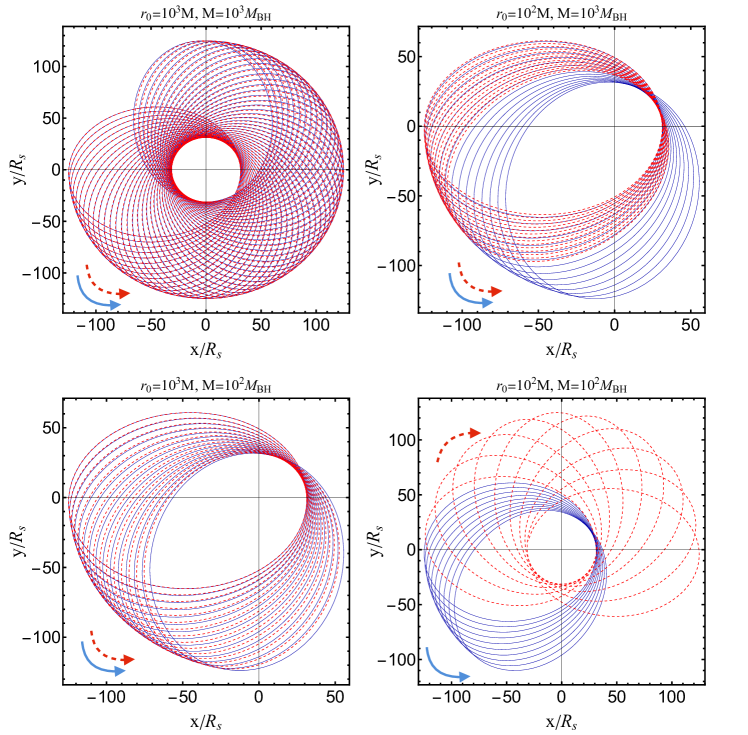
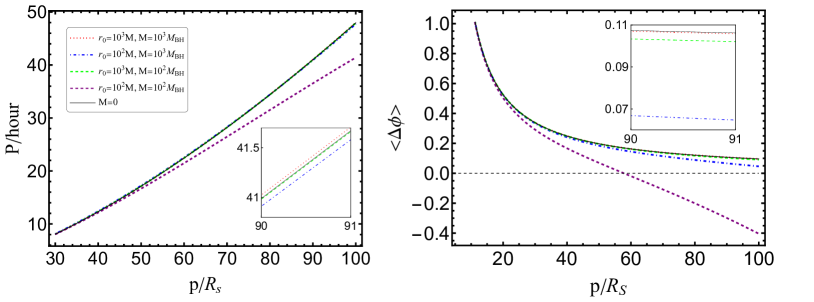
Using an analytic, static, and spherically symmetric metric for a Schwarzschild black hole immersed in a dark matter (DM) halo with the Hernquist-type profile, we derive analytic expressions for the orbital period and precession of eccentric extreme mass ratio inspirals (EMRIs) surrounded by DM halos, and we show how the precession rates decrease and even undergo a prograde-to-retrograde precession transition if the density of DM halo is large enough. The presence of local DM halos also retards the decrease of the semi-latus rectum and the eccentricity. The orbital evolution of EMRIs immersed in DM halos is then calculated numerically by considering the combined effects of gravitational radiation reaction, dynamical friction, and accretion. Comparing the number of orbital cycles accumulated over a one-year evolution for EMRIs with and without DM halos, we find that DM halos with compactness as small as $10^{-5}$ can be detected. From the mismatch between gravitational waveforms of EMRIs with and without DM halos, we show that EMRIs in galaxies can be used to probe the existence of DM halos and detect the compactness of DM halos as small as $10^{-5}$. Employing the Fisher information matrix method, we find that larger compactness and density values of DM halos help to reduce the estimation error of parameters and further break the degeneracy between the parameters.
研究の動機と目的
- 大質量ブラックホールの周囲の暗黒物質ハローがEMRIの軌道とGW信号にどのように影響するかを評価する。
- DM環境における軌道周期と進行(近回転)に対する解析式を導出する。
- LISAでの検出性のために、DMハローによるGW位相ずれと波形ミスマッチを定量化する。
提案手法
- Hernquist-type DMハロー内のSchwarzschildブラックホールに対して、静的で球対称な計量を用いる。
- 測地線運動から軌道要素(p, e)と進行の解析表現を導出する。
- 環境補正を含む一階のGWフラックス(dE/dt, dL/dt)を計算する。
- エネルギー・角運動量バランスとGW放出からp(t)とe(t)を進化させる。
- 真空ケースと比較した時間領域のGW波形と位相ずれを計算する。
- LISAにおける周回数と波形ミスマッチを用いて検出可能性を評価する。
実験結果
リサーチクエスチョン
- RQ1Hernquist DMハローは中心の Schwarzschild BH 周りの測地線軌道をどのように変えるか?
- RQ2DMハローによる軌道周期、進行、軌道要素の進化の解析的補正は何か?
- RQ3DMハローはLISAのような宇宙系検出器で観測されるEMRI信号で測定可能な位相ずれや波形ミスマッチを生み出し得るか?
- RQ4GW観測を用いたDMハローのコンパクト性 M/r0 の検出閾値は何か?
- RQ5楕円軌道はEMRIにおけるDMハローの検出可能性にどのように影響するか?
主な発見
- DMハローは軌道の進行を低下させ、十分に密なハローでは逆進行を起こすことがある。
- DMハローはGW放出下で半長半径pと離心率の減少を緩める。
- 合体の1年前には、コンパクト性が 10^-4 ほどのDMハローでも周回数カウント位相ずれによって検出可能。
- DM埋め込みEMRIと真空EMRIの波形ミスマッチは、LISAにおいてコンパクト性 ~10^-5 までのDMハローを探ることができる。
- 離心軌道は円軌道と比べてより小さなDMハローのコンパクト性を検出する能力を高める。
- DMハロー補正を含むT(軌道周期)とΔφ(離心進角)の解析的表現を提供(本文のEq. 23–24)。
より良い研究を、今すぐ始めましょう
論文設計から論文執筆まで、研究時間を劇的に削減しましょう。
クレジットカード登録不要
このレビューはAIが作成し、人間の編集者が確認しました。