
[論文レビュー] Fair coins tend to land on the same side they started: Evidence from 350,757 flips
350,757回のコインネックの大型スケール研究により、ダイアコニス、ホルムズ、モンゴメリー(2007年)が提唱した物理学的モデルが強く裏付けられた。このモデルは、人間のネックにおけるわずかなプレセッションの影響により、公平なコインは元の面の上に落ちやすいと予測している。データは、50.8%(95%信頼区間[0.506, 0.509])の統計的に有意な同じ面へのバイアスを示しており、個人差が顕著に認められ、コインが公平であっても人間のネックが予測可能な物理的バイアスをもたらすことが確認された。
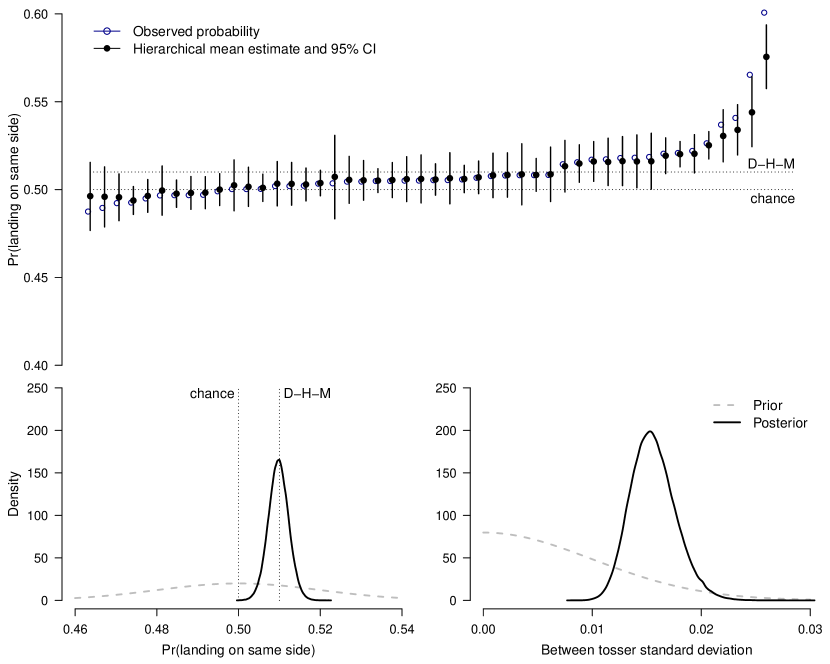
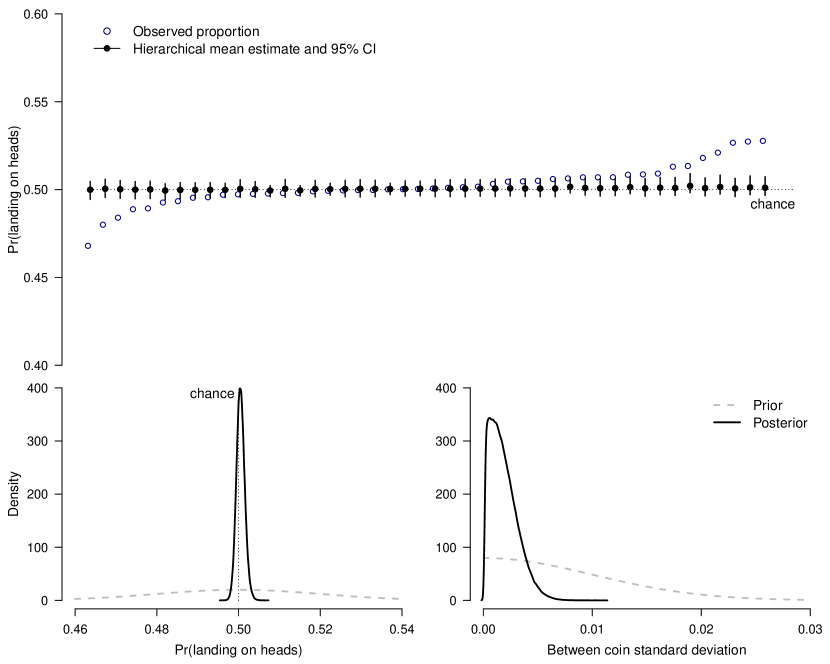
Many people have flipped coins but few have stopped to ponder the statistical and physical intricacies of the process. We collected $350{,}757$ coin flips to test the counterintuitive prediction from a physics model of human coin tossing developed by Diaconis, Holmes, and Montgomery (DHM; 2007). The model asserts that when people flip an ordinary coin, it tends to land on the same side it started -- DHM estimated the probability of a same-side outcome to be about 51\%. Our data lend strong support to this precise prediction: the coins landed on the same side more often than not, $ ext{Pr}( ext{same side}) = 0.508$, 95\% credible interval (CI) [$0.506$, $0.509$], $ ext{BF}_{ ext{same-side bias}} = 2359$. Furthermore, the data revealed considerable between-people variation in the degree of this same-side bias. Our data also confirmed the generic prediction that when people flip an ordinary coin -- with the initial side-up randomly determined -- it is equally likely to land heads or tails: $ ext{Pr}( ext{heads}) = 0.500$, 95\% CI [$0.498$, $0.502$], $ ext{BF}_{ ext{heads-tails bias}} = 0.182$. Furthermore, this lack of heads-tails bias does not appear to vary across coins. Additional analyses revealed that the within-people same-side bias decreased as more coins were flipped, an effect that is consistent with the possibility that practice makes people flip coins in a less wobbly fashion. Our data therefore provide strong evidence that when some (but not all) people flip a fair coin, it tends to land on the same side it started.
研究の動機と目的
- D-H-M物理学モデルが予測する直感に反する予測、すなわち人間がネックする公平なコインは、元の面と同じ面に落ちやすいという仮説を検証すること。
- この同じ面へのバイアスが個人間で一貫しているか、また個人によって異なるかを調査すること。
- 元の面をランダムにした場合に、表が出る全体の確率が50%のままであるかを検証し、表と裏のバイアスがないことを確認すること。
- 現実の意思決定の文脈における同じ面バイアスの実用的影響を評価すること。
- 多様な参加者から収集した大規模かつ事前に登録済みのデータセットを用いて、D-H-Mモデルを検証すること。
提案手法
- 350,757回の個別コインネックを含む、事前に登録済みの大規模なデータ収集作業。
- 参加者は好みの方法で標準的な米国およびオランダ製のコインをネックし、元の面(表か裏)がランダムに割り当てられた。
- 各ネックは動画で記録され、データ品質の確保と操作の防止を目的とした監査が実施された。
- 統計的分析ではベイズ推論を用いて同じ面の結果の確率と表裏バイアスを推定し、モデル比較にはベイズファクターが用いられた。
- 個人内変動を含めた分析により、同じ面バイアスにおける個人差の程度を評価した。
- データと資料は、透明性と再現性を高めるためにオープンサイエンスフレームワーク(OSF)を通じて公開された。
実験結果
リサーチクエスチョン
- RQ1D-H-M物理学モデルが予測するように、コインが元の面と同じ面に落ちる確率は50%を超えるか?
- RQ2異なるコインネッカー間で、同じ面バイアスの程度に顕著な個人差が認められるか?
- RQ3元の面をランダムにした場合に、コインが表に落ちる全体の確率は50%であるか。これは表と裏のバイアスがないことを示唆する。
- RQ4観察された同じ面バイアスが、現実の意思決定シナリオにおいてどの程度実用的影響を及ぼすか?
- RQ5D-H-Mモデルが予測する51%の同じ面バイアスが、大規模で高品質なデータセットを用いて実証的に確認できるか?
主な発見
- コインが元の面と同じ面に落ちる確率は50.8%であり、95%信用区間[0.506, 0.509]であった。これは同じ面バイアスに強い証拠を示している。
- 同じ面バイアスに関するベイズファクターは2364であり、D-H-Mモデルの予測を強く支持する証拠となった。
- 同じ面バイアスの程度に、個人間で顕著な変動が認められ、ネックの力学的特性に個人差があることが示唆された。
- 表に落ちる全体の確率は50.0%であり、95%信用区間[0.498, 0.502]であった。ベイズファクターは0.183であり、表と裏のバイアスがないという強い証拠が得られた。
- 同じ面バイアスは、コインの種類に関係なく一貫しており、コイン固有の特性に依存しないことが示された。
- シミュレーションにより、元の面を知ることで1,000回の賭けで19ドルの利益を得られる可能性があることが示され、繰り返しの賭けの場面で戦略的利点があることが示唆された。
より良い研究を、今すぐ始めましょう
論文の読解から最終レビューまで、研究時間を劇的に削減しましょう。
クレジットカード登録不要
このレビューはAIが作成し、人間の編集者が確認しました。