
[論文レビュー] Fast quantum algorithm for differential equations
本稿では、系のサイズ $N$ における対数的多項式スケーリングと、条件数 $κ$ に依存しない性能を達成する、大規模な非同次偏微分方程式(PDE)を解く高速な量子アルゴリズムを提示する。ウェーブレット基底を座標系として用いることで、一様に有界な条件数を保証する対角型プリコンディショナが可能となり、量子特異値変換(QSVT)を用いた量子線形システム解法が、$κ$ に対して部分線形スケーリングで効率的に行える。主な貢献は、悪条件なPDEに対して古典的手法と比較して指数的高速化を達成する量子アルゴリズムの構築である。
Partial differential equations (PDEs) are ubiquitous in science and engineering. Prior quantum algorithms for solving the system of linear algebraic equations obtained from discretizing a PDE have a computational complexity that scales at least linearly with the condition number $κ$ of the matrices involved in the computation. For many practical applications, $κ$ scales polynomially with the size $N$ of the matrices, rendering a polynomial complexity in $N$ for these algorithms. Here we present a quantum algorithm with a complexity that is polylogarithmic in $N$ but is independent of $κ$ for a large class of PDEs. Our algorithm generates a quantum state from which features of the solution can be extracted. Central to our methodology is using a wavelet basis as an auxiliary system of coordinates in which the condition number of associated matrices becomes independent of $N$ by a simple diagonal preconditioner. We present numerical simulations showing the effect of the wavelet preconditioner for several differential equations. Our work could provide a practical way to boost the performance of quantum simulation algorithms where standard methods are used for discretization.
研究の動機と目的
- 既存のPDEを解く量子アルゴリズムが条件数 $\kappa$ に線形に依存するという限界を克服し、悪条件系においても非効率となるのを防ぐ。
- 系のサイズ $N$ に対して対数的多項式スケーリングを達成するとともに、$\kappa$ に依存しない量子アルゴリズムを開発し、広範なPDEクラスに対して指数的高速化を実現する。
- ウェーブレットの数学的性質を活用して、系のサイズ $N$ にかかわらず一様に有界な条件数を保証するプリコンディショナを構築する。
- ウェーブレットに基づくプリコンディショニングが、非対称または係数が変化する微分作用素に対しても、量子特異値変換(QSVT)による効率的な量子行列逆行列計算を可能にすることを示す。
提案手法
- 離散化されたPDEのための代替座標系としてウェーブレット基底を用い、システム行列の条件数が $N$ に依存しない形に変換する。
- 対角型ウェーブレットプリコンディショナを適用し、行列サイズにかかわらず一様に有界な条件数(例えば、ハールウェーブレットでは定数)を維持することで、システムの安定化を実現する。
- プリコンディショニングされた行列を、多項式近似による行列逆行列への近似を可能にする量子特異値変換(QSVT)で処理する。
- ゼロに近い区間を除いた区間上で逆関数およびステップ関数の多項式近似を構築し、$\varepsilon$ の精度を保ちつつ演算子ノルムが有界であることを保証する。
- 複合多項式 $P_{\varepsilon/c,I_c}^{\textsc{mi}}(x)$ を用いて $1/(2cx)$ を近似し、逆関数とステップ関数の近似を組み合わせることで $\varepsilon/c$ の精度を達成する。
- ウェーブレットプリコンディショナが一様に有界な条件数をもたらす限り、2階微分作用素や係数が変化する微分作用素を含む広範なPDEクラスに適用可能である。
実験結果
リサーチクエスチョン
- RQ1条件数 $\kappa$ に依存せず、系のサイズ $N$ に対して対数的多項式スケーリングを達成する量子アルゴリズムは、PDEの広範なクラスを解くことができるか?
- RQ2ウェーブレットに基づくプリコンディショニングにより、系のサイズ $N$ にかかわらず、離散化されたPDE行列の条件数が一様に有界に保たれるか?
- RQ3条件数 $\kappa$ が $N^2$ に比例する悪条件系に対しても、多項式近似を用いたQSVTにより、効率的な量子行列逆行列計算が可能か?
- RQ4ウェーブレット座標における構造的対角プリコンディショナの使用により、$\kappa$ に対して部分線形スケーリングが達成可能であり、既知の量子複雑度下限と整合的か?
主な発見
- ウェーブレットプリコンディショナは、系のサイズ $N$ に依存せず、離散化されたPDE行列の条件数が一様に有界(例えば、ハールウェーブレットでは定数)に保たれることを保証する。
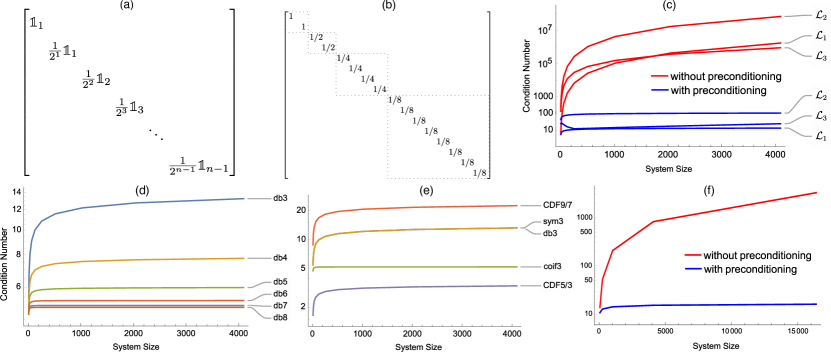
- 数値シミュレーションにより、$\mathcal{L}_1 = d^2/dx^2$、$\mathcal{L}_2 = d^2/dx^2 - d/dx + 1$、$\mathcal{L}_3 = -d/dx(\cosh(x/4)d/dx) + e^x$ のような作用素に対し、ウェーブレットプリコンディショナが条件数を効果的に低減することが確認され、$N$ が増加しても条件数が有界に保たれている。
- 量子アルゴリズムは、$N$ に対して対数的多項式スケーリングであり、$\kappa$ に依存しない計算複雑性を達成し、悪条件なPDEに対して古典的手法と比較して指数的高速化を実現する。
- この方法は、既知の量子複雑度下限に反するものではない。なぜなら、これは「速く解ける」(fast-solvable)と呼ばれる特定のPDEクラスに限定して適用されるためであり、これは「速くフォワード可能」(fast-forwardable)なハミルトニアンに類似している。
- 逆関数およびステップ関数の多項式近似を用いたQSVTの使用により、誤差を $\varepsilon$ に制御しながら、量子コンピュータ上で正確かつ有界な行列逆行列計算が可能である。
- ウェーブレットプリコンディショナが一様に有界な条件数をもたらす限り、2階微分作用素や係数が変化する微分作用素を含む広範な非同次PDEクラスに適用可能である。

より良い研究を、今すぐ始めましょう
論文の読解から最終レビューまで、研究時間を劇的に削減しましょう。
クレジットカード登録不要
このレビューはAIが作成し、人間の編集者が確認しました。