
[論文レビュー] Federated Learning and Blockchain-enabled Fog-IoT Platform for Wearables in Predictive Healthcare
この論文は、機械学習の連邦学習と私的ブロックチェーンを組み合わせたフォグ-IoTプラットフォームを提案し、ウェアラブルIoTにおける予測医療のデータプライバシー、完全性、適応性を保護する。1D CNNを用い、Raspberry Piテストベッド上でHARデータセットを用いて検証。
Over the years, the popularity and usage of wearable Internet of Things (IoT) devices in several healthcare services are increased. Among the services that benefit from the usage of such devices is predictive analysis, which can improve early diagnosis in e-health. However, due to the limitations of wearable IoT devices, challenges in data privacy, service integrity, and network structure adaptability arose. To address these concerns, we propose a platform using federated learning and private blockchain technology within a fog-IoT network. These technologies have privacy-preserving features securing data within the network. We utilized the fog-IoT network's distributive structure to create an adaptive network for wearable IoT devices. We designed a testbed to examine the proposed platform's ability to preserve the integrity of a classifier. According to experimental results, the introduced implementation can effectively preserve a patient's privacy and a predictive service's integrity. We further investigated the contributions of other technologies to the security and adaptability of the IoT network. Overall, we proved the feasibility of our platform in addressing significant security and privacy challenges of wearable IoT devices in predictive healthcare through analysis, simulation, and experimentation.
研究の動機と目的
- ウェアラブル IoT の予測医療におけるデータプライバシーとサービス完全性の課題に対処する。
- 連 federated learning と private blockchain を活用したスケーラブルで適応的な fog-IoT アーキテクチャを開発する。
- 分散医療分析におけるモデルの精度とセキュリティ影響を評価する低コストのテストベッドを評価する。
提案手法
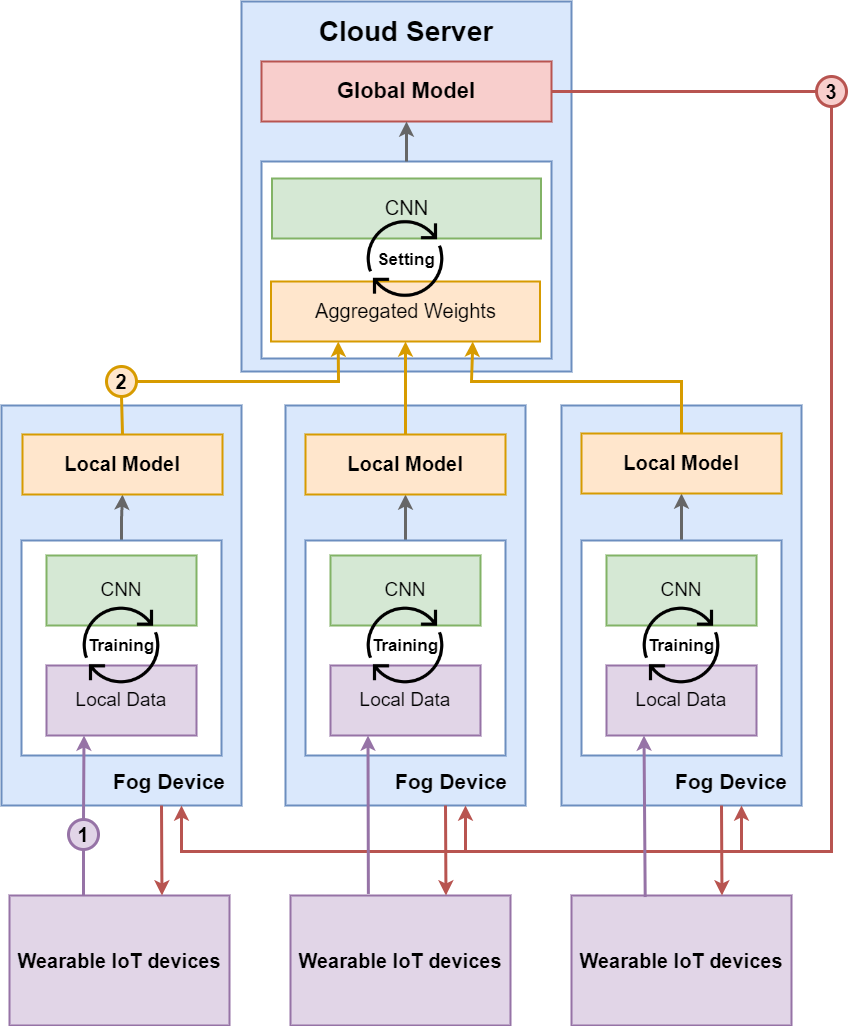
- ウェアラブルデバイスがクライアントとして機能し、トレーニングをフォグデバイスへ移動させるフォグ-IoT アーキテクチャを利用する。
- ローカルに訓練された CNN モデルをグローバル HAR モデルへ集約する federated learning を実装する。
- トレーニングデータとモデルのバージョン管理を改ざん耐性のあるハイパーレジャーで行う私的ブロックチェーンを組み込む。
- HARデータで訓練された 1D CNN を用いて予測医療モニタリングをシミュレートする。
- 分散学習と評価を模擬するために 10 fog ノードを備えた Raspberry Pi ベースのテストベッドを展開する。
- グローバルモデルの精度とローカルモデルの平均精度を比較して FL の有効性を評価する。

実験結果
リサーチクエスチョン
- RQ1エッジからフォグへのトレーニングを含む連邦学習は、ウェアラブル IoT 環境において患者データのプライバシーを保持しつつ予測モデルの完全性を維持できるか。
- RQ2私的ブロックチェーンを統合することで、フォグ-IoT ヘルスケアプラットフォームにおける locally trained models およびグローバル集約のセキュリティと追跡性を強化できるか。
- RQ3提案されたスケーリング方式は、局所モデルを平均化する場合と比較してグローバルモデルの性能にどのような影響を与えるか。
主な発見
- ローカルモデルは HAR データで 90.43% のテスト精度を達成した。
- グローバルモデルの精度は 91.75% にピークし、クライアント数が増えるにつれて平均的なローカルモデルの精度を上回る。
- スケーリング方式は最も良いローカルモデルに最も高いウェイトを与え、グローバルモデルの性能を向上させる。
- フェデレーテッドラーニングの設定は、中央サーバーへの生データ露出を抑えつつ分類子の完全性を維持する。
- 私的ブロックチェーンはトレーニングモデルとフェデレーテッド更新の改ざん防止ログとアクセス制御を提供する。
この論文を読む
Nubintのビューアで原文を開き、読みながら気になる箇所をすぐに質問できます。
Nubintでこの論文を読むこのレビューはAIが論文の原文をもとに作成しました。引用する前に原文をご確認ください。