
[論文レビュー] Federated Learning for 6G: Paradigms, Taxonomy, Recent Advances and Insights
A comprehensive survey of how federated learning can be integrated across the 6G protocol stack, detailing paradigms, taxonomy, algorithms, and applications at PHY, MAC, network, transport, and application layers.
Artificial Intelligence (AI) is expected to play an instrumental role in the next generation of wireless systems, such as sixth-generation (6G) mobile network. However, massive data, energy consumption, training complexity, and sensitive data protection in wireless systems are all crucial challenges that must be addressed for training AI models and gathering intelligence and knowledge from distributed devices. Federated Learning (FL) is a recent framework that has emerged as a promising approach for multiple learning agents to build an accurate and robust machine learning models without sharing raw data. By allowing mobile handsets and devices to collaboratively learn a global model without explicit sharing of training data, FL exhibits high privacy and efficient spectrum utilization. While there are a lot of survey papers exploring FL paradigms and usability in 6G privacy, none of them has clearly addressed how FL can be used to improve the protocol stack and wireless operations. The main goal of this survey is to provide a comprehensive overview on FL usability to enhance mobile services and enable smart ecosystems to support novel use-cases. This paper examines the added-value of implementing FL throughout all levels of the protocol stack. Furthermore, it presents important FL applications, addresses hot topics, provides valuable insights and explicits guidance for future research and developments. Our concluding remarks aim to leverage the synergy between FL and future 6G, while highlighting FL's potential to revolutionize wireless industry and sustain the development of cutting-edge mobile services.
研究の動機と目的
- Explain the motivation for AI-native 6G and the role of FL in enabling privacy-preserving distributed learning for wireless systems.
- Provide a taxonomy of FL paradigms (horizontal, vertical, federated transfer) and related architectures relevant to 6G.
- Assess FL applications and techniques across the physical, MAC, network, transport, and application layers.
- Identify challenges, insights, and open problems to guide future integration of FL in 6G and beyond.
提案手法
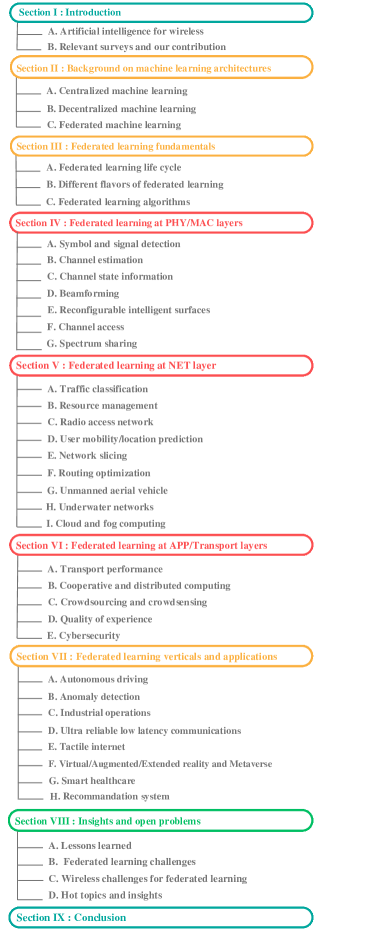
- Survey and synthesis of FL fundamentals, including life cycle, flavors, and algorithms.
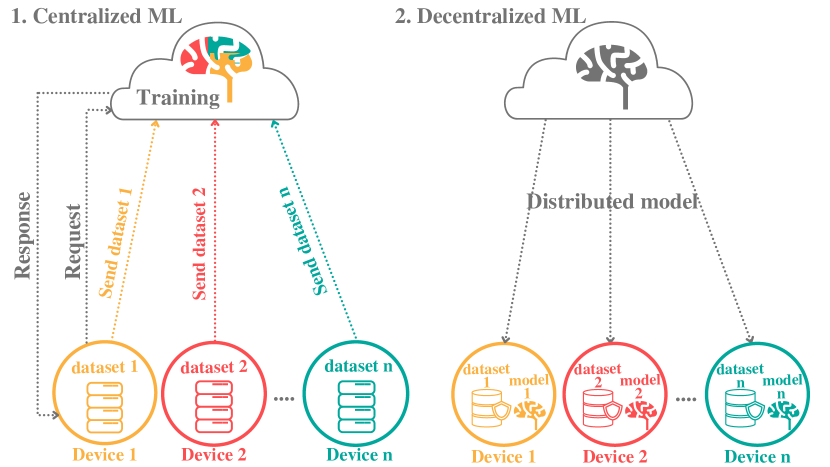
- Comparison of centralized ML, distributed ML, and FL in privacy, scalability, and heterogeneity contexts.
- Analysis of FL applications in PHY, MAC, NET, and APP layers with representative architectures and frameworks.
- Compilation of existing FL algorithms (FedAvg, FedSGD, FedProx, FedATT, SimFL) and their benefits/drawbacks.
実験結果
リサーチクエスチョン
- RQ1What FL paradigms and taxonomy best fit the needs of 6G wireless ecosystems?
- RQ2How can FL be deployed across PHY, MAC, NET, transport, and application layers to enhance performance and preserve privacy?
- RQ3What are the main challenges and open issues in applying FL to 6G wireless networks, and what insights guide future work?
- RQ4Which FL algorithms and frameworks are most suitable for different wireless scenarios and data distributions (IID vs non-IID)?
主な発見
- FL offers privacy-preserving, scalable, and communication-efficient learning suitable for wireless networks compared to centralized and purely decentralized ML.
- FL can be integrated throughout the protocol stack, addressing PHY to APP layer challenges with notable benefits in efficiency and robustness.
- Multiple FL flavors (horizontal, vertical, federated transfer) cover diverse data distribution scenarios in 6G contexts.
- A variety of FL algorithms exist with tradeoffs in convergence speed, data heterogeneity handling, and communication overhead.
- Existing ML frameworks for FL (TFF, PySyft, LEAF, PaddleFL, FATE, IBM FL, FedML) support practical development and experimentation.
- Challenges remain in data non-IIDness, synchronization, communication overhead, and heterogeneous device capabilities, requiring algorithmic and architectural solutions.
より良い研究を、今すぐ始めましょう
論文設計から論文執筆まで、研究時間を劇的に削減しましょう。
クレジットカード登録不要
このレビューはAIが作成し、人間の編集者が確認しました。