
[論文レビュー] FetMRQC: a robust quality control system for multi-centric fetal brain MRI
FetMRQC は、ランダムフォレストを用いて 332 個の画像品質指標を統合することで、マルチセンターフェータル脳 MRI の品質管理を自動化するオープンソースで解釈可能な機械学習フレームワークである。異なるスキャナーやプロトコルにわたって強固な汎用性を示し、1,600 枚以上の手動で評価された T2 加重フェータル MR 画像からなる大規模なマルチセンターデータセットにおいて、回帰(R² = 0.78)および分類(F1 = 0.83)の両タスクでベースラインを上回る性能を発揮した。
Fetal brain MRI is becoming an increasingly relevant complement to neurosonography for perinatal diagnosis, allowing fundamental insights into fetal brain development throughout gestation. However, uncontrolled fetal motion and heterogeneity in acquisition protocols lead to data of variable quality, potentially biasing the outcome of subsequent studies. We present FetMRQC, an open-source machine-learning framework for automated image quality assessment and quality control that is robust to domain shifts induced by the heterogeneity of clinical data. FetMRQC extracts an ensemble of quality metrics from unprocessed anatomical MRI and combines them to predict experts' ratings using random forests. We validate our framework on a pioneeringly large and diverse dataset of more than 1600 manually rated fetal brain T2-weighted images from four clinical centers and 13 different scanners. Our study shows that FetMRQC's predictions generalize well to unseen data while being interpretable. FetMRQC is a step towards more robust fetal brain neuroimaging, which has the potential to shed new insights on the developing human brain.
研究の動機と目的
- 動きアーチファクトやプロトコルの多様性による、マルチセンターフェータル脳 MRI における標準化された自動品質管理の欠如に対処する。
- ドメイン適応を必要とせず、さまざまな臨床的スキャナーや画像収集プロトコルに汎用性を持つフレームワークを構築する。
- 解釈可能性を備えた自動画像品質評価を可能にし、フェータル神経画像研究における信頼性の高いデータキュレーションおよび後続解析を支援する。
- 大規模研究における画像品質評価のためのスケーラブルで客観的な代替手段を提供することで、熟練者の手動評価への依存を低減する。
提案手法
- 未処理の T2 加重フェータル MR 画像から、強度、構造的、深層学習ベースの特徴を含む 332 個の画像品質指標(IQM)を抽出する。
- ランダムフォレストを用いて IQM を統合し、画像品質の専門家評価を予測することで、耐障害性と解釈可能性を確保する。
- 初期モデル選択段階でネストドクロスバリデーション戦略を採用し、過学習を回避するとともにハイパーパrameterを最適化する。
- 特徴量の重要度分析を実施し、予測性能に寄与する上位 20 個の IQM を同定し、最小限の性能低下で実行可能な軽量バージョン(FetMRQC-20)を構築する。
- 回帰評価には R²、スピアマン相関、MAE を、分類評価には F1 スコア、AUC、精度、再現率を標準指標として使用して性能を検証する。
- 超解像再構成パイプラインと統合し、低品質なスタックをフィルタリングすることで出力品質を向上させる。
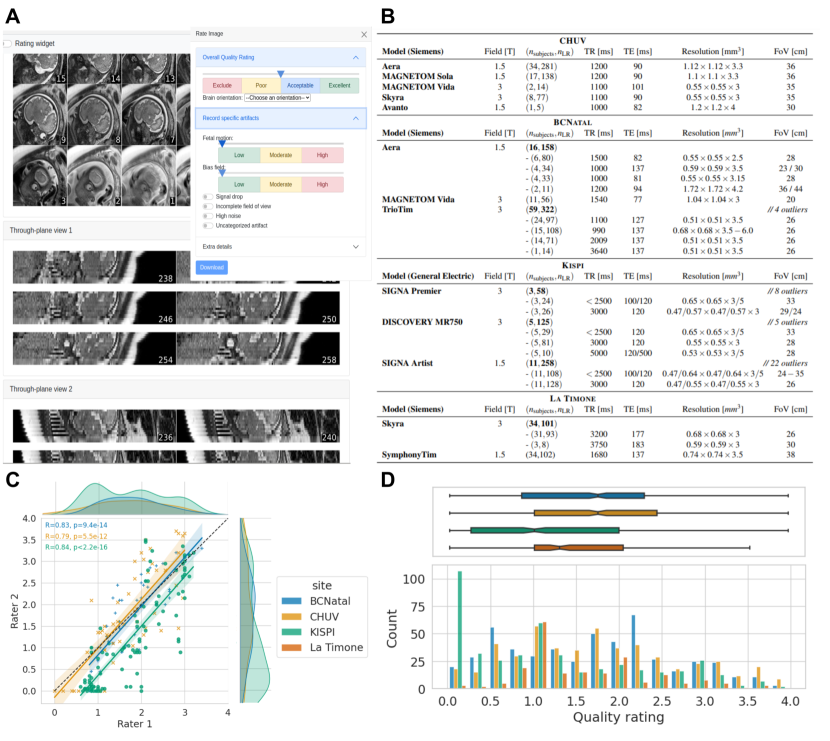
![Figure 1: Variations in data quality illustrated. A – Comparison of data across adult (T1w), from the ABIDE dataset [ 13 ] and from fetal acquisitions. In the excluded scans, the adult image on the left suffers from severe motion artifacts, while large coil artifacts corrupt the image on the right.](https://ar5iv.labs.arxiv.org/html/2311.04780/assets/x1.png)
実験結果
リサーチクエスチョン
- RQ1マルチセンターフェータル脳 MRI データで学習した機械学習フレームワークが、微調整なしに未観測のスキャナーやプロトコルに汎用性を示せるか?
- RQ2どの画像品質指標の組み合わせが、専門家評価の画像品質を最も正確かつ強固に予測できるか?
- RQ3FetMRQC は、深層学習やルールベースの手法を含む既存のベースラインと比較して、予測性能および汎用性の面で優れているか?
- RQ4低品質なデータをフィルタリングすることで、FetMRQC は超解像再構成などの後続処理の品質をどの程度向上できるか?
- RQ5このフレームワークは解釈可能かつ透明性を備えており、臨床医や研究者が品質予測の根拠を理解できるか?
主な発見
- FetMRQC は回帰タスクでピアソンの R² 0.78、分類タスクで重み付き F1 スコア 0.83 を達成し、未観測データに対して強力な予測性能を示した。
- 4 つの臨床センターおよび 13 台の異なる MRI スキャナで効果的に汎用性を示し、ドメインシフトに対しても耐性があることが確認された。
- 特徴量の重要度分析により、上位 20 個の IQM(例:ランク誤差、マスクボリューム、正規化相互相関)が予測力の大部分を占め、わずかな性能低下で実行可能な軽量バージョン(FetMRQC-20)が構築可能となった。
- FetMRQC は低品質なスタックをフィルタリングすることで、超解像再構成の品質を顕著に向上させ、アーチファクトを低減し、最終画像の忠実度を向上させた。
- NiftyMIC-QC や深層学習ベースの手法(dl_stack, dl_slice)を含む既存のベースラインを上回り、特に品質分布の不均衡な状況でも優れた性能を発揮した。
- 特徴量の重要度分析から、構造的指標(例:マスクボリューム、重心)および動き関連特徴(例:ランク誤差)が画像品質予測において最も影響力のある要因であることが明らかになった。
より良い研究を、今すぐ始めましょう
論文の読解から最終レビューまで、研究時間を劇的に削減しましょう。
クレジットカード登録不要
このレビューはAIが作成し、人間の編集者が確認しました。