
[論文レビュー] First Indication of Solar $^8$B Neutrino Flux through Coherent Elastic Neutrino-Nucleus Scattering in PandaX-4T
パンダX-4T実験は液体キセノン中のCEvNSを介して太陽系8Bニュートリノを検出し、標準太陽モデルと一致するフラックスおよび背景を上回る2.64シグマのヒントを報告します。
The PandaX-4T liquid xenon detector at the China Jinping Underground Laboratory is used to measure the solar $^8$B neutrino flux by detecting neutrinos through coherent scattering with xenon nuclei. Data samples requiring the coincidence of scintillation and ionization signals (paired), as well as unpaired ionization-only signals (US2), are selected with energy threshold of approximately 1.1 keV (0.33 keV) nuclear recoil energy. Combining the commissioning run and the first science run of PandaX-4T, a total exposure of 1.20 and 1.04 tonne$\cdot$year are collected for the paired and US2, respectively. After unblinding, 3 and 332 events are observed with an expectation of 2.8$\pm$0.5 and 251$\pm$32 background events, for the paired and US2 data, respectively. A combined analysis yields a best-fit $^8$B neutrino signal of 3.5 (75) events from the paired (US2) data sample, with $\sim$37\% uncertainty, and the background-only hypothesis is disfavored at 2.64$σ$ significance. This gives a solar $^8$B neutrino flux of ($8.4\pm3.1$)$ imes$10$^6$ cm$^{-2}$s$^{-1}$, consistent with the standard solar model prediction. It is also the first indication of solar $^8$B neutrino ``fog'' in a dark matter direct detection experiment.
研究の動機と目的
- 大規模な液体キセノン検出器を用いたCEvNSで太陽8Bニュートリノフラックスの測定を動機づける。
- PandaX-4Tで低閾値CEvNS検出の実現性を示す。
- 複数のデータストリーム(ペア S1-S2 と未ペア US2)を組み合わせて感度を向上。
- 背景(AC、カソード、MD、ER)を特徴づけて潜在的な8B信号を抽出。
- 測定されたフラックスを標準太陽モデルの予測と比較。
提案手法
- 3.7トンのキセノンを用いた二相液体キセノン TPC と特定の S1/S2 信号要件を利用。
- 2つのデータクラスを分析: ペア S1-S2 イベントと未ペア S2 のみ (US2) イベント。
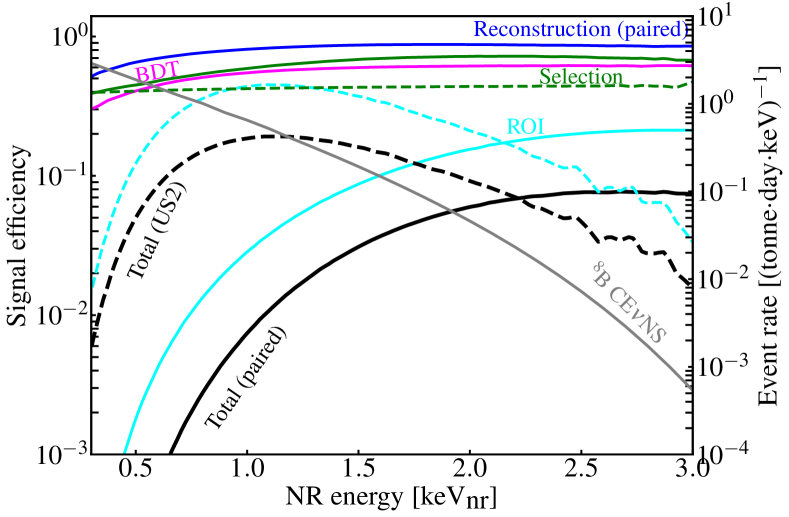
- NRエネルギー閾値を 1.1 keV(ペア)および 0.33 keV(US2)でROIを定義。
- 偶発的同時発生、カソード、マイクロディスチャージ、ERを含む背景をモデル化; ウィンドウ外データおよびサイドバンドデータで検証。
- 信号抽出のためにペアとUS2データを結合するため、両側プロファイル尤度比を適用。
- AC背景排除を強化しROIを最適化するためBoosted Decision Treeを実装。
実験結果
リサーチクエスチョン
- RQ1将来の多トン液体キセノンDM検出器(PandaX-4Tのような)で太陽8BニュートリノCEvNSを検出できるか?
- RQ2PandaX-4T Run0およびRun1データから推定された太陽8B CEvNSニュートリノフラックスはどれか?
- RQ3背景(AC、カソード、MD、ER)はペアデータとUS2データでCEvNS信号の抽出にどのような影響を与えるか?
- RQ4測定されたフラックスは不確かさの範囲で標準太陽モデルの予測と一致するか?
主な発見
- 結合解析により、ペアデータからの最適フィット8B CEvNS信号は3.5(75)イベントであり、US2は332イベントであり、背景のみを棄却して2.64シグマで有意性を示す。
- 推定太陽8Bニュートリノフラックスは (8.4 ± 3.1) × 10^6 cm^-2 s^-1。
- 背景は特定の期待値と不確かさで定量化され、両方のデータチャネルでCEvNS信号抽出を可能にする。
- この結果は太陽8Bフラックスの標準太陽モデル予測と一致している。
より良い研究を、今すぐ始めましょう
論文の読解から最終レビューまで、研究時間を劇的に削減しましょう。
クレジットカード登録不要
このレビューはAIが作成し、人間の編集者が確認しました。