
[論文レビュー] Fitting the light curves of Sagittarius A* with a hot-spot model
本研究では、Sagittarius A*の偏光ミリ波光曲線を、ブラックホールの周囲を公転する磁化プラズマブロブからのシンクロトロン放射を含む、準解析的ホットスポットモデルをベイジアンフレームワーク内でフィットする。最良のフィットモデルは、約90分の公転周期、150–160°の軌道傾き、10.7–13.0重力半径の半径、ケプラーモーションの0.8–0.9倍の非ケプラーモーションを示し、スピンは低め(a* < 0.6)である。
Sagittarius A* exhibits frequent flaring activity across the electromagnetic spectrum. Signatures of an orbiting hot spot have been identified in the polarized millimeter wavelength light curves observed with ALMA in 2017 immediately after an X-ray flare. The nature of these hot spots remains uncertain. We expanded existing theoretical hot-spot models created to describe the Sgr A* polarized emission at millimeter wavelengths. We sampled the posterior space, identifying best-fitting parameters and characterizing uncertainties. Using the numerical radiative transfer code ipole, we defined a semi-analytical model describing a ball of plasma orbiting Sgr A*, threaded with a magnetic field and emitting synchrotron radiation. We then explored the posterior space in the Bayesian framework of dynesty. We fit the static background emission separately, using a radiatively inefficient accretion flow model. We considered eight models with a varying level of complexity, distinguished by choices regarding dynamically important cooling, non-Keplerian motion, and magnetic field polarity. All models converge to realizations that fit the data, but one model without cooling, non-Keplerian motion, and magnetic field pointing toward us improved the fit significantly and also matched the observed circular polarization. Our models represent observational data well and allow testing various effects in a systematic manner. From our analysis, we have inferred an inclination of $155-160$ deg, which corroborates previous estimates, a preferred period of 90 minutes, and an orbital radius of $9-12$ gravitational radii. Our non-Keplerian models indicate a preference for an orbital velocity of $0.6-0.9$ times the Keplerian value. Last, all our models agree on a high dimensionless spin value ($a_{*}>0.8$), but the impact of spin on the corresponding light curves is subdominant with respect to other parameters.
研究の動機と目的
- Sgr A*の偏光ミリ波放射を、磁化プラズマブロブからのシンクロトロン放射を含む準解析的ホットスポットモデルでモデル化すること。
- ベイジアン推論を用いて、ホットスポットの物理的パラメータ(サイズ、磁場強度、公転速度など)を制約すること。
- 非ケプラーモーションやシンクロトロン冷却といった動的効果が、フィットの質と観測との整合性に与える影響を検証すること。
- 放射的に非効率な降着流(RIAF)モデルを用いて、ホットスポット信号を背景降着流から分離すること。
- ブラックホールスピンと磁場配置が、観測された光曲線および偏光シグネチャーに与える役割を評価すること。
提案手法
- Sgr A*の周囲を公転する局所的プラズマブロブからのシンクロトロン放射をシミュレートするために、数値的放射輸送コードipoleを用いる。
- dynestyを用いたベイジアン推論フレームワークを適用し、スポット位置、磁場、公転運動などのモデルパラメータの事後分布を探索する。
- 背景放射を別々にRIAFモデルでフィットし、観測されたストークスパラメータ(I, Q, U, V)におけるホットスポット寄与を分離する。
- 冷却、非ケプラーモーション、磁場極性に関する仮定の違いにより8つのモデルバリアントを検討し、モデルの頑健性を評価する。
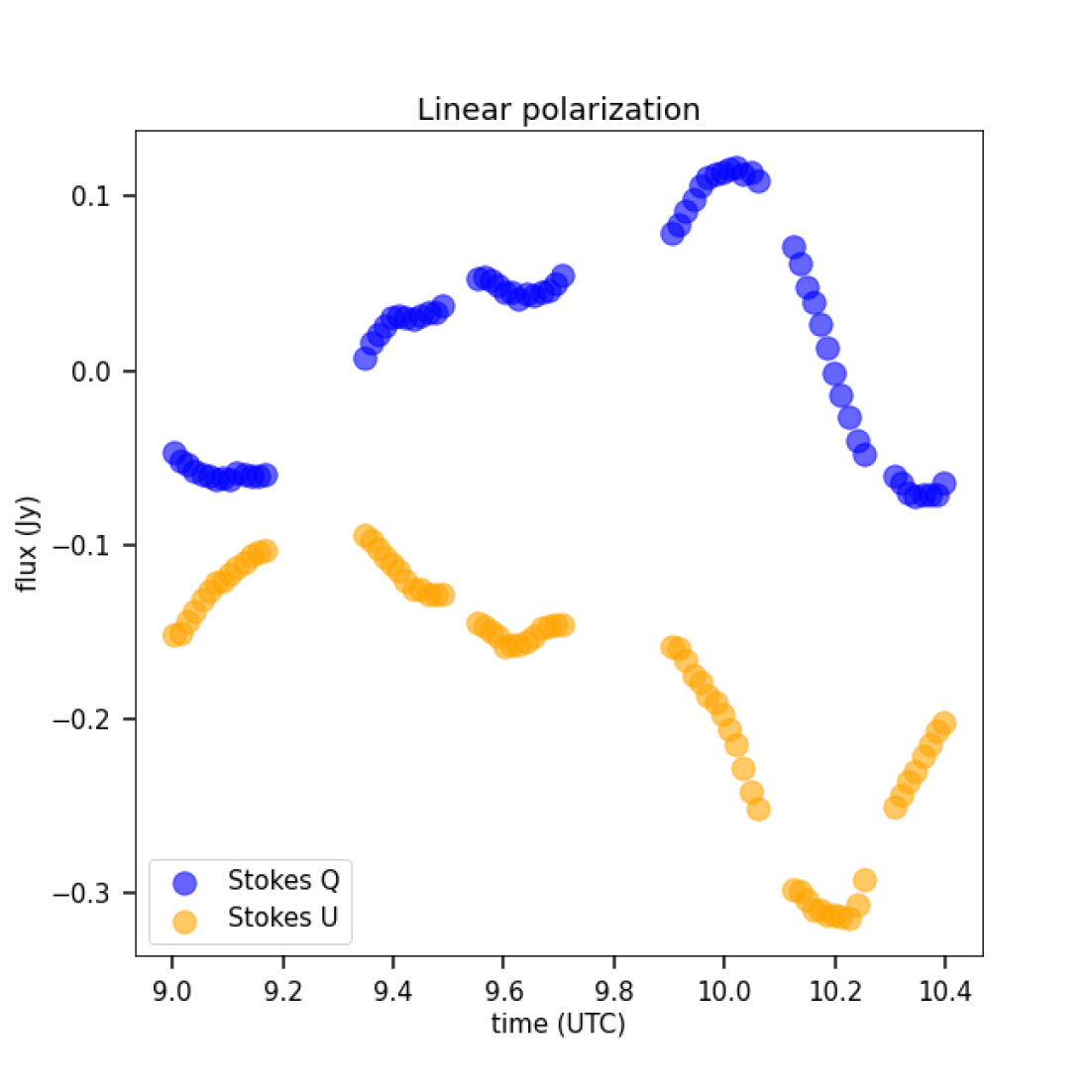
- ALMA 2017年のSgr A*観測(1.3 mmバンド)と比較し、Q–Uループと円偏光に注目する。
- 背景モデルが、スポットフィッティングプロセスから得られたシャドウに類似たストークスパラメータを再現できるかをチェックすることで、モデルの一貫性を検証する。
実験結果
リサーチクエスチョン
- RQ1観測されたSgr A*のQ–Uループを生成するホットスポットの最良の公転および磁場パラメータは何か?
- RQ2シンクロトロン冷却や非ケプラーモーションを含めることで、標準モデルと比較してALMA光曲線へのフィットがどの程度改善されるか?
- RQ3観測結果がブラックホールスピンと軌道傾きに課す制約は何か?
- RQ4磁場配置(例:内向き vs. 外向き)の違いが偏光シグネチャーとモデル尤度に与える影響は何か?
- RQ5背景RIAF放射が、推定されるホットスポットパラメータにどの程度影響を及ぼすか?また、ディスク+スポットの統合モデルは、すべてのストークスパラメータをよりよく再現できるか?
主な発見
- 最良のフィットモデルは、約90分の公転周期に収束し、観測されたQ–Uループの時間スケールと整合的である。
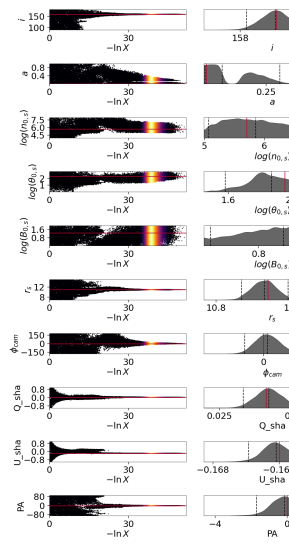
- 軌道傾きは150–160度に制約され、EHTや他の研究からの以前の推定値と一致している。
- ホットスポットの公転半径は10.7–13.0重力半径と推定され、安定な円運動の内側に位置している。
- 非ケプラーモーション(ケプラーモーションの0.8–0.9倍の速度)を含むモデルは、フィットを著しく改善し、予想されるシンクロトロン冷却時間スケールとも一致する。
- シンクロトロン冷却を含めることでフィットが改善され、特に磁場が観測者に向かって向いている場合、観測された円偏光を再現する。
- ブラックホールスピンは低値(a* < 0.6)に制約されるが、光曲線への影響は他のパラメータ(軌道傾き、公転半径など)に比べて二次的である。
より良い研究を、今すぐ始めましょう
論文の読解から最終レビューまで、研究時間を劇的に削減しましょう。
クレジットカード登録不要
このレビューはAIが作成し、人間の編集者が確認しました。