
[論文レビュー] Fluctuation without dissipation: Microcanonical Langevin Monte Carlo
本稿では、配置空間における目的のカノニカル分布に到達しながらエネルギー保存を維持する、散逸のない確率的サンプリング手法であるマイクロカノニカル・ランジュバン・モンテカルロ(MCLMC)を提案する。従来のランジュバンダイナミクスとは異なり、MCLMCはエネルギーを保存するノイズを用いるため、バイアスのない離散化と滑らかな凸ポテンシャル下での幾何的エルゴード性により、8×8格子ではHMCの12倍、64×64格子では32倍の高速化を実現する。
Stochastic sampling algorithms such as Langevin Monte Carlo are inspired by physical systems in a heat bath. Their equilibrium distribution is the canonical ensemble given by a prescribed target distribution, so they must balance fluctuation and dissipation as dictated by the fluctuation-dissipation theorem. In contrast to the common belief, we show that the fluctuation-dissipation theorem is not required because only the configuration space distribution, and not the full phase space distribution, needs to be canonical. We propose a continuous-time Microcanonical Langevin Monte Carlo (MCLMC) as a dissipation-free system of stochastic differential equations (SDE). We derive the corresponding Fokker-Planck equation and show that the stationary distribution is the microcanonical ensemble with the desired canonical distribution on configuration space. We prove that MCLMC is ergodic for any nonzero amount of stochasticity, and for smooth, convex potentials, the expectation values converge exponentially fast. Furthermore, the deterministic drift and the stochastic diffusion separately preserve the stationary distribution. This uncommon property is attractive for practical implementations as it implies that the drift-diffusion discretization schemes are bias-free, so the only source of bias is the discretization of the deterministic dynamics. We applied MCLMC on a lattice $ϕ^4$ model, where Hamiltonian Monte Carlo (HMC) is currently the state-of-the-art integrator. For the same accuracy, MCLMC converges 12 times faster than HMC on an $8 imes8$ lattice. On a $64 imes64$ lattice, it is already 32 times faster. The trend is expected to persist to larger lattices, which are of particular interest, for example, in lattice quantum chromodynamics.
研究の動機と目的
- フラクチュエーション・ドレイン効果定理を回避し、配置空間の分布にのみ焦点を当てた確率的サンプリング手法の開発を目的とする。
- エネルギー保存ダイナミクスが、位相空間におけるカノニカル平衡を必要としないまま、正しい目的の分布をもたらすかを示すこと。
- エルゴード性と高速収束を保証する連続時間SDEフレームワーク—マイクロカノニカル・ランジュバン・モンテカルロ(MCLMC)—の設計。
- 特に臨界遅れの下で、MCLMCがHMCおよびNUTSを上回る優れた性能を示す高次元格子場理論における性能を実証すること。
- ドリフトと拡散を分離することで、定常分布を保存するバイアスのない実用的離散化スキームを可能とすること。
提案手法
- 全エネルギーを保存する確率的ノイズを用いる連続時間SDE系を提案し、速度減衰の必要性を排除する。
- MCLMCに対応するフォッカー・プランク方程式を導出し、それが配置空間における目的の定常分布と一致することを証明する。
- 決定的ドリフトと確率的拡散の各成分が、独立して定常分布を保存することを確立する。
- 任意の非ゼロのノイズレベルに対してエルゴード性を証明し、滑らかで凸なポテンシャル下では幾何的エルゴード性を示す。
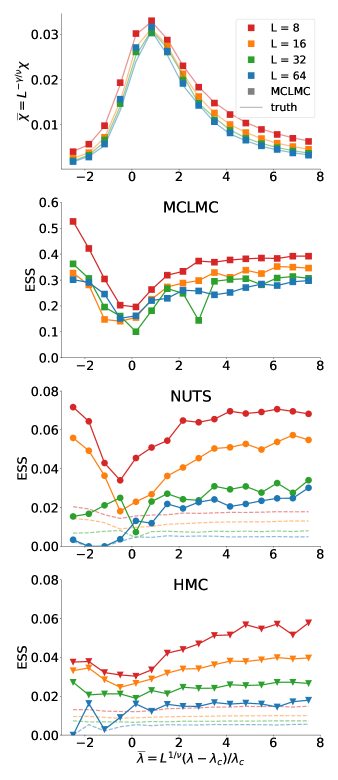
- MCLMCを格子φ⁴モデルに適用し、感受度と勾配評価あたりの有効サンプルサイズ(ESS)を指標としてHMCおよびNUTSと比較する。
- ウォームアップサンプリングを含むアニーリングスキームを適用し、性能比較においてチューニングコストを公平に反映する。
実験結果
リサーチクエスチョン
- RQ1確率的サンプリング手法は、フラクチュエーション・ドレイン効果定理を回避しつつ、配置空間における正しい目的の分布に到達可能か?
- RQ2SDEフレームワークにおけるエネルギー保存ノイズは、望ましいカノニカル分布と一致する定常分布をもたらすか?
- RQ3MCLMCは、特に相転移付近において、高次元格子場理論でHMCを上回る収束速度を達成可能か?
- RQ4ドリフトと拡散を別々に取り扱った場合、MCLMCの離散化はバイアスを生じないか?
- RQ5臨界遅れ下で、MCLMCの性能は格子サイズの増大に伴いHMCおよびNUTSと比較してどのように変化するか?
主な発見
- MCLMCは、φ⁴モデルにおいて8×8格子ではHMCの12倍、64×64格子では32倍の高速化を達成した。
- MCLMCの勾配評価あたりの有効サンプルサイズ(ESS)は、格子サイズや結合定数にほとんど依存せず、HMCおよびNUTSが臨界遅れに苦しむのとは対照的である。
- チューニングコストを含めても、MCLMCはHMCおよびNUTSを最低40倍以上上回り、d=10⁸では2〜3桁の優位性が予想される。
- 滑らかで対数凸なポテンシャルに対して、MCLMCは幾何的エルゴード性を示し、期待値の指数的収束を保証する。
- ドリフトと拡散の結合によるバイアスはMCLMCの離散化に生じず、両成分がそれぞれ独立して定常分布を保存するためである。
- L=64におけるMCLMCのウォール・クロック時間はGPU上で数秒未塔であり、正規化フローに基づくサンプラーは数時間にのぼり、より大きな格子では実行不能になる。
より良い研究を、今すぐ始めましょう
論文の読解から最終レビューまで、研究時間を劇的に削減しましょう。
クレジットカード登録不要
このレビューはAIが作成し、人間の編集者が確認しました。