
[論文レビュー] Fourier Neural Operator for Plasma Modelling
この論文は Fourier Neural Operator (FNO) を、MHDシミュレーションとMASTのカメラ観測におけるプラズマ進化の高速代替手段・デジタルツインとして示し、Conv-LSTMとU-Netより速さとパラメータ効率で優れ、精度を維持している。
Predicting plasma evolution within a Tokamak is crucial to building a sustainable fusion reactor. Whether in the simulation space or within the experimental domain, the capability to forecast the spatio-temporal evolution of plasma field variables rapidly and accurately could improve active control methods on current tokamak devices and future fusion reactors. In this work, we demonstrate the utility of using Fourier Neural Operator (FNO) to model the plasma evolution in simulations and experiments. Our work shows that the FNO is capable of predicting magnetohydrodynamic models governing the plasma dynamics, 6 orders of magnitude faster than the traditional numerical solver, while maintaining considerable accuracy (NMSE $\sim 10^{-5})$. Our work also benchmarks the performance of the FNO against other standard surrogate models such as Conv-LSTM and U-Net and demonstrate that the FNO takes significantly less time to train, requires less parameters and outperforms other models. We extend the FNO approach to model the plasma evolution observed by the cameras positioned within the MAST spherical tokamak. We illustrate its capability in forecasting the formation of filaments within the plasma as well as the heat deposits. The FNO deployed to model the camera is capable of forecasting the full length of the plasma shot within half the time of the shot duration.
研究の動機と目的
- トカクのリアルタイム制御を可能にし、計算コストの高いコードへの依存を減らすための迅速なプラズマ進化予測を動機づける。
- Fourier Neural Operators がメッシュ不変性をもって MHD 解のマッピングを学習できることを示す。
- シミュレーションデータと実験カメラデータの双方に対して、標準的な代理モデル(Conv-LSTM、U-Net)と FNO を比較評価する。
- MAST トカクのカメラベースのプラズマ状態予測のデジタルツインとして FNO を検討する。
提案手法
- オートレグレッシブ框架で 2D Fourier Neural Operator (FNO-2d) を採用し、20 入力時刻ステップを次の5時刻ステップへ写像し、反復的に予測して T_out=70 まで推定する。
- 密度、ポテンシャル、渦度場に対して別個の FNO を訓練し、入力は 100x100 のグリッド、特徴数は 32、層あたり最大 16 の Fourier モード。
- 同一の訓練条件( Adam オプティマイザ、500 エポック、バッチサイズ 5)で FNO を ConvLSTM および U-Net アーキテクチャと比較する。
- MAST の実験用高速カメラデータへ FNO アプローチを拡張し、センターソレノイドおよび偏流導入カメラに観測されるプラズマ進化を、較正済みの均一グリッドを用いて予測する。
実験結果
リサーチクエスチョン
- RQ1FNO はトロイダル幾何学における縮約MHD方程式の解演算子を、 efficiency の高い 正確に学習できるか?
- RQ2プラズマ場の進化における訓練時間、パラメータ数、NMSE の観点で、FNO は Conv-LSTM および U-Net とどう比較されるか?
- RQ3FNO は実験カメラデータをモデル化して、フィラメント形成と熱沈着パターンを含むトカクプラズマのリアルタイムデジタルツインとして機能できるか?
- RQ4ELM や L-H 遷移のようなイベントを予測するカメラベースの診断に対する FNO の予測能力はどの程度か?
主な発見
| モデル | 訓練時間 (分) | パラメータ数 | NMSE | 推論時間(s) |
|---|---|---|---|---|
| JOREK | - | - | - | 36000 |
| FNO | 13 | 2106981 | 4.245e-05 | 0.025 |
| ConvLSTM | 481 | 4874648 | 1.12e-03 | 0.14 |
| U-Net | 26 | 7931909 | 4.48e-04 | 0.033 |
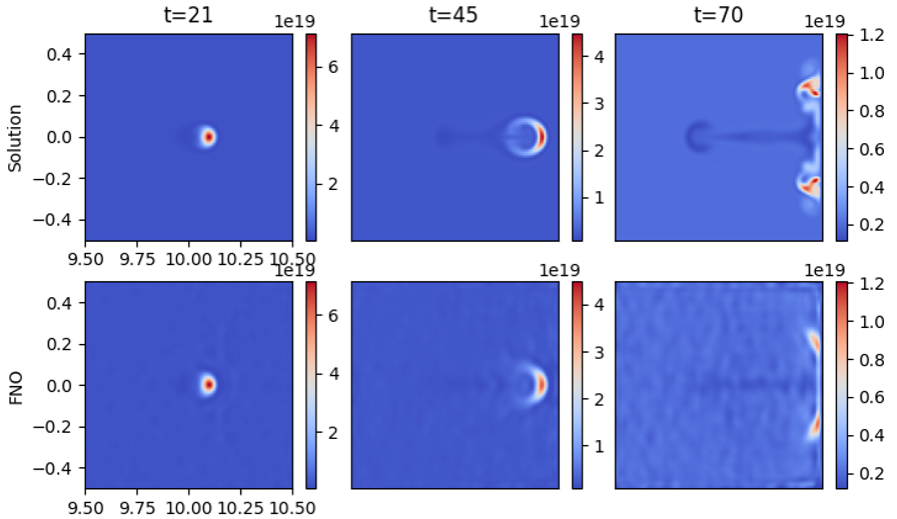
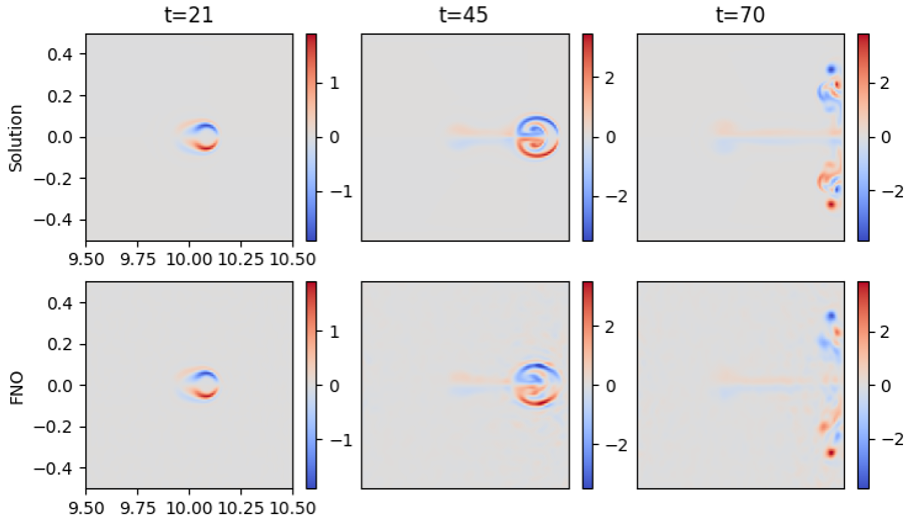
- FNO は電位、密度、渦度にわたる縮約MHD進化を NMSE ≈ 4–5×10^-5 で予測する。
- FNO 推論時間は1回あたり 0.025 s、従来のソルバーや比較代替手段よりはるかに高速。
- FNO は ConvLSTM および U-Net よりはるかに少ないパラメータと短い訓練時間で、精度は優れているか同等である。
- MAST のカメラデータについて、FNO は NMSE ~0.04(中央ソレノイドカメラ)、 ~0.014(ダイバータカメラ)を達成し、残りショットの全期間を予測した。
- FNO はグローバルなプラズマ特徴と熱束流領域を効果的に捉える一方、局所的なピクセルレベルの精度は限られることがある。
- 本フレームワークは、融合機器におけるリアルタイム計画と制御、および診断のデジタルツインとして可能性を示す。
より良い研究を、今すぐ始めましょう
論文設計から論文執筆まで、研究時間を劇的に削減しましょう。
クレジットカード登録不要
このレビューはAIが作成し、人間の編集者が確認しました。