
[論文レビュー] Fourier Neural Operator Surrogate Model to Predict 3D Seismic Waves Propagation
本稿では、3次元地中構造から地震動を予測するための、U字型アーキテクチャを用いた3次元フーリエニューラルオペレータ(FNO)代理モデル(UNO)を提案する。このモデルは、地下の不均一性を時間領域の速度波形出力にマッピングする。30,000件の高精度なSEM3Dシミュレーションで訓練されたモデルは、波の到着時刻と位相の予測において高い精度を達成しており、92%の位相Goodness-of-Fit(GOF)スコアが8以上である。一方で、ピーク振幅は低めに推定されている。
With the recent rise of neural operators, scientific machine learning offers new solutions to quantify uncertainties associated with high-fidelity numerical simulations. Traditional neural networks, such as Convolutional Neural Networks (CNN) or Physics-Informed Neural Networks (PINN), are restricted to the prediction of solutions in a predefined configuration. With neural operators, one can learn the general solution of Partial Differential Equations, such as the elastic wave equation, with varying parameters. There have been very few applications of neural operators in seismology. All of them were limited to two-dimensional settings, although the importance of three-dimensional (3D) effects is well known. In this work, we apply the Fourier Neural Operator (FNO) to predict ground motion time series from a 3D geological description. We used a high-fidelity simulation code, SEM3D, to build an extensive database of ground motions generated by 30,000 different geologies. With this database, we show that the FNO can produce accurate ground motion even when the underlying geology exhibits large heterogeneities. Intensity measures at moderate and large periods are especially well reproduced. We present the first seismological application of Fourier Neural Operators in 3D. Thanks to the generalizability of our database, we believe that our model can be used to assess the influence of geological features such as sedimentary basins on ground motion, which is paramount to evaluating site effects.
研究の動機と目的
- 不均一な地中構造における3次元弾性波動の伝播を扱える汎用的な深層学習代理モデルの開発。
- 異なる地中パラメータに一般化できない従来のニューラルネットワークの限界を克服すること。
- 計算コストの高いシミュレーションに代わって、地震ハザード評価における不確実性評価を効率的に行えるようにすること。
- 特に複雑な地中不均一性を有する3次元地震学的問題において、フーリエニューラルオペレータの実用性と精度を検証すること。
- 3方向の速度成分を同時に予測することで、モデルの一般化性能と性能が向上することを示すこと。
提案手法
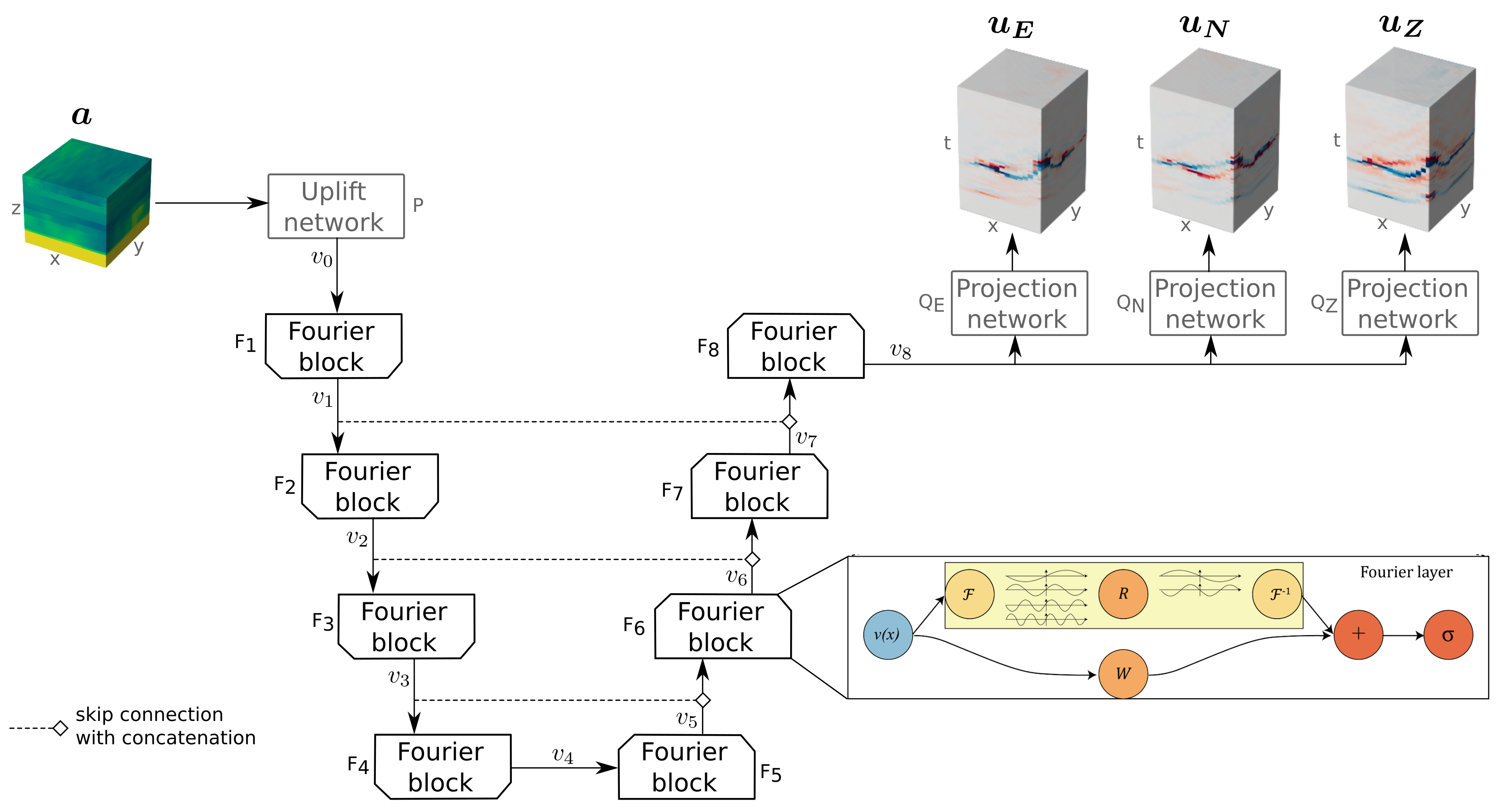
- 3次元弾性波方程式の解演算子を学習する10層のU字型ニューラルオペレータ(UNO)アーキテクチャを採用。
- 入力は地中不均一性を表す3次元S波速度場であり、出力は複数のセンサーにおける3成分の地面速度時間系列である。
- 地中構造の深さ方向を出力の時間方向にマッピングすることで、4次元問題(3次元空間+時間)を扱いやすい3次元入出力マッピングに変換している。
- ランダムフィールドを用いて生成された30,000件のユニークな3次元地中構造を含むデータセットを、高精度なSEM3Dスペクトル要素法でシミュレーションして得た。
- 時間領域と周波数領域の正則化を組み合わせて損失関数を最小化し、位相とエンベロープの忠実度に配慮している。
- フーリエ特徴埋め込みを組み込み、周波数領域における学習されたスペクトル畳み込みにより、空間的・時間的依存性を学習している。
実験結果
リサーチクエスチョン
- RQ1フーリエニューラルオペレータは、多様な3次元地中構造に一般化して、完全な3次元地面動揺時間系列を予測できるか?
- RQ2強い地中不均一性が存在する状況下でも、FNOは波の到着時刻と位相をどれほど正確に予測できるか?
- RQ33方向の速度成分を同時に予測することで、単一成分予測と比較してモデルの一般化性能が向上するか?
- RQ4モデルは高周波数成分をどの程度正確に保持しているのか。また、振幅表現においてどこで失敗しているか?
- RQ5代理モデルは、地震ハザード評価における不確実性評価に十分な精度を維持しつつ、計算コストを削減できるか?
主な発見
- UNOモデルは、92%のセンサー位置で位相予測のGoodness-of-Fit(GOF)スコアが8以上を達成しており、波の到着時刻予測の高精度を示している。
- エンベロープのGOFスコアは95%の時間系列で6を超えており、全体的な信号エネルギーと波形の再現性が信頼できることが確認された。
- 正確な位相予測とは対照的に、ピーク振幅は体系的に低めに推定されており、特に1 Hz以上で顕著である。これは、高周波数振幅モデル化における限界を示している。
- フーリエ領域における振幅減衰勾配は、基準信号とよく一致しており、人工的なフィルタリングは行われていないが、高周波数分解能が低下している可能性がある。
- 3方向の速度成分を同時に学習することで一般化性能が向上した。これは、パrameterの大幅な増加を伴わずに有効な訓練データ量が増加したためと推定される。
- 特に堆積盆地のような強い不均一性を持つ未学習の地中構造に対しても、モデルは良好な一般化性能を示しており、現場効果評価への応用可能性が示された。
より良い研究を、今すぐ始めましょう
論文の読解から最終レビューまで、研究時間を劇的に削減しましょう。
クレジットカード登録不要
このレビューはAIが作成し、人間の編集者が確認しました。