
[論文レビュー] Fourier PINNs: From Strong Boundary Conditions to Adaptive Fourier Bases
この論文は、ネットワークアーキテクチャに適応的フーリエ基底関数を統合することで、高周波数およびマルチスケール解の学習を向上させる、新しい物理知覚ニューラルネットワークフレームワークであるFourier PINNsを紹介する。ニューラルネットワーク最適化と動的基底選択、係数の切り捨てを組み合わせることで、Fourier PINNsは相対的 $L_2$ 誤差を $10^{-3}$–$10^{-4}$ まで低減し、標準PINNs、W-PINNs、A-PINNs、RFF-PINNsに比べて優れた精度を達成する。これらは高周波数問題に対してハイパーパrameterの感度に起因して頻繁に失敗するが、Fourier PINNsはその問題を克服する。
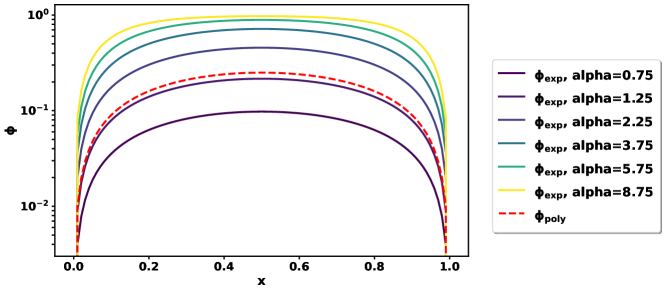
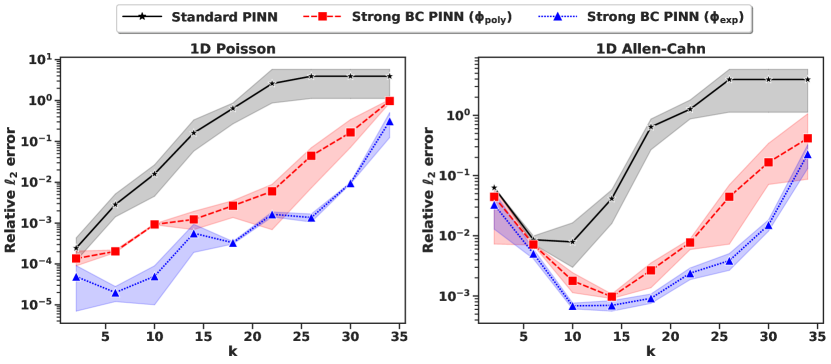
Interest is rising in Physics-Informed Neural Networks (PINNs) as a mesh-free alternative to traditional numerical solvers for partial differential equations (PDEs). However, PINNs often struggle to learn high-frequency and multi-scale target solutions. To tackle this problem, we first study a strong Boundary Condition (BC) version of PINNs for Dirichlet BCs and observe a consistent decline in relative error compared to the standard PINNs. We then perform a theoretical analysis based on the Fourier transform and convolution theorem. We find that strong BC PINNs can better learn the amplitudes of high-frequency components of the target solutions. However, constructing the architecture for strong BC PINNs is difficult for many BCs and domain geometries. Enlightened by our theoretical analysis, we propose Fourier PINNs -- a simple, general, yet powerful method that augments PINNs with pre-specified, dense Fourier bases. Our proposed architecture likewise learns high-frequency components better but places no restrictions on the particular BCs or problem domains. We develop an adaptive learning and basis selection algorithm via alternating neural net basis optimization, Fourier and neural net basis coefficient estimation, and coefficient truncation. This scheme can flexibly identify the significant frequencies while weakening the nominal frequencies to better capture the target solution's power spectrum. We show the advantage of our approach through a set of systematic experiments.
研究の動機と目的
- 高周波数またはマルチスケール解を有するPDEを解く際、標準PINNsの性能が著しく劣化するという長年の課題に対処すること。
- 周波数スケールのチューニングが必須で、感度の高さにより頻繁に失敗するRFF-PINNsなどの既存手法の限界を克服すること。
- 境界条件やドメイン幾何の制約なしに、高周波成分の学習を強化できる汎用的で柔軟かつ頑健なフレームワークを構築すること。
- 人為的なチューニングなしに、顕著な周波数を自動で同定し、不適切な周波数を抑制する適応的基底選択アルゴリズムを設計すること。
- 多様な1次元および2次元PDE問題において、既存のPINN変種と比較して精度と頑健性に優れたFourier PINNsの有効性を実証すること。
提案手法
- 高周波数解成分の表現を向上させるために、事前に指定された固定で密なフーリエ基底関数をPINNアーキテクチャに追加する。
- ニューラルネットワーク重み、フーリエ基底係数の同時更新に加え、顕著な周波数のみを保持するための係数切り捨てを実施する、交互最適化スキームを導入する。
- フーリエ変換と畳み込み定理に基づく理論的分析を用いて、境界条件を強く強制することで高周波成分の振幅学習が向上する理由を正当化する。
- 十分に大きな候補周波数範囲 $K$ を用いた粗いから細かい周波数探索戦略を適用し、目的の周波数が基底集合に含まれるようにする。
- 低振幅のフーリエ係数を削除する機構を実装することで、ノイズ低減とモデル一般化性能の向上を図る。
- 損失関数の変更や境界条件固有のアーキテクチャの必要性なしに、フーリエ基底をインダクティブバイアスとして統合することで、既存PINNトレーニングとの互換性を維持する。
実験結果
リサーチクエスチョン
- RQ1PINNsにおいて境界条件を強く強制することは、PDE解の高周波成分の学習を改善できるか?
- RQ2PINNsに事前に指定されたフーリエ基底を用いることで、標準PINNsと比較して高周波数およびマルチスケール問題においてより頑健かつ正確な解を得られるか?
- RQ3手動による基底関数の数やスケールのチューニングなしに、適応的基底選択アルゴリズムが顕著な周波数を自動で同定できるか?
- RQ4RFF-PINNsと比較して、Fourier PINNsの性能は、ハイパーパrameter選択への感度と解の精度の観点でどのように優れているか?
- RQ5Fourier PINNsは、アーキテクチャの変更なしに、さまざまなPDEや境界条件に一般化できる程度はどの程度か?
主な発見
- Fourier PINNsは、全テスト対象の1次元および2次元問題において、相対的 $L_2$ 誤差が $10^{-3}$ から $10^{-4}$ の範囲に収まり、標準PINNs、W-PINNs、A-PINNs、RFF-PINNsを著しく上回る。
- 標準PINN変種は高周波数問題において一貫して失敗し、相対的 $L_2$ 誤差が約1.0に達するため、高周波成分を捉えることができない。
- RFF-PINNsは周波数スケールと数の設定に対して極めて感度が高く、テスト構成の60–70%で失敗するが、一部の設定では低誤差を達成する。
- スペクトル法は効果的ではあるが、相対的 $L_2$ 誤差がFourier PINNsの約2桁高い上に、境界付近で顕著な点ごとの誤差バイアスを示す。
- Fourier PINNsは周波数範囲 $K$ の選択に対して頑健であり、$K$ が目的の周波数を十分に含む限り、一貫した精度を達成する。
- 提案された適応的基底選択アルゴリズムは、顕著な周波数を的確に同定し、不適切な周波数を抑制することができ、基底パrameterの手動チューニングなしに正確な解の回復を可能にする。
この論文を読む
Nubintのビューアで原文を開き、読みながら気になる箇所をすぐに質問できます。
Nubintでこの論文を読むこのレビューはAIが論文の原文をもとに作成しました。引用する前に原文をご確認ください。