
[論文レビュー] From existing and new nuclear and astrophysical constraints to stringent limits on the equation of state of neutron-rich dense matter
この論文は、物理学に依存しないベイズ的枠組みの中で多様な核物理学および天体物理学の制約を組み合わせ、ニュートロン星の方程式状態(EOS)に対して厳密な制限を導出し、標準的なニュートロン星半径および最大質量に関する顕著な境界を生み出す。
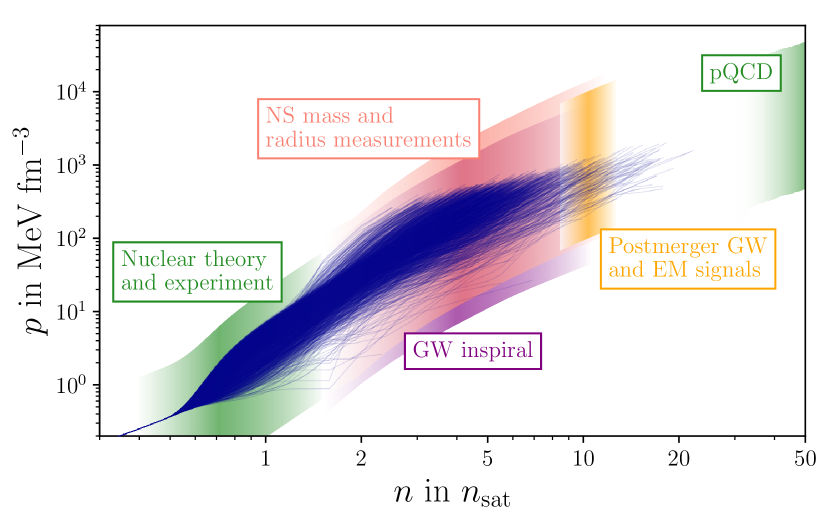
Through continuous progress in nuclear theory and experiment and an increasing number of neutron-star observations, a multitude of information about the equation of state (EOS) for matter at extreme densities is available. To constrain the EOS across its entire density range, this information needs to be combined consistently. However, the impact and model-dependency of individual observations vary. We present a broad compendium of different constraints and apply them individually to a large set of EOS candidates within a Bayesian framework. Specifically, we explore different ways how chiral effective field theory and perturbative quantum chromodynamics can be used to place a likelihood on EOS candidates. We also investigate the impact of nuclear experimental constraints, as well as different radio and X-ray observations of neutron star (NS) masses and radii. This is augmented by reanalyses of the existing data from BNS coalescences, in particular of GW170817, with improved models for the tidal waveform and kilonova light curves, which we also utilize to construct a tight upper limit of 2.39$\,$M$_\odot$ on the TOV mass based on GW170817's remnant. Our diverse set of constraints is eventually combined to obtain stringent limits on NS properties. We organize the combination in a way to distinguish between constraints where the systematic uncertainties are deemed small and those that rely on less conservative assumptions. For the former, we find the radius of the canonical 1.4$\,$M$_\odot$ neutron star to be $R_{1.4}= 12.26_{-0.91}^{+0.80}\,$km and the TOV mass at $M_{ m TOV}= 2.25_{-0.22}^{+0.42}\,$M$_\odot$ (95% credibility). Including all the presented constraints yields $R_{1.4}= 12.20_{-0.48}^{+0.50}\,$km and $M_{ m TOV}= 2.30_{-0.20}^{+0.07}\,$M$_\odot$.
研究の動機と目的
- 密度の高い物質の EOS を制約する際に、異なる核物理学および天体物理学の入力がどのように影響するかを評価する。
- 核子性までの高密度領域から核子非核子を含む広範な物理自由度にまたがる大規模な物理学に依存しない先行集合を構築する。
- 各制約(χEFT、pQCD、ニュートン肌、重イオン衝突、NS質量半径データ、GW、キロノヴァ)を EOS パラメータに与える影響を定量化する。
- 制約を組み合わせて、量的不確実性を定量化したうえで標準的なNS半径とTOV最大質量を推定する。
- 異なる制約の組み合わせが推定される EOS および関連観測量(R1.4、M_TOV、p3n_sat、n_TOV)に与える影響を評価する。
提案手法
- n_break までの核子性物質用のメタモデルを用いて100,000個の候補からEOS先行集合を構築し、低密度での外殻モデルを固定する。
- 9点のグリッドポイントを用いた速さのサウンドによる高密度外挿を物理モデルに依存しない形で付与し、c_s^2(n)を補間する。
- AFDMC帯に基づくスコア関数f(p,n)を通じてχEFT制約を適用し、p(n)曲線の積分/積分で尤度を計算する。
- 低密度EOSと高密度pQCD領域との補間の機械的安定性と因果性を検証することにより、保守的なn_L = n_TOVでのマッチングと、より厳密なpQCD*アプローチの両方を用いてpQCD制約を組み込む。
- ニュートン肌および重イオンデータを取り込み、ニュートン肌の厚さとの相関を通じて対称エネルギーパラメータE_symとL_symを制約する。
- EOS候補のベイズ後方ウェイト付けを用いてR1.4、M_TOV、および関連量の分布を導出する。
実験結果
リサーチクエスチョン
- RQ1χEFT、pQCD、ニュートン肌、重イオン、およびNS観測がニュートロン星のEOSに対して個別および総合でどのような影響を与えるか?
- RQ2制約はEOSの密度領域にどのように写し出され、どの観測量(R1.4、M_TOV)が最も影響を受けるか?
- RQ3すべての制約を変動する厳格さで適用したとき、どの標準的なNS半径R1.4およびTOV質量M_TOVが支持されるか?
- RQ4保守的な一致付けとpQCD*の選択によって事後EOSはどのように変化するか?
主な発見
- 制約を含む場合、R1.4 = 12.27_{-0.94}^{+0.83} km および M_TOV = 2.26_{-0.22}^{+0.45} M_sun(95%信頼区間)
- より保守的でない制約の組み合わせでは R1.4 = 12.20_{-0.50}^{+0.53} km および M_TOV = 2.31_{-0.20}^{+0.08} M_sun。
- χEFT制約は低密度でのEOSをより柔らかくする傾向を示すが、高密度外挿の柔軟性のために高質量構造の硬直的な配置を完全には除外しない。
- pQCD制約は非常に硬いまたは非常に軟らかいEOSを不利にする。pQCD*アプローチはより強い制約を提供し、M_TOVおよびp3n_satの推定区間をより情報量の多い方向へ動かす。
- ニュートロン肌測定(PREX-II、CREX)は対称エネルギーパラメータE_symとL_symに影響を与え、NSにとって重要な中性子過剰EOS領域に影響を与える。
![Figure 2: Score function $f(p,n)$ from Eq. ( 4 ) used in Eq. ( 6 ) to calculate the likelihood of an EOS given $\chi$ EFT constraints. The black dashed lines show the band obtained by $\chi$ EFT calculations in Ref. [ 46 ] .](https://ar5iv.labs.arxiv.org/html/2402.04172/assets/x2.png)
より良い研究を、今すぐ始めましょう
論文設計から論文執筆まで、研究時間を劇的に削減しましょう。
クレジットカード登録不要
このレビューはAIが作成し、人間の編集者が確認しました。