
[論文レビュー] From Persona to Personalization: A Survey on Role-Playing Language Agents
LLMで動作するRole-Playing Language Agents (RPLAs)の包括的な調査で、ペルソナを人口統計、キャラクター、個別化タイプに分類し、構築、評価、リスク、適用を概説する。
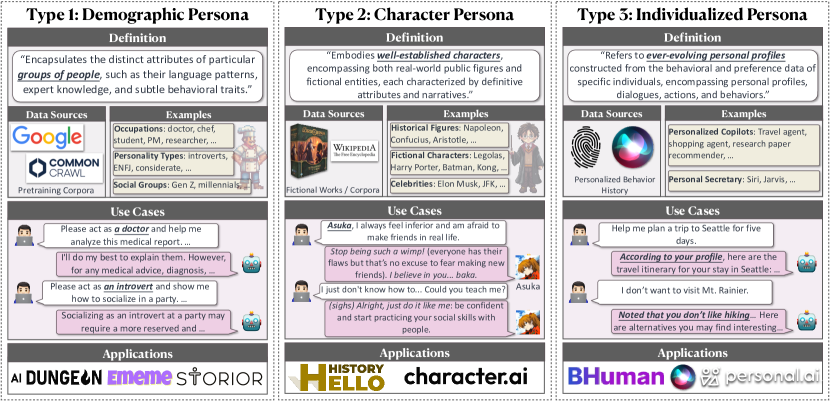
Recent advancements in large language models (LLMs) have significantly boosted the rise of Role-Playing Language Agents (RPLAs), i.e., specialized AI systems designed to simulate assigned personas. By harnessing multiple advanced abilities of LLMs, including in-context learning, instruction following, and social intelligence, RPLAs achieve a remarkable sense of human likeness and vivid role-playing performance. RPLAs can mimic a wide range of personas, ranging from historical figures and fictional characters to real-life individuals. Consequently, they have catalyzed numerous AI applications, such as emotional companions, interactive video games, personalized assistants and copilots, and digital clones. In this paper, we conduct a comprehensive survey of this field, illustrating the evolution and recent progress in RPLAs integrating with cutting-edge LLM technologies. We categorize personas into three types: 1) Demographic Persona, which leverages statistical stereotypes; 2) Character Persona, focused on well-established figures; and 3) Individualized Persona, customized through ongoing user interactions for personalized services. We begin by presenting a comprehensive overview of current methodologies for RPLAs, followed by the details for each persona type, covering corresponding data sourcing, agent construction, and evaluation. Afterward, we discuss the fundamental risks, existing limitations, and future prospects of RPLAs. Additionally, we provide a brief review of RPLAs in AI applications, which reflects practical user demands that shape and drive RPLA research. Through this work, we aim to establish a clear taxonomy of RPLA research and applications, and facilitate future research in this critical and ever-evolving field, and pave the way for a future where humans and RPLAs coexist in harmony.
研究の動機と目的
- RPLAペルソナの分類法(人口統計、キャラクター、個別化)を定義し、RPLAにおけるパーソナライズを動機づける。
- 各ペルソナタイプに対するデータソース、構築方法、評価基準を調査する。
- 安全で効果的なRPLAの研究と応用を導くためのリスク、制限、将来の方向性について議論する。
提案手法
- パラメトリック訓練とノンパラメトリック prompting を含む、RPLA構築の既存の方法論を調査する。
- RPLAに人間らしい振る舞いを可能にするメモリ、ツール使用、計画モジュールを説明する。
- 各ペルソナタイプ(人口統計、キャラクター、個別化)に対するデータソースと構築アプローチを要約する。
- 役割演技能力とペルソナ忠実度の評価基準を概説する。
- RPLAの研究と応用を分析できる分類と枠組みを提供する。
実験結果
リサーチクエスチョン
- RQ1RPLAsは人口統計、キャラクター、個別化ペルソナへどのように分類され、各タイプを支持するデータソースは何か?
- RQ2RPLAがペルソナをシミュレートするのを可能にする共通の構築技術とモジュール(メモリ、ツール、計画)は何か?
- RQ3役割演技能力と割り当てられたペルソナへの忠実度の観点からRPLAはどのように評価されるか?
- RQ4各ペルソナカテゴリーに関連する実用的な応用とリスクは何か?
- RQ5安全で効果的なRPLA研究と展開のための将来の方向性とギャップは何か?
主な発見
- RPLAsは効果的に3つの進行的ペルソナタイプ(人口統計、キャラクター、個別化)に整理されている。
- メモリ、ツール使用、計画モジュールは、RPLAで動的で文脈認識されたロールプレイを可能にする核となる。
- パラメトリック訓練は人口統計およびキャラクターのペルソナに適しており、個別化には prompting 手法が一般的である。
- 評価は役割演技能力と割り当てられたペルソナへの忠実度を区別する。
- RPLAsはデジタルクローンやコンパニオンからインタラクティブゲームまで幅広い応用を提供する一方で、毒性、バイアス、幻覚、プライバシーの懸念といったリスクを生じさせる。
より良い研究を、今すぐ始めましょう
論文設計から論文執筆まで、研究時間を劇的に削減しましょう。
クレジットカード登録不要
このレビューはAIが作成し、人間の編集者が確認しました。