
[論文レビュー] From Words to Watts: Benchmarking the Energy Costs of Large Language Model Inference
この論文は、マルチノードGPU展開、データセット、およびハードウェア全体で LLaMA モデル(7B、13B、65B)の推論計算リソースとエネルギーコストをベンチマークし、スループット-エネルギーのトレードオフと共有機会を理解する。
Large language models (LLMs) have exploded in popularity due to their new generative capabilities that go far beyond prior state-of-the-art. These technologies are increasingly being leveraged in various domains such as law, finance, and medicine. However, these models carry significant computational challenges, especially the compute and energy costs required for inference. Inference energy costs already receive less attention than the energy costs of training LLMs -- despite how often these large models are called on to conduct inference in reality (e.g., ChatGPT). As these state-of-the-art LLMs see increasing usage and deployment in various domains, a better understanding of their resource utilization is crucial for cost-savings, scaling performance, efficient hardware usage, and optimal inference strategies. In this paper, we describe experiments conducted to study the computational and energy utilization of inference with LLMs. We benchmark and conduct a preliminary analysis of the inference performance and inference energy costs of different sizes of LLaMA -- a recent state-of-the-art LLM -- developed by Meta AI on two generations of popular GPUs (NVIDIA V100 \& A100) and two datasets (Alpaca and GSM8K) to reflect the diverse set of tasks/benchmarks for LLMs in research and practice. We present the results of multi-node, multi-GPU inference using model sharding across up to 32 GPUs. To our knowledge, our work is the one of the first to study LLM inference performance from the perspective of computational and energy resources at this scale.
研究の動機と目的
- Characterize inference performance and energy use of LLaMA 65B with sharding across GPUs and nodes.
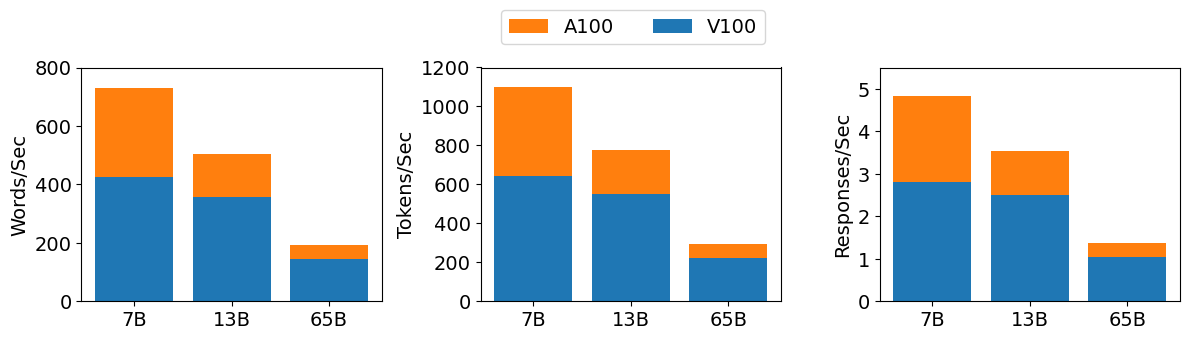
- Compare inference throughput and energy for smaller LLaMA variants (7B, 13B) under bare-minimum hardware.
- Assess how dataset type (Alpaca vs GSM8K) affects compute-energy dynamics during inference.
- Explore how batch size, number of shards, and generation length impact energy per second, per token, and per response.
- Discuss implications for GPU power-capping and resource sharing in HPC/datacenter contexts.
提案手法
- Use open-source LLaMA 65B implementation with model sharding via FairScale to run multi-GPU, multi-node inference.
- Evaluate on two datasets (Alpaca instruction-following; GSM8K math problems) with 4,096 inputs each.
- Measure throughput (words/tokens/responses per second) and energy using nvidia-smi and DCGM, defining energy per second/token/response.
- Benchmark configurations across V100 (32 GB) and A100 (80 GB) GPUs, and across shard counts up to 32.
- Analyze baseline with LLaMA 7B, 13B to illustrate bare-minimum hardware trade-offs.
- Report power-cap effects on inference time and energy.
- Provide utilization notes for SM, memory under distributed inference.
実験結果
リサーチクエスチョン
- RQ1What are the inference throughput characteristics of LLaMA 65B when sharded across multiple GPUs and nodes?
- RQ2How do smaller LLaMA variants (7B, 13B) compare in throughput and energy under bare-minimum hardware?
- RQ3How do batch size, number of shards, and maximum generation length affect energy per second, per token, and per response?
- RQ4How does dataset type (Alpaca vs GSM8K) influence compute-energy dynamics during inference?
- RQ5Can power-capping GPUs materially reduce energy usage without prohibitive latency penalties in LLM inference?
主な発見
- Inferencer throughput and energy scale with model size and hardware; A100s provide higher throughput than V100s but can incur higher energy per second.
- 65B LLaMA inference requires significant multi-GPU/shard configurations (eight V100s or four A100s) to be viable, with noticeable energy and latency implications.
- Energy per second, per token, and per response generally rise with more shards; longer generation lengths tend to increase energy per second, with dataset-dependent effects.
- For LLaMA 65B, energy consumption ranges from roughly hundreds of watts to around a kilowatt as shards increase from 4 to 32, with diminishing returns in throughput gains at higher shard counts.
- Power capping can reduce energy usage with some latency and throughput trade-offs; moderate caps (e.g., 175W) may achieve meaningful energy reductions (~23% total energy) at modest time increases (~6-7%).
- GPU utilization remains high (SM utilization ~95% on A100; ~94-95% on V100) when shard configurations fit memory, suggesting potential for co-locating multiple models on the same GPUs
この論文を読む
Nubintのビューアで原文を開き、読みながら気になる箇所をすぐに質問できます。
Nubintでこの論文を読むこのレビューはAIが論文の原文をもとに作成しました。引用する前に原文をご確認ください。